

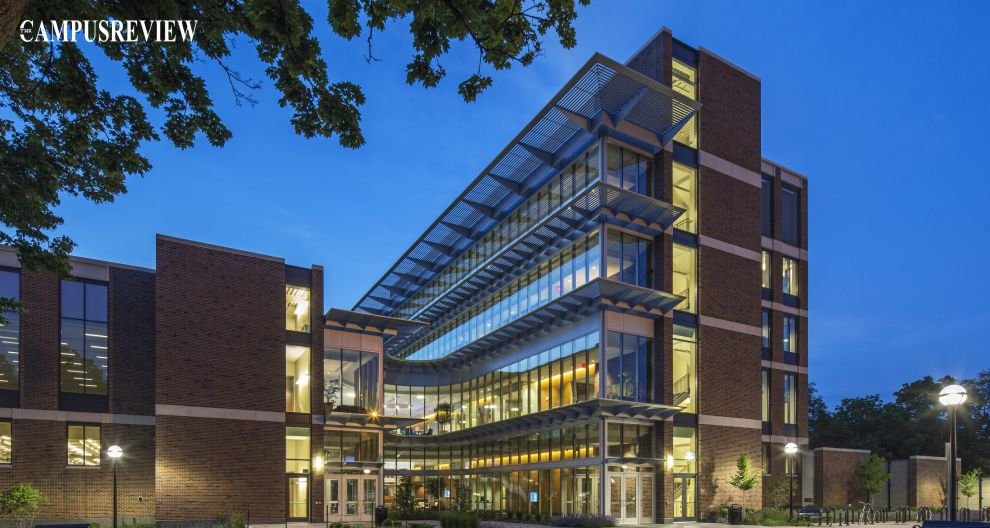
If you stand in the atrium of the University of Michigan School of Nursing (UMSN) long enough, you begin to notice the light. It pours in through vast sheets of glass, illuminating a space that feels less like a traditional academic bunker and more like a high-end tech incubator, or perhaps a very sleek, very well-funded airport terminal where the destination is always “The Future.”
It is a long way from 1891. Back then, the “University of Michigan Training School for Nurses” opened its doors with a grand total of six students. They were pioneers, certainly, but they were operating in a world where nursing was viewed largely as a domestic extension—a matter of fluffing pillows and maintaining a stiff upper lip.
Walk the halls today, and you realize that the pillow-fluffing days are over. In 2025, UMSN is a place where nursing is treated as a rigorous, distinctive science, a discipline that demands as much from the cerebral cortex as it does from the cardiac muscle. It is a place that has decided, quite consciously, to be elite without being elitist, a difficult needle to thread in the tapestry of American higher education.
The Architect of the Brain
To understand the current pulse of the school, you have to look at the woman in the Dean’s office, Patricia D. Hurn.
In the casting call of life, Deans of Nursing are often expected to be matronly figures, perhaps with a background in hospital administration. Hurn is a scientist. specifically, a neuroscientist. Her background is in the molecular and cellular basis of brain injury; she speaks the language of stroke physiology and translational medicine.
Her presence at the helm signals a specific intent. Under her leadership, the school has pivoted hard toward the idea that a nurse is not just a caregiver but a researcher, an innovator, and a data analyst. Hurn champions a curriculum that is steeped in inquiry. It is not enough to know how to administer a treatment; the Michigan nurse is expected to ask why the treatment exists, and if there is a way to make it better, cheaper, or more equitable.
This philosophy is encapsulated in the school’s tagline, which is plastered on banners and embedded in the psyche of the faculty: “We Dare.” It sounds a bit like a sneaker commercial, but here, it lands differently. They dare to challenge the status quo of healthcare. They dare to suggest that nurses should be writing policy, not just following protocol.
The Theater of the Almost-Real
The physical manifestation of this ambition is most visible in the Clinical Learning Center. It is a fascinating, slightly eerie place. Here, in a sophisticated suite of simulation labs, students encounter patients who breathe, blink, and occasionally go into cardiac arrest, but who are made entirely of rubber and circuitry.
These high-fidelity manikins are the flight simulators of the medical world. The attention to detail is obsessive. In the standardized-patient suites, actors play out complex medical dramas, allowing students to practice the soft skills that machines cannot teach—how to deliver bad news, how to comfort a grieving relative, how to notice the subtle hesitation in a patient’s voice.
It is a safe space to make dangerous mistakes. This experiential training is the bridge between the classroom theory and the terrifying reality of a hospital floor. It is here that the school’s investment in infrastructure—the move to this purpose-built facility in 2015 was a massive undertaking—pays its dividends. The air hums with the quiet intensity of rehearsal for the greatest show on earth: saving a human life.
The Menu of Minds
The academic structure at UMSN is vast, a sprawling menu of options that caters to every stage of a nursing career. There is, of course, the Bachelor of Science in Nursing (BSN), a program that has evolved significantly since its modern inception in 1952. Today’s BSN students are taking liberal arts and social sciences alongside anatomy; they are joining an Honors Program that feels more like a graduate seminar, engaging in research projects that would intimidate many tenured professors.
But the real expansion is happening at the margins. The Master of Science in Nursing (MSN) offers pathways that range from Nurse-Midwifery to complex Leadership tracks. Recognizing that the modern nurse is often a working parent or a professional in a different state, UMSN has aggressively adopted digital modalities. Through simulation software and virtual classrooms, they are beaming the “Michigan difference” into living rooms across the country.
At the doctoral level, the distinction between the “doer” and the “thinker” blurs. The Doctor of Nursing Practice (DNP) creates super-clinicians, while the Ph.D. program produces nurse-scientists who will likely never touch a bedpan again, but whose research on health disparities or informatics will save millions of lives.
Beyond the Ann Arbor Bubble
One might expect a state university to be somewhat parochial, focused inward on its own borders. UMSN, however, seems determined to conquer the map.
Through its Office of Global Affairs, the school operates as a World Health Organization Collaborating Centre. This isn’t just a plaque on the wall; it’s a mandate. Students are routinely dispatched to Ghana, Thailand, or Ethiopia, not for “voluntourism,” but for rigorous clinical immersions and research partnerships.
They come back changed. They come back understanding that “population health” isn’t just a buzzword, but a complex equation involving politics, geography, and economics.
Closer to home, the innovation engine is revving. The Healthcare Innovation Impact Program (HiiP) is a particularly un-academic initiative. It acts like a startup accelerator within the nursing school. Do you have an idea for a better catheter? A new app for tracking patient symptoms? HiiP provides the coaching and intellectual property support to get it to market. It reinforces the idea that nurses are natural inventors—they are the ones, after all, who spend the most time wrestling with the inefficiencies of the current system.
The Open Door
Perhaps the most poignant aspect of UMSN’s modern identity is its grappling with the question of access. Elite institutions often become gated communities of privilege. UMSN is trying to pry the gates open.
Programs like the “EPIC Pathways” are designed to scout talent in community colleges, offering mentorship and scholarships to students who might otherwise view a University of Michigan degree as an impossible dream. The culture focuses heavily on equity and social justice, acknowledging that a nursing workforce that doesn’t look like the patients it serves is a failed workforce.
There is a palpable sense of community here—mentoring networks connect jittery freshmen with confident seniors; peer support groups flourish. It is a “Community Culture” that feels less like a corporate strategy and more like a family survival tactic.
The Vibe
Leaving the building, stepping out into the crisp Michigan air, you are left with an impression of momentum.
The University of Michigan School of Nursing is not a quiet place of rest. It is a restless, ambitious, slightly noisy engine of change. It is for the student who wants to be a nurse, yes, but also for the student who wants to be a disruptive force.
It is a place where science meets sweat, where the legacy of 1891 meets the digital frontier of 2025. It is, in short, a place where they dare you to be better. And standing in that atrium, watching the students rush by in their scrubs, clutching coffees and laptops, you get the distinct feeling that they are up for the challenge.
Also Read : The Elite Nursing Institutions of 2025

