For decades, schools relied on tests to judge student performance. Today, educators focus more on evidence of learning. This shift has changed how teachers think about the types of assessment they use in class.
Instead of asking what students remember, modern education asks what students can actually do. This approach fits well with competency-based learning and skill-focused education. These changes also reflect global concerns about student outcomes.
In PISA 2022, mathematics performance in OECD countries fell to the lowest level ever recorded. The share of students below basic math proficiency rose by 5.8 percentage points between 2012 and 2022. These results show that traditional testing alone does not work well.
Educators now need better ways to track progress, support learning, and reduce pressure. Understanding the types of assessment in education helps teachers make informed choices. Moving beyond the standard quiz, let us explore the foundational pillars of evaluation.
The Four Types of Assessment Every Educator Needs
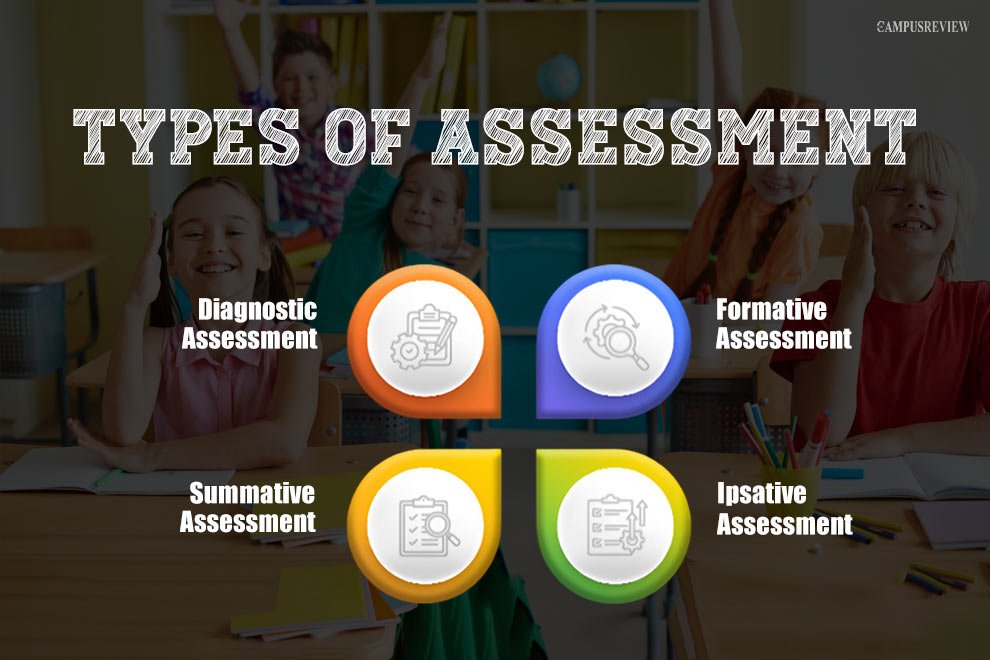
Understanding the types of assessment begins with knowing the four core models used in classrooms worldwide. These models support learning at different stages.
1. Diagnostic Assessment
Diagnostic assessment shapes instruction before it begins. Teachers rely on it to understand student readiness. This assessment reveals gaps, misconceptions, and prior exposure to the topic. When teachers skip this step, lessons often miss their mark. Instruction may move too fast or repeat known material. Diagnostic assessment helps teachers start at the right level. It also supports differentiated instruction. Among the types of assessment in education, this one quietly improves lesson efficiency and learning outcomes.
2. Formative Assessment
Formative assessment operates inside everyday teaching. It appears through observation, questioning, short responses, and discussion. Teachers use it to read students’ thoughts in real time. When students struggle, teachers adjust pace or strategy. This ongoing process explains the true meaning of formative assessment. It focuses on learning while it happens. OECD reviews confirm that formative practices strongly improve student achievement. Within the types of assessment, formative assessment acts as a compass that guides instruction forward.
3. Summative Assessment
Summative assessment captures learning at the end of instruction. Schools use it to confirm whether learning goals were achieved. These assessments often carry higher stakes. They influence grades, progression, and reporting. When used alone, they create pressure. When balanced, they provide structure and clarity. Summative assessment supports accountability and comparability. Within the 4 types of assessment, it marks learning milestones rather than the learning process itself.
4. Ipsative Assessment
Ipsative assessment centers on individual growth. It compares current performance with past performance. Teachers use it to highlight improvement over time. This approach reduces unhealthy competition. Students focus on progress instead of rank. Ipsative assessment builds confidence and self awareness. It encourages goal setting and reflection. Among the types of assessment, this one supports motivation and long term engagement.
These 4 types of assessment align with how global systems evaluate learning. PISA measures 15 year olds by testing how they apply reading, mathematics, and science knowledge to real life contexts. This focus reinforces the need for diverse assessment methods. While these four form the core, debate often centers on two specific approaches.
Formative vs. Summative Assessment: The Feedback Loop
Educators often compare formative vs summative assessment because both serve different purposes. Understanding this difference improves classroom decisions.
Meaning of Formative Assessment
The meaning of formative assessment is simple. It represents assessment for learning, not assessment of learning. Teachers use feedback to improve outcomes while learning continues.
Key Differences at a Glance
| Aspect | Formative Assessment | Summative Assessment |
| Timing | During learning | After learning |
| Purpose | Improve instruction | Measure achievement |
| Stakes | Low | High |
| Feedback | Immediate | Final |
OECD reviews show that formative assessment complements summative testing. These reviews also show that formative practices have one of the strongest positive impacts on student achievement.
Teachers can use formative data to adjust pacing, revisit topics, or offer support. This feedback loop strengthens understanding and reduces failure risk. To make these ideas practical, educators must choose the right tools.
Modern Assessment Tools and Practical Examples
Effective assessment depends on choosing suitable methods. Educators today use a wide range of assessment tools and examples.
Analog Tools
- Exit tickets
- Think pair share activities
- Oral questioning
Digital Tools
- Online quizzes
- Digital portfolios
- Peer feedback platforms
Portfolio based assessments show long term growth. Peer feedback builds reflection skills. AI tools now help teachers generate rubrics faster. These tools save time but still require human judgment. Global data supports this diversity.
UIS maintains an Inventory of Learning Assessments covering national and international systems from 2010 to 2025. This inventory shows that no single tool fits every context. Choosing the right tool is only half the battle. Teachers must also understand measurement standards.
Advanced Classifications: Norm Referenced vs Criterion Referenced
Beyond basic models, educators also classify assessments by comparison method. These classifications guide interpretation.
- Norm Referenced Assessment
This approach compares students against a group average. Standardized tests often use this method. It helps policymakers track trends.
- Criterion Referenced Assessment
This method measures performance against fixed criteria. Mastery based systems prefer this model. Bloom’s Taxonomy supports this approach by linking objectives to outcomes.
Long term studies show why benchmarks matter. TIMSS has tracked math and science achievement every four years since 1995. It assesses students at fourth and eighth grades.
This data helps systems evaluate curriculum effectiveness. Effective assessment depends not only on data. It also depends on student experience.
Overcoming Assessment Anxiety and Best Practices
Assessment anxiety affects motivation and performance. Educators can reduce stress through better design.
Best Practices:
- Use low stakes assessments
- Share grading criteria early
- Offer feedback before final evaluation
These strategies support learning rather than fear. PISA analyses show gaps in minimum proficiency across education systems. These gaps often reflect inequity, not ability.
Transparent assessment practices help students feel supported. When students understand expectations, motivation improves. As we conclude, effective assessment should empower learners.
Building a Holistic Assessment Strategy
A strong education system blends multiple types of assessment to support learning in meaningful ways. Diagnostic tools guide early planning. Formative methods nurture growth during instruction. Summative evaluations confirm outcomes without overshadowing the process. Ipsative approaches, meanwhile, shift attention toward personal progress rather than comparison.
Global evidence continues to support this balance. The PISA 2025 cycle is currently underway, with results expected in 2026. It introduces new domains such as learning in the digital world and foreign languages. These additions reflect how skill demands are changing beyond traditional academic boundaries.
From what we observe in classrooms and academic systems, the most effective assessment strategies remain surprisingly simple. Clear goals reduce confusion. Consistent feedback builds trust. Well chosen tools save time and improve outcomes. When educators apply the right types of assessment in education, learning feels purposeful instead of pressurized.
A thoughtful assessment strategy also strengthens long term learning outcomes. In practice, many educators begin with something basic, such as a checklist or a carefully designed rubric. Over time, these small steps create classrooms where progress is visible, feedback is valued, and assessment truly supports learning.
FAQ
1. How do different types of assessment support competency-based learning?
Different types of assessment measure learning at various stages. Diagnostic assessment identifies readiness, formative assessment guides progress, and summative assessment verifies mastery. Together, they evaluate real skills rather than memorization, helping educators ensure students achieve competency-based outcomes aligned with practical knowledge and performance standards.
2. Which type of assessment is most effective for skill-based education?
Formative and performance-based assessments are most effective for skill-based education because they evaluate how students apply knowledge in real situations. These methods emphasize problem-solving, collaboration, and practical application, helping learners develop competencies required for real-world tasks instead of focusing only on theoretical understanding.
3. How do modern assessment methods improve student engagement?
Modern assessment methods improve engagement by making learning interactive and participatory. Techniques like peer review, project-based tasks, digital quizzes, and real-time feedback encourage active involvement. These approaches reduce exam pressure, increase motivation, and help students feel more connected to their learning process.
Tejas Tahmankar