A teacher completes a lesson and moves forward. Still, one question lingers. Did students truly understand the idea, or did they simply stay quiet? This uncertainty is why formative assessment plays a central role in modern education. Teachers need insight during learning, not after it ends.
Formative assessment refers to an ongoing process that helps educators track progress, identify gaps, and adjust instruction in real time.
This guide explains the meaning of formative assessment, how it differs from grading, and why it matters today. It also explores evidence based designs of formative assessment, practical classroom examples, and data driven implementation strategies. These ideas matter more than ever.
In 2023, nearly 272 million learners remained out of school worldwide, while many education systems still missed minimum proficiency benchmarks.
By the end of this guide, educators will know what formative assessment is, how to apply it, and how it supports sustainable student growth.
What Is Formative Assessment?
Understanding the Core Pillars of Formative Evaluation
So, what is formative assessment in a modern classroom? At its core, it focuses on learning progress rather than final judgment. It helps teachers see how students think during instruction. It also helps students understand their own learning path.
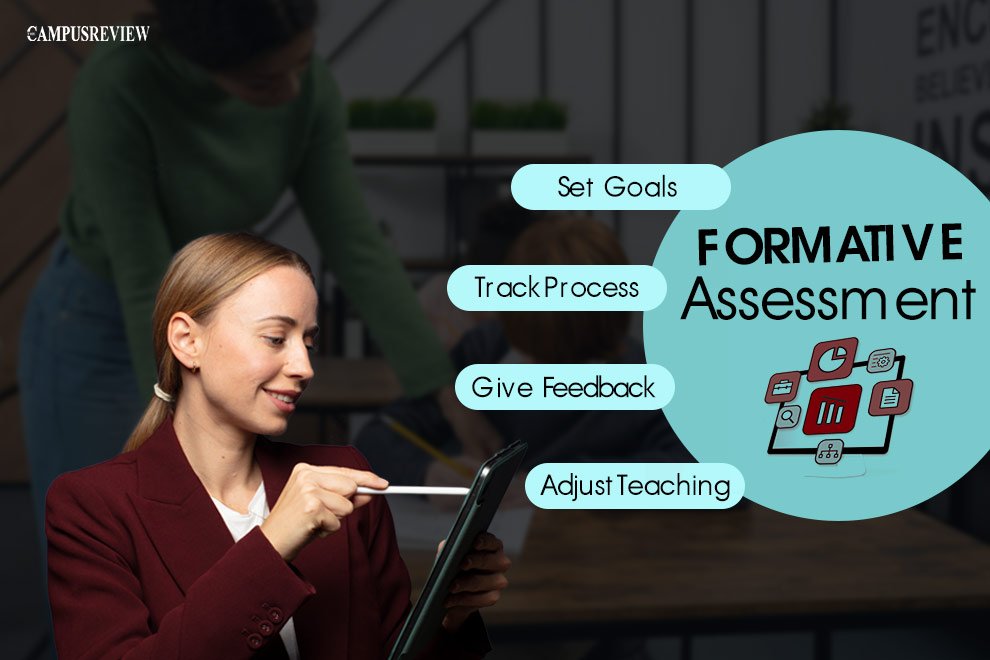
According to a 2025 OECD education framework, formative assessment is an ongoing process. Teachers set learning goals, diagnose understanding, provide feedback, and adjust instruction. This cycle repeats throughout teaching. Unlike grading, this process does not rank students. Instead, it guides improvement.
Meaning of Formative Assessment vs Grading
The meaning of formative assessment becomes clearer when compared with grading. Grades summarize performance after learning ends. Formative assessment operates during learning. It answers three practical questions:
- What should students learn next?
- Where does understanding break down?
- How should instruction change today?
- Teachers use formative assessment to inform action. Grades only record results.
- Why Formative Feedback Is the GPS of Learning
Formative feedback works like a navigation system. It shows where learners stand and where they should go next. Evidence supports this role strongly. OECD analysis in 2025 found stronger causal links between formative assessment and student outcomes than many other teaching practices.
These findings matter because they confirm that feedback-driven instruction improves learning more consistently than content delivery alone. With theory established, teachers can now focus on design and execution.
Strategic Architecture: Professional Designs of Formative Assessment
Evidence-Based Designs of Formative Assessment
Effective classrooms do not rely on random checks. They follow intentional designs of formative assessment. These designs align assessment with instructional timing and purpose. UNESCO’s Inventory of Learning Assessments tracks classroom and system-level practices from 2010 to 2025. This global record shows that strong assessment systems rely on structured approaches.
Below are three widely used designs.
The Diagnostic Design
Teachers apply this design before instruction begins. They identify prior knowledge and misconceptions. Short prompts, concept maps, or entry questions work well. This design prevents teachers from reteaching what students already know.
The Interactive Design
This design operates during lessons. Teachers ask questions, observe responses, and adjust pacing. Polls, think-pair-share, and quick checks fit this approach. Interaction ensures that instruction responds to evidence.
The Reflective Design
Reflection occurs after instruction. Students explain what they learned and where they struggled. Journals and self-assessments support this design. Reflection strengthens metacognition.
These designs reflect wider system trends. OECD data shows that about 75 percent of countries use assessment data to inform teaching for formative purposes. In contrast, around 40 percent rely mainly on summative use. This shift confirms the growing value of formative-driven design.
15 Examples of Formative Assessment for Every Grade Level
These examples of formative assessment work across elementary, middle, and secondary classrooms. Teachers can adapt them easily based on age and subject.
1. Exit Tickets
Students answer one short question before leaving the class. Teachers quickly check understanding.
2. Think–Pair–Share
Students think alone, discuss with a partner, and then share ideas with the class.
3. One-Minute Papers
Students write what they learned and what still feels unclear.
4. Thumbs Up, Thumbs Down
Students show understanding using simple hand signals.
5. Traffic Light Cards
Students use red, yellow, or green cards to show confidence levels.
6. Quick Quizzes Without Grades
Teachers use short quizzes only to guide instruction, not grading.
7. Peer Feedback Checklists
Students review each other’s work using clear criteria.
8. Concept Mapping
Students draw connections between ideas to show understanding.
9. Whiteboard Responses
Students write answers on mini whiteboards and hold them up together.
10. Class Polls or Clicker Questions
Teachers collect instant responses using digital tools.
11. Learning Journals
Students reflect regularly on what they understand and where they struggle.
12. Error Analysis Tasks
Students identify and explain mistakes in sample answers.
13. Question Box
Students submit anonymous questions about confusing topics.
14. Observation Checklists
Teachers note student behaviors and responses during activities.
15. Self-Assessment Rubrics
Students rate their own work against learning goals.
These approaches scale beyond individual classrooms. Cambridge University supports formative assessment through its learning frameworks across more than 125 countries. This global adoption shows that simple practices can support personalized learning at scale. However, strong examples require structured follow-up through data.
The Implementation Roadmap: Data-Driven Instruction
How to Turn Formative Data Into Instructional Action
Collecting evidence alone does not improve learning. Teachers must interpret and act on it. Data-driven instruction begins with identifying misconceptions early. Teachers then adjust grouping, pacing, or explanations.
UNESCO’s Institute for Statistics reinforces this approach at scale. In its 2025 update, UIS added over 808,000 national education data points to its database. Learning assessment data now covers 236 countries and territories under SDG 4.1.6. This global effort shows that education systems increasingly rely on evidence to guide decisions.
Analyzing Student Misconceptions in Real Time
Teachers can group errors by concept rather than students. This method keeps feedback focused and constructive.
Differentiating Instruction Based on Results
Teachers can provide targeted practice for struggling students. Others can move forward with enrichment tasks. This flexibility builds trust and progress. Effective use of formative assessment supports both equity and efficiency.
Moving Toward a Growth-Centric Classroom
After years of observing classroom practice across systems and contexts, one pattern remains consistent. Formative assessment delivers the strongest results when teachers treat it as a daily habit rather than an occasional tool. Used this way, it creates a continuous feedback loop that supports both student growth and instructional clarity. Recognizing the broader Types of Assessment ensures formative practices work alongside other evaluation methods to support complete learning development.
Evidence from OECD continues to confirm its measurable impact on learning outcomes. At the same time, UNESCO’s global monitoring explains why early identification of learning gaps now matters more than ever. Their documentation of formative evaluation practices, including classroom systems in Argentina, shows how feedback embedded in instruction builds trust and reflection. Learning becomes visible, adjustable, and purposeful.
For educators planning ahead, formative assessment offers a sustainable and evidence aligned path. It brings data, professional judgment, and human understanding into one coherent practice. Teachers who adopt it do more than measure learning. They actively shape how learning unfolds.
FAQ
1. How often should teachers use formative assessment in the classroom?
Formative assessment is most effective when used regularly during instruction. Daily questioning, weekly quizzes, and continuous feedback help teachers monitor progress and address learning gaps early. Frequent use ensures students stay on track and allows educators to adjust teaching strategies based on real-time understanding.
2. How does formative assessment support personalized learning?
Formative assessment supports personalized learning by revealing each student’s strengths, weaknesses, and learning pace. Teachers use this information to adjust instruction, provide targeted support, and offer enrichment activities. This approach ensures that students receive learning experiences tailored to their individual needs and progress levels.
3. What skills do students develop through formative assessment?
Formative assessment helps students develop critical thinking, self-reflection, goal-setting, and problem-solving skills. By receiving regular feedback and evaluating their own progress, learners become more responsible for their learning. This process strengthens metacognitive skills that support lifelong learning and academic success.
Tejas Tahmankar