
The Nicholas School of the Environment dates its founding to 1991, but its roots run deeper than that. Today’s school draws on three older Duke traditions in environmental scholarship: forestry, marine science, and geology. These fields developed separately for decades before being brought together within the school in stages, leading to a particular idea: the earth and the environment, humans included, should be understood as an integrated whole.
Three Threads, One School
The threads begin in the 1930s. The Department of Geology was formed in 1936. In 1938, two more arrived: the School of Forestry, established as the first School of Forestry in the southern United States, and the Duke University Marine Lab, which began as a summer field station at the southern tip of North Carolina’s Outer Banks.
In 1991, Duke brought its forestry and marine programs together to create the School of the Environment, beginning the institutional structure that would become the Nicholas School. The geological tradition was incorporated later, helping form what is now the Earth and Climate Sciences division. The name changed again in 1995, after a $20 million gift from Peter M. and Virginia “Ginny” Nicholas led to the school being named the Nicholas School of the Environment. In 2000, the Department of Geology was formally integrated into the school, becoming part of its expanding earth-science structure.
A Hall, a Lab and a Forest
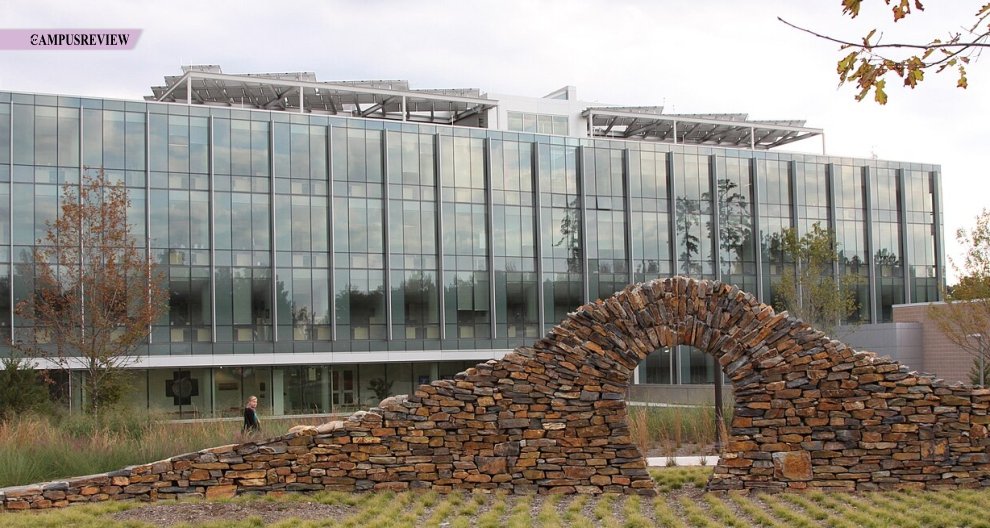
The Nicholas School’s main academic home is Grainger Hall on Duke’s West Campus in Durham, North Carolina. Opened in 2014, the 70,000-square-foot building is LEED Platinum certified and houses classrooms, offices, laboratories, an auditorium, computer facilities, an environmental art gallery, and shared spaces designed to encourage collaboration. A pedestrian connection leads from Grainger Hall into the A wing of the Levine Science Research Center, extending the school’s footprint to additional research, teaching, and faculty spaces.
Beyond those buildings lies another defining resource: the Duke Forest, a teaching and research laboratory comprising just over 7,000 acres of land primarily in two counties adjacent to campus. With its long-term records of forest cover, the school describes it as a resource for forest ecosystem study that is unequaled at any other university.
Building Outward
The 1990s marked a period of deliberate expansion, as Duke developed new centers and initiatives that took environmental inquiry into broader areas of research and public engagement. Today, its interdisciplinary reach spans forty-five core focal areas, covering subjects such as tropical forestry, environmental communication and industrial ecology. Its interdisciplinary model also extends into joint and concurrent degree programs, bringing environmental study together with fields such as public policy, business, law, and theology, while international programs link students to Duke Kunshan University in China.
In 2017 came a new Strategic Plan. It brought a revised curriculum for the Master of Environmental Management, with more emphasis on specialization and its signature flexibility intact. The school continued expanding its intellectual reach through centers and forums designed to bring researchers, policymakers, practitioners, and other voices into conversation around complex environmental challenges.
Today students choose among ten learning communities, from Business and the Environment to Water Resource Science and Management. Students can choose from professional and research pathways that include the Master of Forestry, Master of Environmental Management, Master of Environmental Science, Master of Forest Science, executive programs, and doctoral study.
Faculty Who Move the Field
The school’s own history names new voices: Dorceta Taylor and Gerald Torres in environmental justice, Yuan Yao in industrial ecology, Nyeema Harris in wildlife and land conservation, and Luke Sanford in environmental policy. Across the school, more than 150 researchers and educators work across the physical, life, and social sciences, organized into four divisions: Earth and Climate Sciences, Environmental Natural Sciences, Environmental Social Systems, and Marine Science and Conservation.
The reach extends to the airwaves. Yale Climate Connections has covered more than 2,960 stories on over 780 radio frequencies across the United States.
Resources have followed ambition. The Nicholas School has also benefited from major philanthropic support, including a $20 million gift from Peter and Ginny Nicholas that helped establish the school’s identity and development.
Graduates With Work to Do
The Class of 2026 offers a quick portrait of where the school’s graduates are heading. Jenelle Lee ’26 MEM, a co-founder of Oilzyme, developed a bioremediation system that uses microbes to break down toxic oil sludge aboard tankers. Shipping moves over 80 percent of global trade, yet its waste streams remain underregulated. Oilzyme won both the Grand Prize and the Audience Choice award in the Planetary Solutions Prize at Startup Yale 2026. Lee said the recognition reinforces that “shipboard oil waste doesn’t have to be treated as an inevitable pollutant.”
Hassan Alzain ’26 MEM now works in Saudi Aramco’s Green Energy and Environmental Policy Department, where he led project management for the company’s inaugural E&H Roadshow. His work earned him the UK’s Chartered Fellowship of the Chartered Institute of Environmental Health. Olivia Johnson ’26 MEM, during an internship with the National Association of State Energy Officials, co-authored a report on strengthening safeguards for residential solar customers, with a focus on enforceability and the contract phase.
The school’s global reach is also visible among its Three Cairns Scholars from the Class of 2026, drawn from countries including Panama, India, Kenya, and Mexico.
A Dean Who Grew With the School
Lori Snyder Bennear is now the Stanback Dean of the Nicholas School of the Environment. She joined the school as an assistant professor in 2004, later serving as executive vice dean before becoming interim dean in 2023. In 2025, she was appointed dean, effective July 1.
Looking back on her career at Duke, Bennear once described becoming a professor at the Nicholas School in 2004 as a “dream job.” In a 2024 reflection, she similarly described the deanship as her “new dream job.” Over her twenty years there, she writes, the school has been transformed, with research that has moved well beyond classical fieldwork.
What the Numbers Suggest
Count the pieces: three historical lineages, four divisions, three strategic fronts, a campus in Durham and a laboratory in Beaufort, and a forest of more than 7,000 acres. The pattern is plain. The Nicholas School is built to refuse the idea that environmental problems belong to a single discipline, and it builds its students to match.
Also Read – Sewanee – The University of the South (The Elite Green Schools of 2026)
