
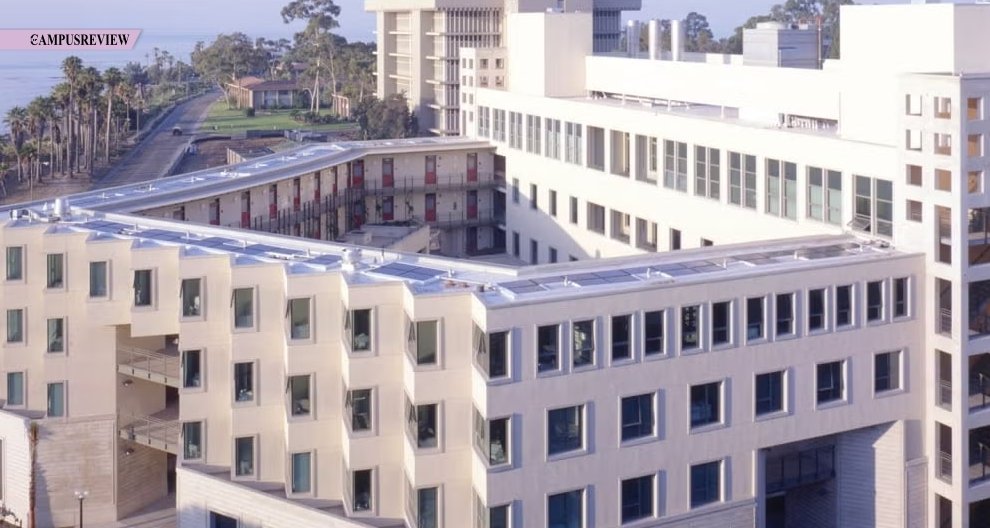
Santa Barbara is considered by many to be the birthplace of modern environmentalism, a movement that emerged in response to a devastating oil spill in 1969. Afterward, UC Santa Barbara established its Environmental Studies Program in 1970, which now has more than 900 students. The story of Bren School of Environmental Science & Management began taking institutional shape in 1991, when the University of California Board of Regents gave its approval for a new graduate school devoted to environmental science and management.
Small Beginnings, Fast Decisions
The timeline is compact. In 1994, Jeff Dozier, a professor of Earth systems science, was named founding dean by Chancellor Henry Yang, in the first academic appointment of Yang’s tenure. The first faculty were appointed in 1995. When the MESM program welcomed its inaugural class in 1996, just 20 students made up the cohort. Two years later, the school expanded into doctoral education with the arrival of its first PhD student.
In 1997, Donald Bren invested in the school, funding a new building, student fellowships and faculty chairs, and the school took his name. In 2010, the Michael J. Connell Memorial Trust made the largest gift in Bren’s history, supporting student fellowships, instruction and seed funding for research in perpetuity.
A Building That Argues for Itself
Bren Hall opened in April 2002 as the first laboratory building in the United States to earn LEED Platinum, the highest level of the U.S. Green Building Council’s program. It earned Platinum again in 2009 and a third time in 2017, which made it the first laboratory building in the nation to receive three LEED Platinum certifications. In 2017, it scored 93 credits, when the then-current standard required 80 for Platinum, and it was recognized as the greenest laboratory building in the country. That year it was also the highest-scoring LEED project in California and the entire nation.
The details reward a close look. The building cost $26 million, and building sustainably added only 2 percent. The ocean-facing office wing has no air conditioning, relying instead on flow-through ventilation, with a sensor in each operable window that switches off the office heater when the window opens. A roof-integrated photovoltaic system generates up to 10 percent of the building’s power, and a white roof reflects heat.
The site was once a parking lot. During construction, 100 percent of demolition waste and 92 percent of construction waste were recycled, and the finished building is composed of 40 percent recycled materials. Each waterless urinal is estimated to save about 45,000 gallons of water a year. Metering was installed deliberately so students and faculty can treat the structure as a “living laboratory.”
What Students Study, and Where It Leads
Its graduate education now centers on two professional degrees: the Master of Environmental Science and Management (MESM) and the Master of Environmental Data Science (MEDS), complemented by doctoral study in Environmental Science and Management. Within the MESM program, students can shape their studies around either Communication or Innovation and Entrepreneurship, adding a more defined direction to their environmental training. Former dean Steve Gaines, whose research on marine ecology and sustainable fisheries has drawn over 52,000 citations, presided over the launch of MEDS and both of those focus areas.
Student work reaches beyond coursework. Four Bren students turned a capstone project into a peer-reviewed study on what drives utility-scale wind and solar siting across the U.S. At the center of the research is a practical question: what determines where utility-scale wind and solar facilities ultimately take shape across the United States?
This September, the school celebrated five years of MEDS, whose alumni now work in research, government, nonprofits, and industry. Marie Rivers (MEDS ’22) now works as a Geospatial Research Scientist at the National Laboratory of the Rockies, where she uses spatial data to help identify locations for renewable energy infrastructure. Nicole Pepper (MEDS 2025) now works as Program and Communications Coordinator at NASA Acres, using satellite data to support research on U.S. agriculture. Richard Montes Lemus (MEDS ’26) is an associate consultant at Ramboll.
By 2020, the school had already built an alumni community of more than 1,500 graduates, with its reach extending throughout the United States and in over 30 countries on climate change, conservation, and sustainable water and agriculture.
Faculty and a New Dean
The faculty keep collecting recognition. Kelly Caylor was elected a Fellow of the American Geophysical Union for 2026, and Christopher Costello was named an AERE Fellow in August 2026 for pioneering work on environmental markets. Eric Masanet has been examining whether underwater data centers could shrink AI’s environmental footprint.
On September 14, 2026, Elena Irwin became dean, arriving from The Ohio State University, where she founded the Sustainability Institute in 2019. Before joining UCSB, Elena Irwin led Ohio State’s Sustainability Institute, where a core group of 25 faculty worked alongside a much larger network of more than 370 affiliated faculty, researchers, and instructors.
The institute’s efforts also helped bring in more than $90 million in external funding. In 2021, Irwin was appointed to serve on the U.S. EPA’s Science Advisory Board. Of her new home, she says it represents the best of what a school of the environment can be: “intellectually rigorous, highly interdisciplinary, and a mission to solve environmental problems.”
Bren’s faculty have also written principles for artificial intelligence, shaped by student feedback, so that the technology enhances learning rather than circumvents it.
The Quiet Lesson
A school can talk about sustainability, or it can build a roof that reflects the sun and a window that turns off the heater. Bren has done both for more than two decades.
Also Read – Sewanee – The University of the South (The Elite Green Schools of 2026)
