
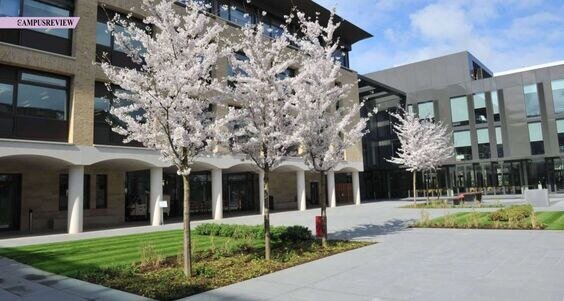
On the banks of the River Thames in Barnes, London, St Paul’s School and St Paul’s Prep School share a 45-acre riverside site, an expansive setting for an institution whose history reaches back to 1509. Yet its story is not simply one of longevity. It begins with a particular idea about education: that intellectual ability should be cultivated through serious learning, and that knowledge should prepare a young person to contribute meaningfully to society.
The school was founded by John Colet, Dean of St Paul’s Cathedral, during the English Renaissance. After receiving a substantial inheritance in 1505, Colet chose to invest his resources in creating an educational institution that would bring his vision to life. His original ambition was to educate 153 boys “from all nacions and countres indifferently.”
The phrase, with its language of another age, expresses an enduring principle: educational opportunity should extend beyond a narrow circle of privilege. Colet entrusted the school’s governance to the Mercers’ Company of London, an institution that remains closely connected to its heritage. More than five centuries later, the founding vision continues to inform the school’s understanding of scholarship, access and responsibility.
An Education Built Around the Individual
St Paul’s School and St Paul’s Prep School together provide an independent education for boys aged seven to eighteen. Entry points are at 7+ and 11+ for the Prep School and at 13+ and 16+ for St Paul’s School. Its educational philosophy places considerable importance on intellectual ambition, but the school’s stated mission extends beyond examination performance. It seeks to nurture a generation of pupils who will make a positive contribution to the world.
Three pillars, Scholarship, Opportunity and Character, underpin that ambition. The school emphasises respect, kindness, humility, integrity and resilience alongside academic development. This combination matters because learning is not only an accumulation of facts. It calls for thoughtful inquiry, an awareness of what remains unknown, and the discernment to put acquired knowledge to good use.
Through its academic departments, subject specialists and wider co-curricular programme, the school gives pupils opportunities to explore connections across disciplines and pursue interests beyond examination specifications. Its aim is to develop independent thinkers who recognise that intellectual ability carries responsibilities as well as rewards.
Results That Represent Years of Work
St Paul’s academic record is an important part of its identity, and its published 2026 examination results provide a detailed picture of achievement. At A Level, 60% of grades were awarded at A*, while 91.5% were at A* or A. For the third consecutive year, more than three-quarters of the cohort achieved no grade below A. In 2026, that proportion was 77.4%, representing 164 of 212 candidates.
The same cohort included 99 pupils who gained at least three A* grades, with 46 achieving four A* grades across their subjects. The school also reported that 87% of pupils met their first-choice university offer in the United Kingdom or internationally, while 98% met either their first or insurance choice. These figures demonstrate the scale of the cohort’s academic achievement, while also illustrating the close connection between school preparation and the next stage of education.
The 2026 GCSE results were similarly strong. The school reported that 72% of all grades were at grade 9, 93% were at grades 9 or 8, and 99% were at grades 9, 8 or 7. Forty-three pupils achieved straight 9s, while 83 pupils, more than 40% of the cohort, earned at least nine grade 9s. Dhian Gopal also received an outstanding commendation in Cambridge OCR GCSE Art and Design: Fine Art.
Such results emerge from a combination of dedicated preparation, committed teaching and the perseverance required to work through challenging subjects.
The Life Beyond Lessons
A school’s character is also revealed by what it makes possible after the formal timetable ends. St Paul’s has a broad co-curricular programme encompassing sport, the arts, societies, clubs, trips and volunteering. Its 100-minute lunch break, riverside setting and on-site facilities help create room for such activities within the routine of a day school. The school’s January 2025 Independent Schools Inspectorate (ISI) report identified the co-curricular programme as a significant strength.
The trips programme includes nearly fifty residential trips each year for pupils aged thirteen to eighteen, alongside day visits and opportunities in the United Kingdom and overseas. Recent examples listed by the school range from Physics visits to CERN and Classics trips to Naples to Geography excursions in Switzerland and activities connected with the Duke of Edinburgh’s Award. Such experiences allow subjects to be encountered outside the classroom, where a concept might become a landscape, a laboratory or a historical site.
The school’s practical and creative opportunities also extend into engineering, music, drama, art and enterprise. In 2026, more than 160 Year 11 pupils from five West London schools attended St Paul’s annual Sustainable Entrepreneurship Course. One example is Hex Gardens, a student-led venture that developed modular bee hotels and bird feeders using 3D printing and went on to represent St Paul’s at a Young Enterprise final. These examples illustrate how academic learning can meet design, environmental awareness and commercial thinking.
Opportunity as a Shared Responsibility
The founding commitment to educate boys from different nations and backgrounds has a modern expression in the school’s Founder’s Awards, its bursary programme. The school reports that it currently supports 143 pupils through these awards. Assistance can cover full or partial school fees, uniforms, sports kit, textbooks and examination fees. It can also help with music lessons, instruments, sports tours, the Duke of Edinburgh’s Award and educational trips. This matters because participation in a school’s richest opportunities should not depend solely on a family’s ability to pay.
St Paul’s also describes partnerships with approximately 30 primary and secondary schools in the maintained sector. Its volunteering programme includes sports coaching, mathematics mentoring and support for homeless shelters. Through these activities, pupils encounter people and experiences beyond their immediate school community. Social responsibility becomes something practised, rather than a principle merely recited.
A Legacy Still Being Written
St Paul’s treats its heritage as a foundation for continued development. Its distinction lies in the relationship between demanding academic standards, meaningful opportunity and a commitment to service. Its enduring proposition is that the most valuable education does more than prepare a pupil to excel; it helps that pupil understand what excellence is for.
Also Read – Loreto Grammar School (The UK’s Most Distinguished Schools of 2026)
