
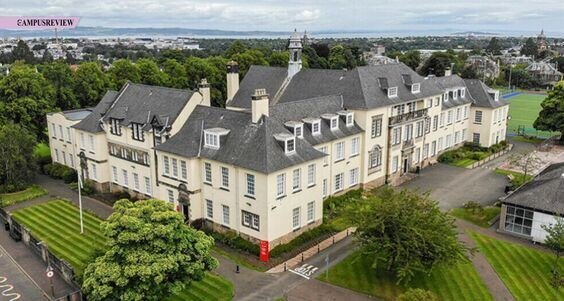
Some schools are founded to continue a tradition. Others begin because someone recognises that a tradition needs to change. St George’s School, Edinburgh, was established not merely to uphold existing educational traditions, but to challenge the barriers that prevented girls from accessing a fuller academic education. Its story began in the nineteenth century, when opportunities for women to pursue a full academic education were still restricted. The school’s founders did not simply seek to improve the education available to girls. They set out to challenge the assumptions that had limited it.
The movement began with St George’s Hall Classes in 1876, established to provide teaching up to university level, either through attendance in Edinburgh or by correspondence courses. In 1886, the founders established Scotland’s first training college for women teachers in secondary schools. In 1888, St George’s High School for Girls opened under its first Headmistress, Miss Walker. Fifty girls attended on the opening day at a converted house in Melville Street. The initiative was led by Dame Sarah Mair and a group of Victorian women determined to widen educational opportunity.
The timing was significant. Four years after the school’s founding, Scottish universities finally admitted women, and students from St George’s were among the early Edinburgh University graduates. The school therefore emerged not as a passive observer of educational reform, but as part of the movement that helped make reform possible. Its foundation rests on the belief that a girl’s potential should not be determined by the limits society places around her.
A Heritage of Progress
The school’s physical history reflects that original determination. As enrolment grew, St George’s moved in 1914 to a purpose-built facility in Ravelston and Murrayfield. During the Second World War, staff and pupils temporarily relocated to Hallrule House in Bonchester Bridge for safety, returning to Edinburgh in 1944 to restore the school building. In 1976, St George’s merged with Lansdowne House, using the latter’s building for middle-school girls.
Its history also intersects with the wider story of girls’ education in Edinburgh. St Margaret’s School, founded in 1890, closed on 10 June 2010. Following the closure of St Margaret’s, some of its former pupils transferred to St George’s to finish their education, carrying with them a continuing connection to their previous school. Such details illustrate how educational communities preserve memories and relationships even as institutions change.
Today, St George’s provides education from age two to eighteen on its Ravelston campus. Its nursery admits girls and boys, while the junior and senior school provide education for girls. The school’s “One School” project brought pupils and facilities together across its nursery, junior and senior provision, strengthening the sense of a connected educational community rather than a series of separate stages.
Four Values, One Educational Philosophy
St George’s draws on a Chaucerian motto: “Trouthe & Honour, Fredom & Curteisye.” The phrase is more than a historical ornament. The school continues to use its four principles, truth, honour, freedom and courtesy, to articulate how pupils should learn, relate to others and participate in society.
Truth involves encouraging girls to be themselves while nurturing creativity, innovation and problem-solving. Honour asks members of the community to treat one another with respect and act responsibly inside and outside school. Freedom means allowing each girl to develop an individual educational pathway and find confidence in her own abilities. Courtesy extends beyond manners to open-mindedness, consideration and engagement with the local community and the wider world.
Together, these values place academic ambition alongside empathy, accountability and respect, making character part of achievement rather than an optional addition.
A Curriculum Designed for the Individual
The St George’s Signature Curriculum combines a British academic framework with a broad co-curricular programme and skills intended to prepare girls for a changing world. The curriculum is built around the understanding that preparing young people for an evolving world requires intellectual flexibility, cooperation, critical judgement and the ability to respond constructively to change.
The school chooses from GCSE, National 5, Higher, Advanced Higher and A Level courses according to factors that include content, feedback, results and the student experience. Rather than assuming every pupil should follow precisely the same route, it seeks to provide flexible subject choices aligned with individual interests and ambitions. At S3 and S4, pupils can study subjects spanning the sciences, humanities, languages, computing, art, design and technology, music, drama and physical education.
The school also reports strong achievement in traditionally male-dominated STEM subjects, reflecting its commitment to enabling girls to explore disciplines on their merits rather than through inherited assumptions. The intention is not to direct every girl towards the same future, but to ensure that a broad range of possibilities remains open to her.
The 2026 Results: Achievement With Breadth
The school’s published 2026 GCSE results provide a useful indication of how its academic approach translates into outcomes. Across compulsory and optional GCSE subjects, grades 9 to 6 accounted for 68% of all examination entries, marking the school’s strongest performance at this level in three years. More than one in ten pupils secured grades 7 to 9 in every subject, achieving consistently high results across their examinations. In mathematics, 60% of the year group achieved an A-equivalent grade, while 80% of Further Mathematics results were at A-equivalent level. Looking ahead to the next stage of their studies, 65% of the year group planned to pursue Mathematics at Higher level.
The figures also extend beyond the core examination subjects. Among the optional National 5 subjects of Physical Education, Latin, German, Drama and Design Technology, 98% of results were graded A to B, with 86% at A. The school described this as a record performance for St George’s in these options. Forty-five per cent of the cohort also took the Higher Project Qualification alongside their GCSEs, and 45% of those projects received A* or A grades.
The school described its overall academic results in 2026 as its strongest since the pandemic. It also reported that first-choice university outcomes had remained above 95% during Carol Chandler-Thompson’s tenure as Head, alongside 100% A grades in Higher and Advanced Higher music and languages. These achievements indicate academic strength across core subjects and more specialised pathways.
Confidence Beyond the Classroom
The educational experience at St George’s is not measured solely in examination results. Its stated emphasis on the whole girl places co-curricular participation, individual confidence and the ability to work with others alongside classroom learning. The school reports 100% participation in sport across the school, presenting physical activity as a shared opportunity rather than one reserved for a select few.
The significance of participation lies partly in what it allows pupils to practise: persistence when improvement is gradual, cooperation when success depends on others, and the capacity to recover when an outcome is disappointing. Similar habits can develop through music, drama, research and collaborative projects, where confidence is practised rather than simply described.
St George’s also connects its educational purpose to the community beyond the campus. The school reports that its partnerships programme has grown and that access to its facilities for the wider community has expanded. These connections give its commitment to courtesy and responsibility a practical expression beyond the school gates.
A Future Rooted in Courage
St George’s was founded by women who challenged restrictions on girls’ access to advanced education. Its contemporary curriculum, flexible subject pathways and broad co-curricular participation extend that ambition into the present, while its 2026 results provide evidence of current academic achievement.
St George’s stands out for an education that expands rather than prescribes possibilities. Its ambition is not to dictate what girls should become, but to equip them with the knowledge, confidence and judgement to choose their own paths and make a meaningful contribution to the world.
Also Read – Loreto Grammar School (The UK’s Most Distinguished Schools of 2026)
