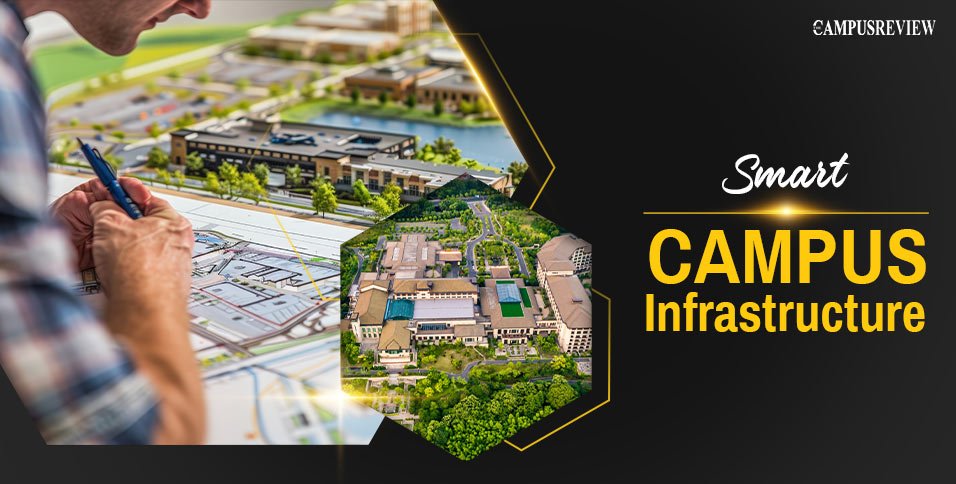
In 2026, campus infrastructure no longer functions as static real estate. Instead, it operates as a living digital system. Universities now depend on networks, sensors, and intelligent platforms to support learning. This shift marks a clear move away from passive facilities toward cognitive ecosystems. Campus infrastructure now shapes how students learn, collaborate, and remain engaged.
This change did not occur in isolation. Higher education expanded rapidly across continents. According to UNESCO, approximately 264 million students enroll in higher education globally, compared to about 100 million in 2000. As a result, institutions face unprecedented scale, complexity, and expectations. Therefore, traditional campus models no longer suffice.
Smart campus infrastructure integrates IoT, Wi-Fi 7, and AI systems. Together, they improve student retention and energy efficiency. More importantly, they create environments that respond to human behavior. This blog explains how that transformation works. It examines connectivity, space design, libraries, flexibility, inclusion, and financial outcomes. Each section shows how strategic campus infrastructure decisions define competitive universities in 2026.
Campus Infrastructure for Future-Ready Classrooms
Every smart campus begins with invisible foundations. Networks, power systems, and data flows determine what learning spaces can achieve. Therefore, campus infrastructure planning must start with connectivity. Without a strong backbone, even the best learning designs fail in practice.
Universities now move beyond Wi-Fi 6 toward Wi-Fi 7. This shift supports higher device density and lower latency. Classrooms now host dozens of connected devices at once. Students stream content. Faculty run simulations. Sensors collect environmental data. Campus infrastructure must support all of this without friction.
Future-ready classroom design depends on this backbone. Power over Ethernet, including PoE++, allows institutions to run displays, sensors, cameras, and access points efficiently. As a result, classrooms gain intelligence without heavy rewiring. Maintenance teams respond faster. IT teams upgrade systems with minimal disruption. Campus infrastructure becomes modular rather than fixed.
However, connectivity alone does not create value. Insight does. Research from EDUCAUSE revealed a critical finding. At least 50 percent of classroom spaces remained unused at any given time before analytics dashboards appeared. Universities did not lack space. They lacked visibility.
Once institutions deployed learning-space analytics, they saw patterns clearly. They adjusted timetables. They consolidated underused rooms. They redesigned layouts for demand. Consequently, they improved utilization without new construction. Campus infrastructure shifted from static capacity to adaptive intelligence.
With this foundation secure, universities can move beyond access. They can now design spaces that actively shape learning behavior.
Designing Collaborative Learning Spaces in Universities
Collaboration now defines modern pedagogy. Knowledge creation increasingly happens through discussion, teamwork, and shared problem solving. Therefore, campus infrastructure must encourage interaction rather than isolation. Collaborative learning spaces in universities address this need through deliberate design.
Smart furniture allows rapid reconfiguration. Tables move easily. Screens reposition quickly. Groups form and dissolve without delay. Occupancy sensors reveal how students actually use rooms across the day. As a result, planners gain evidence instead of assumptions.
Universities then identify engagement hotspots. They expand layouts that support discussion. They retire designs that limit participation. Campus infrastructure evolves through observation and feedback. This process mirrors scientific inquiry. It also reflects institutional maturity.
Sound plays a critical role in collaboration. Noise disrupts focus. Silence suppresses discussion. Therefore, institutions now adopt acoustic intelligence. Sensors monitor ambient sound. Systems adjust absorption or issue alerts. Students benefit from balanced environments that support dialogue without distraction.
These design choices affect outcomes directly. According to OECD, only 43 percent of bachelor’s students complete degrees within expected duration. Completion rises to 70 percent only after three additional years. Rigid environments contribute to this delay.
Collaborative campus infrastructure supports varied learning speeds. It enables peer explanation. It reduces isolation. It sustains motivation. Therefore, space design becomes a retention strategy. It no longer remains an aesthetic concern.
As classrooms improve collaboration, another space demands equal attention. The library now enters a period of profound change.
Library Transformation in the Digital Era
For centuries, libraries symbolized academic life. They stored books. They enforced silence. Yet their function has changed profoundly. Library transformation in the digital era reshapes how knowledge moves across campus.
Books no longer anchor physical space. Digital collections dominate access. Automated storage and retrieval systems compress archives efficiently. As a result, libraries reclaim valuable floor area. Campus infrastructure then reallocates space toward collaboration and analysis.
Visualization labs now replace long shelving rows. Students interact with complex datasets. Faculty guide interpretation rather than retrieval. Research becomes participatory. Libraries evolve into active learning hubs.
This transformation supports interdisciplinary work. Students from engineering, humanities, and sciences gather around shared data. They explore problems together. Campus infrastructure thus strengthens intellectual exchange across disciplines.
Digital libraries also support equity. Students access resources regardless of schedule or location. Working learners benefit. International students gain continuity. As enrollment scales globally, flexibility becomes essential.
Libraries now function as bridges. They connect physical and digital learning. They connect individual study and collective inquiry. They connect tradition and innovation.
However, isolated upgrades cannot succeed. A smart library cannot exist within an inflexible campus. The same adaptable philosophy must extend across teaching spaces, labs, and public areas. Only then can institutions respond to shifting needs coherently.
Library transformation therefore signals a broader truth. Campus infrastructure must evolve as a system. Partial modernization delivers partial value.
Flexible Learning Environments on Campus
Flexibility defines resilience in education. Knowledge changes quickly. Pedagogy evolves. Therefore, flexible learning environments on campus now stand as strategic priorities. Universities design spaces that adapt within minutes.
Lecture halls convert into labs. Seminar rooms host simulations. Group spaces support both instruction and assessment. This adaptability reduces dependency on fixed schedules and rigid formats.
Modular systems enable this change. IoT devices manage lighting, seating, and displays. Faculty adjust layouts without technical support. Students experience learning as responsive rather than constrained. Campus infrastructure becomes an enabler, not a barrier.
Financial logic reinforces this shift. According to OECD, governments spend an average of USD 12,438 per student annually on education. Tertiary education receives about USD 15,102 per student, including research.
Given this investment, static rooms waste value. Flexible campus infrastructure maximizes return. One space serves many functions. Institutions delay expensive expansions. Capital planning improves. Operating costs stabilize.
Flexibility also supports uncertainty. Enrollment fluctuates. Programs emerge and decline. Adaptable spaces absorb change without disruption.
However, flexibility alone does not ensure fairness. A room that changes function but excludes some learners fails its mission. Therefore, accessibility must guide every flexible design decision.
Only inclusive flexibility creates true resilience. Campus infrastructure must serve diversity as deliberately as it serves efficiency.
Designing Inclusive and Accessible Campuses
Inclusion now defines educational legitimacy. Designing inclusive and accessible campuses requires intention, not compliance alone. Campus infrastructure must respond to physical, cognitive, and sensory diversity consistently.
IoT systems enable high-fidelity wayfinding. Students receive personalized navigation support. Sensory-aware environments adjust lighting and sound automatically. Neurodivergent learners benefit from predictability and control.
These features improve daily experience. They also reduce anxiety. They support independence. Campus infrastructure thus becomes a quiet ally rather than a hidden obstacle.
This need extends beyond convenience. According to UNESCO, only 9 percent of refugee youth access higher education globally. Infrastructure barriers remain significant. Accessibility influences who enters and who persists.
Therefore, inclusion aligns with global equity goals. Institutions must also prepare for updated accessibility standards arriving in April 2026. These standards emphasize universal design across physical and digital environments.
Compliance alone will not suffice. Institutions must embed accessibility into planning, procurement, and operations. Campus infrastructure decisions made today shape access for decades.
Inclusive infrastructure also supports enrollment growth. It enhances institutional reputation. It reduces retrofitting costs later.
Leadership often asks for justification. Data now provides it. Accessible campuses retain students. They reduce support costs. They align ethics with strategy.
The Data-Driven ROI: Sustainability and Rankings
Smart campus infrastructure must demonstrate value. Universities increasingly rely on data to assess outcomes. Sustainability metrics, energy savings, and operational efficiency now influence institutional standing.
Predictive maintenance offers a clear example. Sensors monitor equipment health continuously. Systems flag issues before failure. Institutions reduce downtime. Repair costs decline. Energy consumption stabilizes.
These savings accumulate quietly. Over time, they free resources for teaching and research. Campus infrastructure thus supports academic priorities indirectly yet powerfully.
Data also shapes external perception. Rankings frameworks, including QS and NIRF, consider infrastructure quality and sustainability. Campus infrastructure therefore influences reputation directly.
Moreover, data-driven management supports long-term planning. Leaders allocate budgets with confidence. They justify investments transparently. Governance improves.
Smart infrastructure links financial stewardship with academic excellence. It replaces intuition with evidence. It reduces risk.
When infrastructure functions intelligently, universities gain more than savings. They gain strategic clarity. They see their campus as a system that learns, adapts, and improves continuously. That clarity defines leadership in 2026.
Leading the Smart Campus Revolution
Smart campus infrastructure now defines institutional futures. Universities that treat buildings as static assets fall behind. Those that view infrastructure as a digital nervous system advance steadily.
This article traced that evolution carefully. It began with global enrollment growth. It examined connectivity, collaboration, libraries, flexibility, and inclusion. It also showed how data validates investment.
From long experience studying educational systems, one lesson remains constant. Institutions succeed when infrastructure serves human purpose. Technology must remain invisible yet responsive. Space must adapt rather than constrain.
Campus infrastructure in 2026 demands foresight and discipline. Leaders must resist short-term fixes. Instead, they should build systems that learn and improve. Such campuses support students today and generations tomorrow.
The smart campus revolution rewards those who plan patiently and act decisively. Universities now hold that choice clearly before them.
Tejas Tahmankar