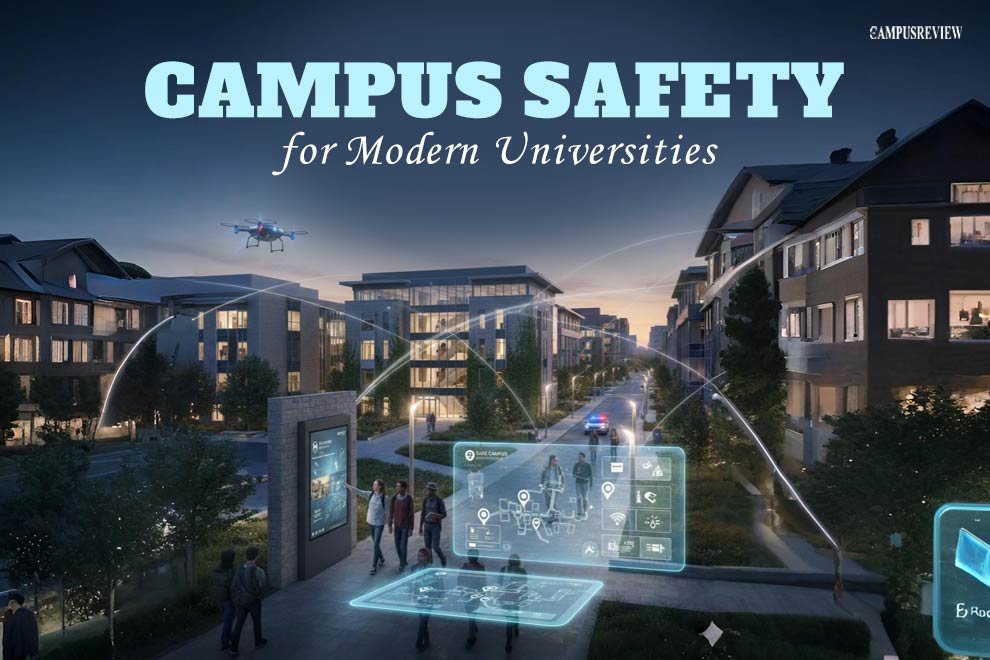
Universities once viewed digital progress through conveniences such as free Wi-Fi and online portals. Today, institutions face a deeper responsibility. Campus safety now shapes student trust, learning continuity, and institutional credibility. Security failures no longer remain isolated events, as they affect academic outcomes and public confidence.
A modern university increasingly resembles a connected urban system. What a smart campus is becomes clear when viewed through this lens. A smart campus functions like a mini city where people, infrastructure, and data interact continuously to support learning and campus safety. This transformation accelerated after the pandemic, as hybrid learning expanded both physical and digital exposure to risk.
The urgency is measurable. According to the National Center for Education Statistics, 77 percent of public schools in the United States reported at least one criminal incident on campus grounds. This reality explains why technology now plays a central role in modern campus safety strategies.
The Invisible Nervous System: IoT & Automation
IoT and automation in smart universities form the foundational layer of modern campus safety. These systems operate continuously in the background, much like a nervous system in a living organism. Rather than relying on manual observation, universities now depend on connected devices to maintain awareness across academic buildings, residences, and shared spaces.
The architecture of this system includes sensors, gateways, and cloud platforms. Sensors collect data related to movement, room occupancy, air quality, and access control. Gateways transmit this information securely across campus networks. Cloud platforms process the data and present insights through dashboards used by facilities and security teams. This structure allows institutions to understand conditions as they develop.
Real-time data changes how campuses manage risk. Occupancy sensors identify overcrowding before it becomes dangerous. Environmental sensors detect unsafe air or temperature conditions. Security teams respond based on evidence rather than assumptions. As a result, campus safety improves without increasing surveillance pressure on individuals.
Automation converts insight into action. Lighting systems adjust based on classroom schedules and presence. HVAC systems respond to actual usage rather than static timetables. These automated responses reduce energy waste while maintaining safe and comfortable environments. Over time, automation strengthens operational reliability.
In its 2025 synthesis on digital education, UNESCO highlights a global shift from passive security approaches to proactive safety systems. Intelligent sensors and real-time risk profiling now allow universities to anticipate threats rather than react after incidents occur. This shift marks a significant evolution in campus safety strategy.
The Connected Learning Space: Beyond the Smartboard
Smart classrooms and connected learning spaces represent the visible face of the smart campus. These environments integrate teaching, technology, and safety into a single experience. Rather than focusing only on content delivery, modern classrooms now support engagement, accessibility, and situational awareness.
Hybrid-ready classrooms allow students to participate both in person and remotely. These spaces support continuity during disruptions while maintaining structured oversight. AR and VR laboratories further expand learning opportunities by simulating environments that would otherwise remain inaccessible. These tools increase engagement while maintaining controlled and supervised conditions.
Artificial intelligence supports personalization within these spaces. Classroom systems analyze attendance patterns, participation levels, and interaction data. Faculty adjust instruction based on real evidence rather than intuition. This responsiveness improves learning outcomes while reducing confusion and disengagement, which often correlate with safety risks.
Accessibility also plays a direct role in campus safety. Smart hearing assistance systems ensure that students receive clear instruction. Real-time captioning supports inclusive participation across diverse learning needs. These features also improve communication during emergencies, when clarity becomes critical.
UNESCO’s 2025 reports note that modern campuses deploy cloud-network-integrated infrastructure and high-capacity smart classrooms. These investments support learning continuity, accessibility, and campus safety at the same time. The classroom thus becomes both a learning environment and a protected space.
Command and Control: Digital Infrastructure & CMS
As campuses grow more complex, fragmented systems increase operational risk. Campus management systems and digital infrastructure address this challenge by integrating data across departments. Integration allows institutions to manage campus safety as a coordinated responsibility rather than a collection of isolated tasks.
Unified dashboards provide a single operational view of security, facilities, and academic activity. Administrators monitor conditions across buildings and systems from one interface. This visibility improves coordination during routine operations and emergencies. Decisions occur faster when teams share the same information.
Reliable infrastructure supports this integration. Private LTE and 5G networks ensure continuous connectivity across large campuses. Cloud platforms scale as institutions expand digital services. Cybersecurity frameworks protect sensitive academic and personal data from breaches that undermine trust.
Smart security technologies close remaining gaps. AI-powered surveillance identifies unusual behavioral patterns. Facial recognition systems support controlled access in high-risk zones. Emergency notification platforms deliver timely alerts across multiple channels. Together, these tools strengthen campus safety without relying solely on human monitoring.
The EDUCAUSE 2025 Top 10 IT Issues report identifies restoring trust through secure and reliable digital systems as a strategic priority. This finding confirms that campus safety now depends on institutional digital reliability and governance.
The ROI of Intelligence: Strategic Benefits
Smart campus investments deliver measurable financial and strategic returns. Campus safety remains central to this value creation. Institutions reduce losses associated with incidents while improving long-term efficiency and resilience.
Automation significantly reduces operational waste. Smart lighting and HVAC systems respond to real occupancy patterns. Many institutions report energy reductions exceeding 30 percent after automation adoption. These savings free resources for academic and safety investments.
Student success improves alongside safety. Engagement analytics identify early signs of disengagement or distress. Support teams intervene before problems escalate. Retention improves when institutions address academic and emotional risks early.
Compliance also strengthens through integrated systems. Digital reporting supports evolving safety and accountability standards. Institutions reduce administrative burden while improving transparency and audit readiness.
According to EDUCAUSE’s 2025 Students and Technology findings, students now expect hybrid learning, accessibility, and AI-enabled systems as standard features. These expectations directly influence enrollment decisions and institutional reputation. The benefits of smart campus transformation therefore extend beyond cost savings.
A Roadmap to Transformation
Smart campus transformation succeeds through phased execution. Most institutions begin with network reliability and Wi-Fi expansion. Sensors, analytics, and automation follow as governance frameworks mature. This sequencing reduces disruption and builds institutional confidence.
A five-year vision provides strategic discipline. Leaders align technology investments with academic priorities and campus safety goals. Each phase reinforces trust among students, faculty, and administrators. Gradual integration prevents fragmented adoption.
Historical observation shows that rushed transformation creates long-term inefficiencies. Institutions that plan carefully avoid disconnected systems. They build campuses that adapt to evolving risks rather than react to crises.
Smart campuses increasingly influence student recruitment. Families assess safety, reliability, and digital maturity. Campus safety now signals institutional preparedness and responsibility in competitive education markets.
Conclusion
Campus safety has always reflected institutional priorities. History shows that universities succeed when they evolve deliberately and responsibly. Smart technology represents the next stage in this evolution.
The evidence remains consistent. Real-time awareness reduces risk. Connected systems support learning and protection together. Trust grows through transparent and reliable digital infrastructure.
From a scholarly perspective, smart campuses resemble well-planned cities. They balance openness with structure and innovation with restraint. Institutions that adopt this approach lead sustainably.
In my academic experience, safety works best when it supports learning quietly and consistently. Smart technology now enables that balance. It deserves informed and measured adoption.
Tejas Tahmankar