Education is evolving faster than ever. In today’s world, where technology shapes almost every aspect of life, traditional classrooms alone can’t keep up with the pace of learning needs. Students, educators, and institutions are searching for solutions that are adaptive, interactive, and scalable.
Enter EdTech startups: young companies leveraging AI, cloud technology, and innovative methods to reshape the way we learn.
Unlike older platforms, these startups are agile, experimental, and focused on creating measurable impact for learners and educators alike.
But what exactly makes a startup a “startup” in today’s world? For this article, we focus on companies that are:
- In the active growth stage, showing rapid adoption or funding
- Driving technological innovation, especially in AI and adaptive learning
- Creating measurable impact for learners or educators
- Recognized in credible industry sources (TIME, Statista, EdTech Wire)
These EdTech startups are not just small apps or niche products; they are shaping global education trends, from K–12 to lifelong learning, and even career-focused upskilling.
Quick Comparison of the Top 10 Edtech Startups
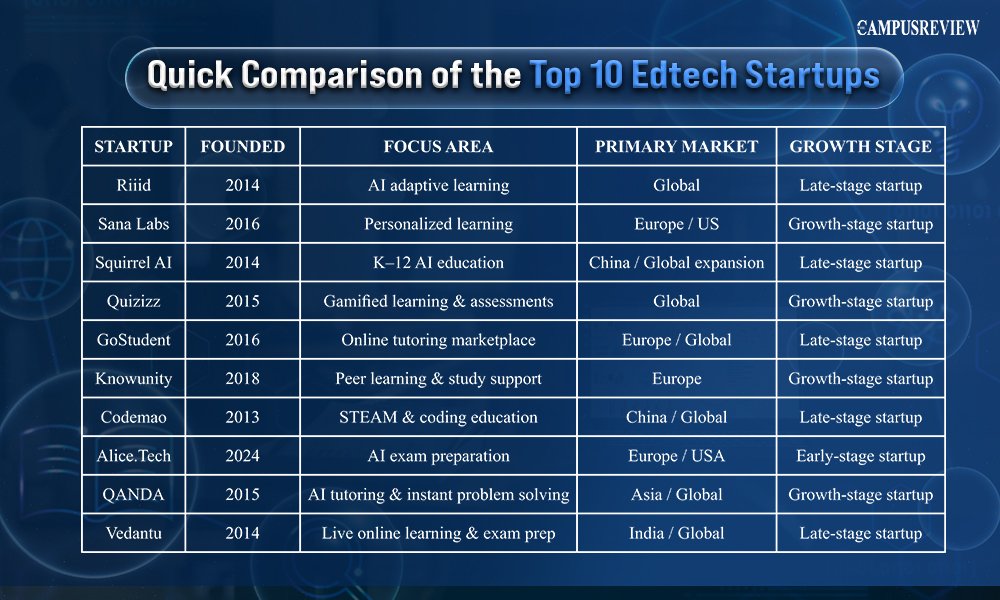
The EdTech startups listed above have been featured or referenced in global education and technology reports by organizations such as TIME, Statista, Business Insider, and UNESCO.
Deep Dive Profiles
- Riiid (South Korea)
Riiid is a pioneer among AI-powered EdTech startups, providing adaptive learning solutions that personalize education at scale. Founded in 2014, this education technology startup leverages machine learning to analyze student behavior, predict weaknesses, and create customized study paths.
Originally focused on test preparation, the platform now serves millions of learners globally across various subjects, placing it among AI‑powered personalized learning leaders.
Key Features:
- Real-time AI assessment that adapts lessons to each student
- Predictive analytics for test scores and learning outcomes
- Integration with institutional learning management systems
Impact & Adoption:
Riiid’s technology has shown measurable improvements in student performance. Many schools and tutoring centers globally now use its platform to enhance outcomes efficiently.
Why It Matters:
By blending AI with pedagogy, Riiid transforms the learning process from a static curriculum to a dynamic, student-centered experience, making education more efficient and engaging.
- Sana Labs (Sweden)
Founded in 2016, Sana Labs specializes in personalized learning solutions for institutions and enterprises. Its AI analyzes learning behavior to optimize content delivery, making every student’s learning journey unique.
Key Features:
- Adaptive content creation for both academic and corporate settings
- Performance tracking and learning analytics dashboards
- Seamless integration with existing educational tools
Global Impact:
Sana Labs partners with universities and companies across Europe and North America. Institutions report increased engagement and faster mastery of complex topics, highlighting AI’s potential beyond K–12 education.
Why It Matters:
Sana Labs demonstrates how AI can scale personalized learning across large groups, proving that adaptive education isn’t just for elite students but is accessible to all.
- Squirrel AI (China)
Squirrel AI combines AI and human teaching expertise to create K–12 personalized learning programs with adaptive learning paths for every student and real‑time feedback mechanisms. It has positioned itself as one of the leaders in AI‑integrated education.
Key Features:
- Adaptive learning paths for every student
- Real-time feedback and AI-driven tutoring
- Integration of teacher oversight for a hybrid learning approach
Impact & Adoption:
Squirrel AI has grown rapidly in China and is expanding internationally. Its unicorn valuation reflects both its scale and innovation. Students using the platform report higher test scores and a deeper understanding of subjects.
Why It Matters:
It proves that combining AI and traditional teaching can dramatically improve learning outcomes, making education more personal and effective at scale.
- Quizizz (USA)
Quizizz is a widely adopted EdTech startup offering interactive learning and assessment tools used by teachers and students worldwide. Founded in 2015, it combines gamification with data-driven insights to make learning engaging and measurable.
Key Features:
- Gamified quizzes and assignments for real-time learning
- AI-assisted question generation and performance insights
- Seamless use in classrooms, homework, and remote learning
Impact & Adoption:
Quizizz is used by millions of teachers and students across K–12 and higher education globally. Schools report higher student engagement and improved retention due to their interactive approach.
Why It Matters:
Quizizz shows that learning doesn’t have to be passive. By combining assessment with fun and analytics, it helps teachers understand student progress while keeping learners motivated.
- GoStudent (Europe)
GoStudent is a global online tutoring platform that connects students with qualified tutors for personalized learning. Founded in 2016, it blends human teaching with technology-driven insights.
Key Features:
- One-on-one and small group online tutoring
- AI-assisted tutor matching and progress tracking
- Coverage across school subjects and exam preparation
Impact & Adoption:
GoStudent operates across multiple European countries and beyond, supporting students from school-level learning to exam readiness. Parents report improved confidence and academic performance in learners.
Why It Matters:
GoStudent highlights the importance of human interaction in education while using technology to scale personalized support effectively.
- Knowunity (Germany)
Knowunity focuses on peer-to-peer learning, connecting students to share study materials, solutions, and collaborative learning paths.
Key Features:
- Community-driven study content
- Gamification to increase engagement
- Collaboration tools for group learning
Impact & Adoption:
Millions of students across Europe actively use Knowunity for exam prep and collaborative study. The platform demonstrates that social learning and peer collaboration remain essential even in a tech-driven environment.
Why It Matters:
Knowunity shows that education can be both social and personalized, leveraging human collaboration alongside technology.
- Codemao (China)
Codemao is a leading STEAM and coding education platform for children. Recognized by UNESCO initiatives and media outlets, it teaches computational thinking, programming, and creative problem-solving.
Key Features:
- Coding courses from beginner to advanced
- STEAM-based project learning
- Online and offline learning modules
Impact & Adoption:
Millions of children use Codemao in China, and the platform is expanding internationally. Its integration of coding and creativity prepares students for future-ready careers.
Why It Matters:
It illustrates that coding and STEAM education are no longer optional; they’re essential for preparing the next generation.
- Alice.Tech (Europe/USA)
Alice. Tech, founded in 2024, is a next-gen AI-powered exam prep platform, often called “Duolingo for tests.”
Key Features:
- Adaptive flashcards and practice exams
- Study progress tracking and analytics
- Personalized study plans
Impact & Adoption:
Rapidly growing in Europe and the US, Alice.Tech is popular among high school and college students seeking efficient, personalized preparation.
Why It Matters:
Alice.Tech shows that even in early-stage startups, AI can deliver highly customized learning outcomes quickly.
- QANDA (South Korea)
QANDA is an AI-powered learning and tutoring EdTech startup that focuses on instant academic support for students. Founded in 2015 in South Korea, QANDA uses artificial intelligence to help students solve questions, understand concepts, and receive personalized explanations across subjects such as math, science, and exam preparation.
Key Features:
- AI-based question recognition that provides step-by-step solutions
- On-demand tutoring support combined with automated explanations
- Personalized learning recommendations based on student performance
Impact & Adoption:
Has expanded rapidly across Asia and international markets, serving millions of students globally. The platform is widely used by middle school, high school, and test-prep learners who need immediate academic assistance. Its ability to blend AI automation with human tutoring has helped it scale efficiently while maintaining learning accuracy.
Why It Matters:
QANDA shows how AI can make learning support instantly accessible, by reducing dependence on traditional tutoring schedules; it helps students overcome learning gaps exactly when they arise, improving confidence and academic continuity.
- Vedantu (India)
Vedantu is a live online learning startup focused on interactive, teacher-led education for K–12 students and competitive exam aspirants. Founded in 2014, Vedantu combines real-time instruction with technology-driven engagement tools to deliver structured learning at scale.
Key Features:
- Live, two-way interactive classes with certified educators
- Personalized doubt-solving and progress tracking
- Curriculum aligned with school education and entrance exams.
Impact & Adoption:
Vedantu has reached millions of students across India and international markets, particularly in regions where access to quality coaching is limited. Its live-class model has helped students replicate classroom engagement in a digital environment while benefiting from flexible access and structured academic planning.
Why It Matters:
Vedantu bridges the gap between traditional classroom learning and digital education. By focusing on live interaction rather than passive content consumption, it reinforces the role of teachers while leveraging technology to extend reach and accessibility.
Thematic Analysis
AI in EdTech: Adaptive learning, personalized content, predictive analytics, many of the tools highlighted here share principles with practical AI tools for students that assist learning in daily study routines.
- STEAM and Coding: Prepares students for future jobs, fosters problem-solving
- Peer & collaborative learning: Knowunity emphasizes social learning
- Global reach: Startups from Asia, Europe, India, and the USA show EdTech is worldwide
Startups vs Established Platforms
While platforms like Coursera, Duolingo, and Khan Academy are widely used, they are no longer startups. The 10 EdTech startups listed here are in active innovation and growth stages, making them more agile and experimental, often piloting features that older platforms may adopt years later.
Choosing the Right EdTech Startup
- Students: Look for platforms that match your learning style and goal
- Teachers: Tools that reduce admin tasks while improving outcomes
- Institutions: Scalable, measurable, and integrable solutions
Key Takeaways: Lessons from the Top EdTech Startups
- AI-Driven Personalization Transforms Learning
- Adaptive learning ensures students progress at their own pace and addresses individual weaknesses.
- Actionable tip: Choose platforms that offer personalized study paths and real-time feedback to maximize learning outcomes.
- STEAM and Career-Focused Skills Are Essential
- Startups emphasize coding, robotics, and creative problem-solving to prepare learners for future opportunities.
- Actionable tip: Integrate STEAM and skill-based programs early to build analytical and creative thinking.
- Empowering Teachers Improves Student Success
- Successful EdTech platforms use technology to support both academic delivery and instructor workflows, enabling broader access to learning opportunities.
- Actionable tip: Educators should adopt tools that streamline grading, attendance, and lesson planning, allowing focus on teaching.
- Collaboration and Community Learning Enhance Engagement
- Peer-to-peer learning platforms foster knowledge sharing, discussion, and retention.
- Actionable tip: Encourage students to participate in study groups, forums, and collaborative projects to reinforce understanding.
- Data, Accessibility, and Global Reach Drive Impact
- Successful EdTech startups leverage analytics to track progress, ensure inclusion, and scale globally.
- Actionable tip: Look for platforms that provide performance analytics, inclusive content, and adaptable features for diverse learners.
Bottom Line:
Top EdTech startups succeed by combining innovation, personalization, teacher support, collaboration, and measurable impact. By learning from these trends, students and educators can make informed choices that maximize learning effectiveness worldwide.
Bookmark this guide and share it with peers, educators, or students looking for innovative EdTech solutions. Stay updated on emerging startups shaping the future of learning worldwide.
FAQs
- What qualifies a company as an EdTech startup?
An EdTech startup is a technology-driven company focused on improving learning, teaching, or skill development through digital tools.
- Is EdTech only for students?
No. Many platforms also serve teachers, professionals, and organizations.
- Does EdTech replace schools?
EdTech complements traditional education by enhancing access, personalization, and flexibility.
- Why is AI so important in EdTech?
AI helps analyze learning patterns, personalize content, and provide timely feedback at scale.