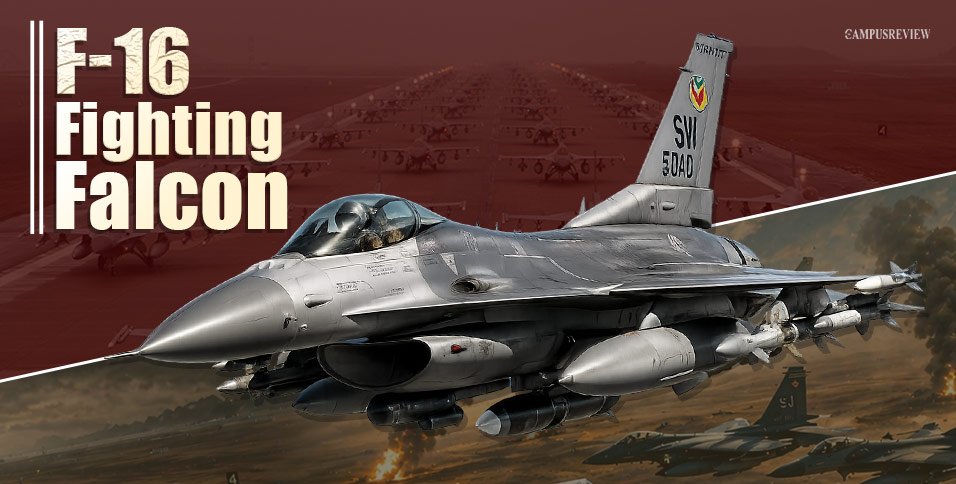
The F-16 Fighting Falcon still matters because it solves a costly airpower problem. It delivers speed, agility, and strike power without a heavy operating burden. Pilots also call it the Viper, while the official name remains Fighting Falcon. Today, more than 3,100 F-16s serve in 25 countries. They have logged about 19.5 million flight hours and at least 13 million sorties. That record explains its unusual staying power. This guide shows how the jet began, how it flies, how it fought, how it spread worldwide, and why upgrades keep it relevant. It also explains why a 1970s fighter still shapes modern strategy.
Genesis of the F-16 Fighting Falcon
The origin of the F-16 Fighting Falcon traces back to a major shift in U.S. air combat thinking during the early 1970s. At that time, defense strategists criticized heavy and expensive fighters like the F-15 Eagle for lacking agility in close combat. Therefore, a group known as the Fighter Mafia pushed for a lightweight, highly maneuverable aircraft. This concept led to the Lightweight Fighter program, where General Dynamics developed the YF-16 prototype.
The first flight took place in 1974, and it immediately proved its agility advantage. Moreover, the aircraft introduced fly-by-wire control, which replaced mechanical systems with electronic inputs. This innovation allowed engineers to design a slightly unstable aircraft that could turn faster and respond quicker. As a result, the F-16 achieved superior maneuverability compared to earlier jets.
In 1993, Lockheed Martin acquired General Dynamics’ fighter division. This transition ensured long-term production and global support. Today, Lockheed Martin continues to upgrade and export the aircraft worldwide.
From a financial perspective, the F-16 program solved a critical cost problem. It delivered high combat performance at a lower procurement and maintenance cost than heavier fighters. Therefore, it became highly attractive for allied nations.
Ultimately, the F-16 Fighting Falcon did not just emerge as another fighter. It redefined how modern combat aircraft balance cost, agility, and technological innovation.
Defying Physics in the Air
The F-16 Fighting Falcon stands out because of its unique aerodynamic philosophy. Engineers designed it with a relaxed static stability concept, which means the aircraft remains slightly unstable in flight. However, the fly-by-wire system continuously corrects this instability. As a result, the aircraft achieves exceptional maneuverability and responsiveness.
The aircraft reaches speeds of around Mach 2 and operates above 50,000 feet. Moreover, its thrust-to-weight ratio allows rapid acceleration and vertical climb. The F-16 uses either Pratt & Whitney or General Electric engines, depending on the variant. Both engine options deliver strong performance and reliability.
In addition, the cockpit design enhances pilot effectiveness. The bubble canopy provides nearly 360-degree visibility, which improves situational awareness. The 30-degree reclined seat reduces the impact of G-forces during high-speed maneuvers. Furthermore, the side-stick controller allows precise control with minimal movement.
The aircraft can sustain up to nine Gs, which gives it a strong advantage in dogfights. At the same time, its lightweight structure reduces drag and improves fuel efficiency. Consequently, the F-16 balances speed, agility, and endurance effectively.
This design approach shows a clear engineering philosophy. Instead of maximizing size or power alone, the F-16 focuses on pilot control and aerodynamic efficiency. Therefore, it continues to outperform many heavier aircraft in close combat scenarios.
Combat History and Strategic Value
The combat record of the F-16 Fighting Falcon provides clear evidence of its effectiveness. Its first major demonstration came during Operation Opera in 1981. Israeli forces used the aircraft to destroy Iraq’s Osirak nuclear reactor with precision. This mission highlighted the aircraft’s ability to execute high-risk, long-range strikes.
During the Gulf War, the F-16 became one of the most widely used aircraft. It flew thousands of sorties and carried out ground attack missions effectively. Moreover, it proved its adaptability by shifting between air-to-air and air-to-ground roles.
Over time, the aircraft evolved from a day fighter into a true multirole platform. It gained night attack capability, precision-guided munitions, and advanced radar systems. As a result, it remained relevant in conflicts across the Balkans, Iraq, and Afghanistan.
The aircraft’s reliability also plays a major role in its strategic value. Military planners prefer platforms that perform consistently under pressure. In addition, the F-16 offers lower operating costs compared to many advanced fighters.
From a broader perspective, the aircraft provides both tactical and economic advantages. It allows nations to maintain strong air defense without excessive spending. Therefore, the F-16 continues to hold a critical position in global military strategy.
The Global Sentinel
The F-16 Fighting Falcon has achieved one of the widest global adoptions among modern fighter aircraft. More than 25 countries operate it, including key NATO members and U.S. allies. This widespread use creates a shared operational ecosystem. As a result, countries benefit from common training, maintenance, and logistics systems.
NATO nations launched the Mid-Life Update program to extend the aircraft’s service life. This initiative upgraded avionics, radar, and weapon systems across multiple fleets. Consequently, older aircraft gained capabilities close to newer variants.
The United States also expanded the aircraft’s reach through Foreign Military Sales programs. Countries like Taiwan, South Korea, and several Middle Eastern nations rely on the F-16 for national defense. Moreover, recent transfers to Ukraine have added a new strategic dimension. These deployments strengthen air defense and improve deterrence in contested regions.
From a financial perspective, the aircraft offers strong value. It provides advanced capabilities at a lower cost compared to fifth-generation fighters. Therefore, many nations choose it as a primary defense platform.
The global presence of the F-16 reflects more than popularity. It demonstrates trust in its performance, reliability, and upgrade potential. As a result, the aircraft continues to serve as a cornerstone of modern air power worldwide.
The 21st Century Viper
The block system shows how carefully the F-16 has evolved. Air Force and Air & Space Forces materials show a clear progression. Block 15 became the first major improvement. Block 30 and 32 brought new engines and broader use. Block 40 and 42 focused on night and all-weather attack. Block 50 and 52 emphasized suppression of enemy air defenses with stronger radar, engines, and weapons. That sequence turned the jet into a long-term platform rather than a fixed design.
The newest production standard is Block 70/72. Lockheed Martin calls it the most advanced 4th generation fighter ever built. It adds the Northrop Grumman APG-83 AESA radar, which gives fifth-generation style radar capability. It also includes advanced avionics, modern displays, and structural life extended to 12,000 hours. Lockheed says the aircraft also uses Auto GCAS, which saved 13 pilots across 12 incidents since late 2014.
The upgrades go beyond new hardware. The U.S. Air Force says its Post Block Integration Team added 22 modifications to improve lethality, survivability, and accuracy. The service also says the F-16 will continue into the 2040s. Lockheed Martin earlier said the service life extension work could support operations to 2048 and beyond. That is a strong signal. It shows that modernization, not replacement, still drives the F-16 story.
Future Outlook
The F-16 still fits the “high-low mix” model. Advanced fighters like the F-35 handle the most demanding missions. Meanwhile, the F-16 covers a huge share of the daily workload. That balance keeps costs lower and force levels higher. In strategic terms, the jet remains a practical bridge between older fleets and fifth-generation airpower.
The strongest proof comes from endurance. A design born in the 1970s still receives major upgrades in the 2020s. Moreover, the aircraft keeps its value because it combines combat history, affordability, and upgrade space. Few fighters have matched that mix. F-16 Fighting Falcon remains a lesson in smart design, disciplined modernization, and strategic patience. In airpower, that combination often matters more than novelty.
End Note
The long life of the F-16 Fighting Falcon reveals a deeper truth about military aviation. Success does not always come from the newest shape or the loudest claim. It comes from usable power, steady upgrades, and a design that keeps room for growth. The Viper survives because it balances cost, combat value, and adaptability with unusual discipline. That balance makes it more than a fighter aircraft. It makes it a durable strategic tool. In a world that changes fast, the F-16 remains relevant because it keeps evolving without losing its original purpose.
Also Read: The 10 Best Military Schools in the US [As of 2026]
Tejas Tahmankar
FAQ’s
Q1. Is the F-16 the best fighter jet?
The F-16 Fighting Falcon is not the absolute best fighter jet today. However, it remains one of the most successful and cost-effective platforms. It balances performance, affordability, and adaptability. Therefore, many air forces still rely on it for both combat missions and long-term operational value.
Q2. Can a MiG-21 defeat an F-16?
A Mikoyan-Gurevich MiG-21 can defeat an F-16 in rare situations. However, the F-16 holds a major advantage in radar, weapons, and maneuverability. In most modern combat scenarios, the F-16 outperforms the MiG-21 due to superior technology and pilot support systems.
Q3. Is the F-16 stronger than the Rafale?
The Dassault Rafale is more advanced than the F-16 in avionics, stealth features, and multirole capability. However, the F-16 remains highly effective and more affordable. Therefore, Rafale leads in technology, while F-16 offers better cost efficiency and global operational flexibility.
Q4. What is the No. 1 best fighter jet?
There is no single best fighter jet globally. However, aircraft like the Lockheed Martin F-35 Lightning II often rank highest due to stealth and advanced systems. Still, effectiveness depends on mission needs, budget, and strategy rather than one universal ranking.