For many decades, universities relied on physical classrooms, paper-based processes, and fixed academic schedules. This structure worked well in a stable and predictable world. However, higher education now operates in a digital environment shaped by data, mobility, and student expectations. Learners expect flexible access to education, responsive campus services, and meaningful engagement beyond classrooms. These pressures explain why the idea of a smart campus has become central to modern academic planning.
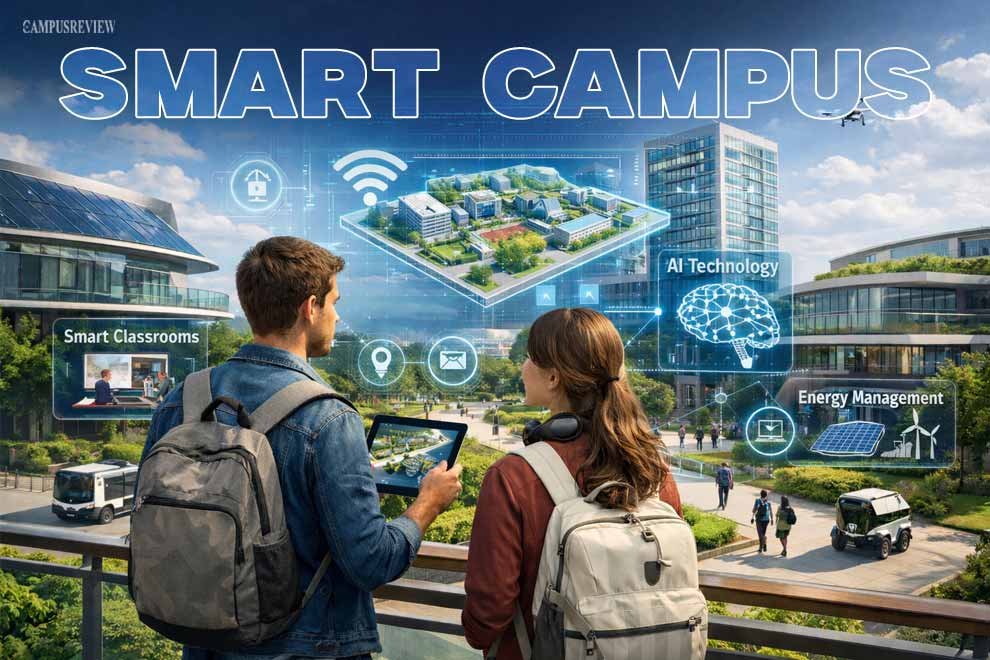
To understand this shift, institutions must answer a basic question. What is a smart campus? A smart campus integrates digital intelligence, connected systems, and human-centered design across teaching, operations, and governance. It does not focus on technology alone. Instead, it uses data and automation to support people and academic outcomes. According to EDUCAUSE, 49 percent of higher education institutions are accelerating technology investments to improve digital transformation and operational efficiency. This trend reflects a global move toward resilient and hybrid campus models between 2024 and 2026.
The Nervous System: IoT and Automation in Smart Universities
The operational foundation of a smart campus rests on IoT and automation in smart universities, which together function as the institution’s nervous system. These technologies operate largely in the background, yet they influence nearly every aspect of daily campus life. Smart lighting systems adjust automatically based on occupancy patterns, environmental sensors monitor space utilization, and automated HVAC systems respond dynamically to real-time temperature and air quality data. Rather than relying on static schedules or manual controls, campuses become responsive environments that align infrastructure performance with actual human behavior.
This shift delivers measurable operational advantages. Automation reduces energy waste, lowers utility costs, and improves safety by ensuring that buildings remain well regulated even during off-peak hours. More importantly, it transforms facilities management from a reactive model into a predictive one. Maintenance teams can identify equipment stress, abnormal energy usage, or system failures before they escalate into disruptions. This predictive capability improves service continuity while extending asset lifecycles.
The scale of adoption reflects how essential these systems have become. According to EDUCAUSE, 99 percent of higher education institutions actively use technology to reduce operational costs, demonstrating that automation is no longer experimental. It has become a financial and operational requirement. In an environment of constrained budgets and rising enrollment expectations, IoT-enabled automation allows institutions to operate sustainably without compromising campus experience. As a result, smart universities treat operational intelligence not as a technical upgrade, but as a strategic capability that supports long-term institutional resilience.
Beyond Four Walls: Smart Classrooms and Connected Learning
Smart classrooms and connected learning environments redefine how knowledge is delivered, accessed, and experienced within higher education. Learning no longer depends exclusively on physical presence in a lecture hall. Instead, digital platforms extend academic engagement beyond traditional boundaries. Lecture capture systems allow students to revisit complex concepts, while digital whiteboards and collaboration tools support real-time interaction across locations. This flexibility accommodates diverse learning styles and supports students balancing academics with work or personal responsibilities.
Faculty benefit as well. Smart classrooms enable blended and hybrid teaching models that combine in-person instruction with digital engagement. Instructors gain access to analytics that reveal participation patterns, content effectiveness, and student comprehension gaps. These insights allow educators to adapt instruction proactively rather than relying solely on end-of-term assessments. Over time, this data-informed teaching approach improves learning consistency and academic outcomes.
Immersive technologies further expand instructional possibilities. Many institutions now deploy augmented and virtual reality labs for disciplines that require experiential learning, such as medicine, engineering, and architecture. These tools simulate complex environments safely and affordably, while also reducing access barriers for students with disabilities. The academic impact is measurable. According to Microsoft, students using AI-powered learning tools demonstrated approximately 10 percent performance improvement and completed tasks nearly 40 percent faster. One institution also reported a 15 percent increase in pass rates and a 12 percent reduction in dropout rates, confirming that connected learning environments directly strengthen student success.
The Digital Bedrock: Campus Management & Infrastructure
Behind every intelligent classroom and automated facility lies a robust digital backbone that enables coordination, security, and scale. Campus management systems and digital infrastructure connect academic platforms, facilities operations, security services, and administrative functions into a unified ecosystem. Without this integration, institutions face fragmented data, inconsistent decision making, and operational inefficiencies. Data silos remain one of the most persistent challenges in higher education, limiting visibility across departments and slowing institutional response.
Unified digital platforms address this challenge by consolidating data flows into centralized systems. Leaders gain a holistic view of campus operations, enabling evidence-based planning rather than intuition-driven decisions. These platforms also strengthen cybersecurity by aligning identity management, network access, and data protection under a single governance framework. As digital complexity increases, institutions must secure not only systems, but also trust among students, staff, and faculty.
A resilient smart campus depends on five foundational pillars: connectivity, security, scalability, interoperability, and analytics. When these pillars operate together, institutions achieve both efficiency and stability. The human impact is equally significant. According to EDUCAUSE, 66 percent of institutions reported reduced staff burnout through AI adoption, while 63 percent achieved direct cost savings. These outcomes demonstrate that strong digital infrastructure supports people as much as processes, reinforcing the idea that technology investments succeed only when they improve both operational performance and employee wellbeing.
The ROI of Intelligence: Benefits of Smart Campus Transformation
The benefits of smart campus transformation extend far beyond operational efficiency or cost control. Intelligent energy systems reduce consumption while supporting institutional sustainability commitments. Advanced analytics help universities identify at-risk students early, enabling timely interventions that improve retention, progression, and graduation rates. Smart security systems enhance campus safety through real-time monitoring and faster emergency response, strengthening trust among students, parents, and staff.
Smart campuses also improve the overall quality of campus life. Predictable digital services reduce administrative friction, while accessible platforms simplify interactions with academic and support services. These improvements lower stress levels and contribute to better mental health outcomes across the campus community. When systems work reliably, students and staff can focus on learning, teaching, and research rather than navigating inefficiencies.
These institutional benefits align with global educational priorities. UNESCO identifies digital education as a key enabler of Sustainable Development Goal 4, which emphasizes inclusive, equitable, and high-quality education worldwide. Smart campuses directly support this objective by expanding access, improving learning quality, and ensuring that education systems remain resilient in the face of disruption. In this context, smart campus transformation represents a long-term investment in academic excellence, social responsibility, and global relevance rather than a short-term technological upgrade.
Future-Proofing the Academic Legacy
A smart campus represents an investment in people rather than infrastructure alone. It strengthens teaching quality, supports staff capacity, and improves student outcomes through informed design. Technology delivers value only when institutions align it with academic purpose and human needs.
From a historical perspective, universities endure through adaptation. Institutions that modernize thoughtfully remain competitive and relevant to future generations. Those that delay change risk losing students to more responsive learning environments. A smart campus therefore protects academic legacy by enabling deliberate and evidence-based evolution.
University leaders should assess readiness today. Strategic action now prevents long-term institutional disadvantage.
Tejas Tahmankar