
There is a particular kind of quiet that settles over a university when it is in the middle of remaking itself, a hum beneath the hum, and in the fall of 2018 that sound was rising out of Cambridge, Massachusetts. The Massachusetts Institute of Technology, an institution not known for timidity, had decided that computer science, the subject that had quietly become the most popular major on its campus, could no longer live inside a single department. It needed a building. It needed a budget. It needed, as it turned out, its own college.
October 15, 2018, is the month people at MIT still point to when they tell this story, the month the university announced what would become the MIT Schwarzman College of Computing, alongside a $1.1 billion commitment from MIT made possible by a $350 million gift from Stephen Schwarzman, the chairman, chief executive, and co-founder of the global asset manager Blackstone.
It was, by any measure, one of the largest academic investments ever directed toward computing and artificial intelligence, and it arrived at a moment when MIT’s own numbers were already telling the story: students were declaring computer science majors in numbers the Institute had never seen, and new joint majors, in fields like biology and economics, were filling up just as fast.
A Committee, Then a College
MIT does not build a college the way other places might, with a single decree from on high. It builds one the way it builds most things, by committee, by working group, by draft report circulated and revised and circulated again.
In February 2019, Provost Martin A. Schmidt convened a task force, and five working groups made up of faculty, students, and staff fanned out across departments to think through what a College of Computing should actually look like: its organizational structure, its faculty appointments, its academic degrees, even its ethics. Their draft reports arrived in June. Their final reports arrived in August. The college’s initial organizational structure then became effective on January 1, 2020, turning a proposal into an operating academic structure.
Somewhere in the middle of all that planning, MIT went looking for someone to run the thing, and it found him closer than it expected. Dan Huttenlocher, an MIT graduate with a master’s degree from 1984 and a doctorate from 1988, had spent the intervening decades doing almost exactly this kind of work elsewhere: he had helped found Cornell Tech, the digital-technology graduate school Cornell built in New York City, and had served as its first dean and vice provost.
Before that, he had been a computer science faculty member at Cornell, a researcher and manager at Xerox PARC, and, for a stretch, the chief technology officer of a fintech startup. His own research lived in computer vision, social media, and the always-shifting project of understanding artificial intelligence. MIT named him the college’s inaugural dean on February 21, 2019, and he took up the post that summer. He remains the college’s dean today.
Huttenlocher has described the college as a structure that simultaneously strengthens MIT’s existing computing programs and creates new educational and research connections across disciplines, a formulation that manages to sound modest about something enormous. That cross-cutting design remains central to the college: it is both a focused home for computer science and AI and a connector between computing and the rest of MIT.
Three Days in February
MIT threw the new college a party, of sorts, though “party” undersells it. From February 26 to 28, 2019, the Institute held a three-day launch celebration that pulled in Massachusetts Governor Charlie Baker, New York Times columnist Tom Friedman, and Eric Schmidt, the former chief executive of Google, then serving as a visiting innovation fellow at MIT.
It was the kind of guest list that signals a university believes it is doing something the rest of the world should be watching. The program included academic panels, student events, discussions of AI ethics, and sessions examining how computing could connect with fields across the Institute.
Fifty New Faculty and a New Kind of Fluency
What the college actually set out to do was never simply to grow the computer science department. Its mission, as MIT describes it, unfolds across three fronts: strengthening the computing fields themselves, from hardware to software to algorithms to AI; building real collaboration between computing and every other discipline on campus, rather than treating one as a service to the other; and taking the lead on the social and ethical questions computing raises, questions that increasingly shape policy and industry far beyond a university’s walls. To make that possible, the college created fifty new faculty positions, some housed within the college itself, some shared jointly with other departments across MIT.
The word MIT keeps returning to is “bilingual.” The idea is to give students in fields beyond computer science enough computational fluency to work confidently at the intersection of computing and their primary discipline. It is a strange and specific ambition for a college to have: not just to train programmers, but to make sure the historians and biologists and urban planners coming out of MIT can understand and meaningfully engage with the computational systems reshaping their fields.
A Building With a Number
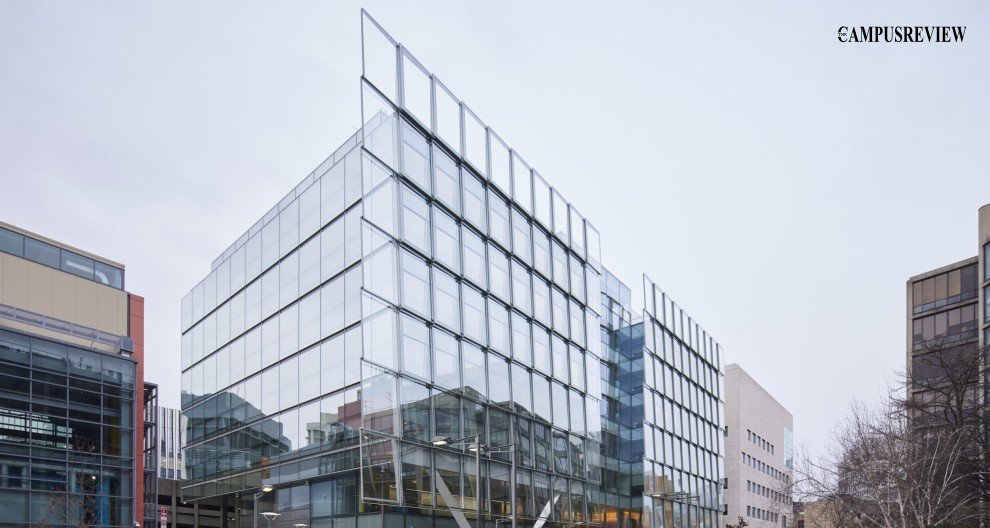
Every college eventually needs an address, and this one got a striking one: a new building on the MIT campus, known simply as Building 45, at 51 Vassar Street in Cambridge, now home to the Schwarzman College of Computing and its Building 45 Event Space. It is the kind of detail that seems small until you remember that for its first several years, the college existed mostly as an idea distributed across other people’s buildings.
Completed and inaugurated in 2024, Building 45 is an approximately 178,000-square-foot, eight-floor headquarters designed to embody the college’s mission of advancing core computing and AI, connecting computing with disciplines across MIT, and addressing the social, ethical, and policy dimensions of technology. It includes classrooms, research space, gathering areas, and facilities intended to encourage collaboration across fields.
1,343 Reasons
This past May 27, the MIT School of Engineering and the Schwarzman College of Computing held their 2026 Advanced Degree Ceremony on Killian Court, and 1,343 graduates participated in the combined ceremony, along with the faculty and family who came to watch them do it. It is a number worth sitting with. Seven years after MIT announced the college, its computing partnership with the School of Engineering had become part of an established commencement tradition, bringing hundreds of advanced-degree recipients together under the same institutional umbrella.
The number itself, however, is a measure of the combined ceremony rather than a count of graduates produced solely by the Schwarzman College of Computing. That distinction matters. What is less ambiguous is the institutional transformation behind it: MIT took a major structural decision in 2018, committed billions in institutional resources over time, created new faculty positions and interdisciplinary programs, and ultimately built a dedicated headquarters for computing and AI at the center of its campus. What began as a bold institutional experiment has become a permanent part of how MIT organizes, teaches, and advances computing.
Also Read: The Rise of Smart Minds: Top AI & Computing Institutions 2026
