
Universities do not create new colleges very often. It is a slow, deliberate, faintly bureaucratic act, closer to redrawing a national border than opening a new storefront, and at the University of Wisconsin–Madison it had not happened in more than forty years, not since 1983, when the School of Veterinary Medicine was created. So when the university announced, in the spring of 2026, that it would launch the College of Computing & Artificial Intelligence (CAI) that July, the decision signaled a major institutional shift: UW–Madison was creating a new academic home around computing and AI after more than four decades without establishing a new college.
Not Starting From Scratch
“People sometimes hear ‘new college’ and assume we’re starting from scratch. In reality, it’s almost the opposite,” said Remzi Arpaci-Dusseau, describing the college he would come to lead.
The new college draws together three established academic units – Computer Sciences, the Information School, and Statistics – bringing their long-standing teaching and research strengths into one institution focused on computing and artificial intelligence. Those three academic units had already been working under a shared structure. Since 2019, they had been part of the School of Computer, Data & Information Sciences (CDIS), established within the College of Letters & Science to connect their teaching and research more closely.
CAI, when it launched on July 1, 2026, gave those three established units a new institutional structure and a broader mandate to advance research, education, public engagement, and thought leadership around computing and artificial intelligence across the university. The transition is not simply a change of name, however: the academic programs themselves will remain in their existing departments until the 2027–28 academic year.
The Man Who Was Already Doing the Job
Remzi Arpaci-Dusseau is the founding dean of the College of Computing & Artificial Intelligence at UW–Madison, a title made official when the university named him to the post in April, with his appointment taking effect July 1, 2026, though in a sense he had been doing the work since 2024, when he began leading the effort to create the college, shaping its vision, building support, and helping secure the philanthropic commitments that would make its launch possible.
Before that, he had directed CDIS and served as special advisor to the provost for computing. His own scholarship, conducted for years with his longtime collaborator Andrea Arpaci-Dusseau, has advanced the field’s understanding of storage systems, operating systems, and distributed computing, work recognized with fellowships from both the Association for Computing Machinery and the American Association for the Advancement of Science.
“I’m honored to lead the college at such an important moment,” Arpaci-Dusseau said when his appointment was announced.
For Arpaci-Dusseau, however, the rise of AI is not a reason for universities to embrace technology uncritically. He has argued that higher education must examine what these systems mean for society as carefully as it studies how to build them. In his view, universities have a dual responsibility: to continue advancing technology while also creating space to examine its consequences, question its assumptions, and prepare students to navigate a rapidly changing technological landscape.
The Vote, the Money, the Building
The college’s creation was approved in December 2025 by the Board of Regents, clearing the way for a launch that had been years in the planning. Behind it sat a substantial financial commitment: $100 million in philanthropic commitments from a group calling itself the Catalyst Collective, made up of alumni, industry leaders, and corporate partners, including John and Tashia Morgridge, Signe Ostby and Scott Cook, Jeff Tangney, Andy Konwinski, and Epic, alongside more than $50 million in annual institutional investment from the university itself.
The new college will hire 50 additional faculty members as part of its own expansion, while that effort builds on a separate campus-wide RISE-AI initiative that has already added more than 50 AI-related faculty.
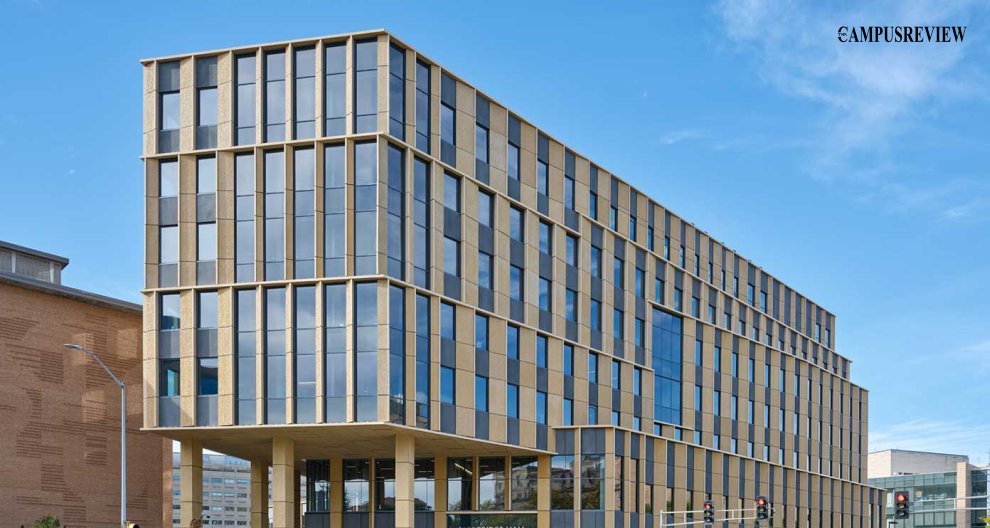
Much of this activity now has a physical home. CAI is based in Morgridge Hall, a 343,000-square-foot building that opened in the fall of 2025 and, within its first month, had already become a central hub of campus life, its second floor home to student advising offices, a tutoring and community space called the Phill and Liz Gross Learning Center, and a gathering area students know as the Rebecca M. Blank Student Commons, or, more informally, the “Blank Space.” The building itself is a privately funded $267 million facility, the largest privately funded building project in UW–Madison’s history.
A Launch, Not a Finish Line
It is worth being precise about what actually changed on July 1, 2026, because the college’s own materials are careful about it. The departments of Computer Sciences, Statistics, and the Information School now sit inside CAI, but their academic programs, the degrees, majors, and certificates students actually earn, will not formally move into the new college until the 2027–28 academic year. In the meantime, the university says, students will keep learning from the same faculty and taking the same courses they always have, with new offerings arriving gradually as the college builds out its identity.
The scale of what CAI now represents is not small. As of fall 2025, more than 3,000 UW–Madison students were enrolled in a computer science major, with another 1,700 in data science and 500 in information sciences, while the three departments brought together in the new college included more than 100 faculty and roughly 5,000 students overall.
UW–Madison computer and information sciences majors earn a median of $115,954 four years after graduation, according to a Journal Sentinel analysis, which identified the figure as the fourth-highest among bachelor’s programs at Wisconsin institutions. When the college officially opened its doors, the story of its student culture had already begun: an overnight MadHacks event in November 2025 drew more than 400 participants to Morgridge Hall.
“At a time when trust in technology has been tested,” Arpaci-Dusseau has said, describing his hopes for what the college can become, “universities can serve as trusted voices and be places where difficult questions are welcomed, where ideas are challenged.”
Also Read: The Rise of Smart Minds: Top AI & Computing Institutions 2026
