
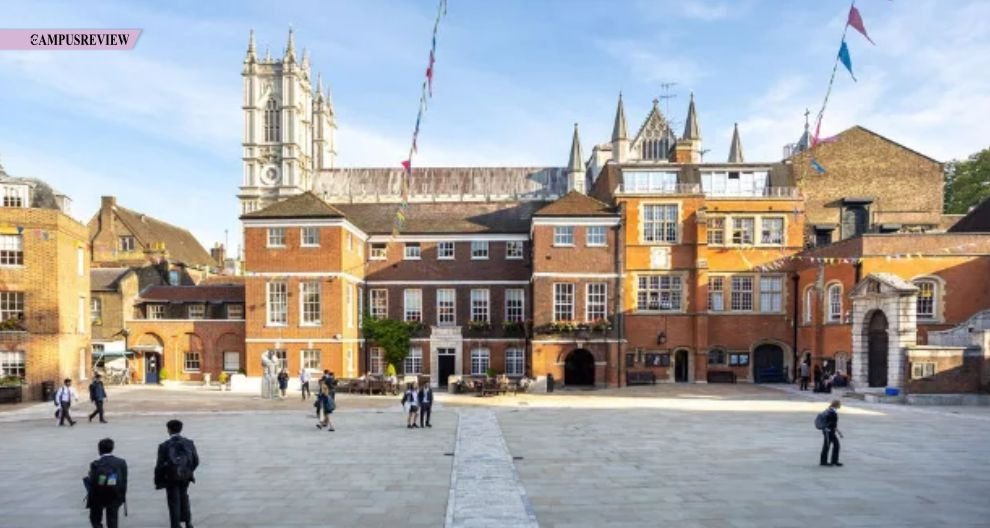
There are few educational settings in which the surrounding city is so closely woven into the experience of school. Westminster School occupies a remarkable position in central London, between Parliament Square and Westminster Abbey. The political life of the country, the architecture of its past and the cultural institutions of a global capital are not distant subjects in a textbook. They are part of the school’s immediate environment.
Westminster’s origins can be traced to a charity school established by Benedictine monks of Westminster Abbey in the early fourteenth century. Its continuous existence is documented from that period, and its location gives it a rare sense of historical continuity. Following the dissolution of the monasteries in 1540, Henry VIII ensured the school’s survival by statute. Elizabeth I confirmed royal patronage in 1560 and is recognised by the school as its Founder.
The school later became an independent institution under the Public Schools Act of 1868, while retaining a close relationship with the Abbey. It remains the only long-established school to occupy its original site in central London.
History, in this setting, is not merely something to preserve. It is an opportunity to consider how institutions change, how knowledge accumulates and how successive generations understand their place in the world.
An Academic Culture of Enquiry
Westminster is a selective day and boarding school for boys aged thirteen to eighteen and girls aged sixteen to eighteen. Its academic approach is built around a broad and rigorous curriculum, subject expertise and a willingness to explore ideas beyond the boundaries of the examination syllabus. Pupils are encouraged to question assumptions, research independently, discuss competing interpretations and develop their own intellectual interests.
The school’s curriculum offers 23 A Level subjects across disciplines including the arts, English, humanities, mathematics, languages and sciences. Pupils entering Year 10 can access 28 subjects, including nine modern and classical languages. The range gives young people room to make deliberate choices, pursue areas of strength and retain an appetite for subjects that challenge them in unfamiliar ways.
This breadth becomes especially meaningful when it is supported by a culture of discussion. Westminster encourages collaborative and independent research, presentations, seminar-style discussion and pupil-led societies as important parts of academic life. Its academic and co-curricular programmes also extend learning through lectures and talks by subject specialists, recognised experts and industry speakers. The objective is not simply to produce pupils who know the answers, but young people who understand how to investigate a question.
The Evidence of Academic Achievement
Westminster’s published 2026 examination results provide a substantial record of academic performance. The school’s current examination-results page lists 207 A Level candidates who received 801 grades across 22 subjects. Sixty-one per cent of grades were A, 89% were A or A, and 99% were between A* and B. The vast majority of pupils took four full A Levels, reflecting the school’s continued emphasis on breadth and academic challenge.
The results also reveal the diversity of interests within the cohort. Mathematics was taken by 181 pupils, of whom 89 also studied Further Mathematics. Seven of the 22 A Level subjects were languages, ancient or modern. French was studied by 28 pupils, while four took Classical Greek. The school’s results-day report also recorded two pupils taking Mandarin. The school’s current results page records 102 pupils earning at least three A grades, while 54 achieved A grades across all their subjects. These details are significant because they show a curriculum that accommodates both widely chosen subjects and more specialised interests.
At GCSE, the school’s current examination-results page lists 120 candidates, with 76% of grades at grade 9, 91% at grades 9 or 8, and 97% at grades 9–7. With early-entry language examinations included, the results encompass 1,222 grades awarded to 129 pupils across 24 subjects. Twenty-seven pupils achieved straight 9s, while more than half the cohort earned all grades at 9 or 8. The curriculum encompassed modern languages, humanities, computer science, electronics, three-dimensional design, the arts and classical subjects.
These results sit within the school’s wider educational philosophy. Subject expertise, intellectual independence and a willingness to learn beyond formal requirements are part of the culture that supports achievement; examinations are an outcome of that culture, not its sole purpose.
Eleven Houses, Many Ways to Belong
A school with Westminster’s scale of history and ambition also needs structures that make its community personal. The house system provides that framework. Westminster’s eleven-house structure gives every pupil a defined place in the school community, whether they attend as day pupils or live on campus during term time. Housemasters, tutors and matrons work alongside the school’s pastoral professionals to support academic progress, welfare and individual development. Older pupils take on leadership responsibilities and offer guidance to younger students, helping them settle into school life and develop a sense of belonging.
Boarding accommodates approximately a quarter to a third of the school’s pupils and operates on a weekly basis during term time. Saturday mornings remain part of the school timetable. The boarding houses cluster in and around Little Dean’s Yard, placing pupils close to Westminster Abbey and the historic heart of the school. Westminster’s location offers boarders access to London’s museums, galleries, theatres and parks, while the house system gives them a more intimate community within the capital’s intensity.
This balance between independence and support matters particularly during adolescence. Pupils are expected to manage increasing academic responsibility, but they are not left to navigate it alone. Pupils’ welfare is supported by a network of professionals that brings together tutors, housemasters, the Chaplain, counselling services, a School Nursing Sister and a Medical Officer. The structures are intended to ensure that welfare is part of the educational experience, rather than separate from it.
Education Beyond the Timetable
A school’s character is also revealed by what it makes possible after the formal timetable ends. Westminster has a broad co-curricular programme encompassing sport, the arts, societies, clubs, trips and volunteering. The school describes these opportunities as ways to broaden pupils’ knowledge, develop their talents and encourage intellectual risk-taking beyond the classroom. Its weekly calendar includes talks by experts, more than 40 music rehearsals, instrumental lessons, plays, concerts, chess tournaments and two afternoons of sport. Expeditions and exchanges take pupils further afield, from visits to galleries in Berlin to Physics exploration at CERN in Switzerland and exchanges in Martinique.
Music has an especially visible place in the school’s identity. Pupils participate in orchestras, chamber ensembles, pop and jazz groups, rehearsals, recitals and concerts. The school community also gathers to sing in Westminster Abbey twice weekly, and pupils perform at venues including Smith Square Hall and the Barbican. These opportunities place individual practice within collective achievement, teaching pupils to listen as closely as they perform.
Pupil-led societies add another dimension. Groups range from Pop Society and Gaming Society to Literature Society, Psychology Society and the African Caribbean Society. Their talks and discussions provide spaces where curiosity can develop outside a prescribed syllabus. The school also organises career events with former pupils and talks by industry specialists. Together, these activities create an environment in which learning is social, self-directed and connected to life beyond the school gates.
Distinction With a Wider Purpose
Westminster’s defining feature is the relationship between its historical setting and its contemporary educational outlook. The Abbey and Little Dean’s Yard offer a physical connection to the past, while London’s institutions and the school’s diverse academic and co-curricular programmes keep pupils engaged with the present.
Its distinction lies in the way tradition remains intellectually alive rather than ceremonial. The school’s legacy is measured not simply by its longevity, but by how each generation turns inherited knowledge into sound judgement, curiosity into understanding, and individual achievement into meaningful engagement with the wider world.
Also Read – Loreto Grammar School (The UK’s Most Distinguished Schools of 2026)
