
Yale’s Forest School took shape in 1900 with founding support from Gifford Pinchot, Yale class of 1889, Henry S. Graves, and the Pinchot family. Its original mission was straightforward and practical: to train the foresters a growing nation would need. Pinchot would go on to become the first head of the U.S. Forest Service. The school that emerged from those founding gifts, then called the Yale Forest School, is today the Yale School of the Environment, and its work now stretches from satellite images of growing cities to oil sludge aboard tankers.
A Lineage Written in Forests
The early record is hard to argue with. Within its first forty years, the school had already produced four men who would go on to lead the U.S. Forest Service. It helped define a new model of forest management and natural resource conservation, and it educated many of the nation’s first foresters.
Then the name began to follow the work. The school formally broadened its identity in 1972, when it adopted the name School of Forestry & Environmental Studies, signaling a move beyond its traditional forestry roots toward a wider environmental focus that included ecology, global planning, urban planning, and environmental justice. In 2020, it became the Yale School of the Environment, and the Forest School was established within it to honor the founding mission. Forestry, the school says, remains a core strength.
A Hill, a Hall and a Forest
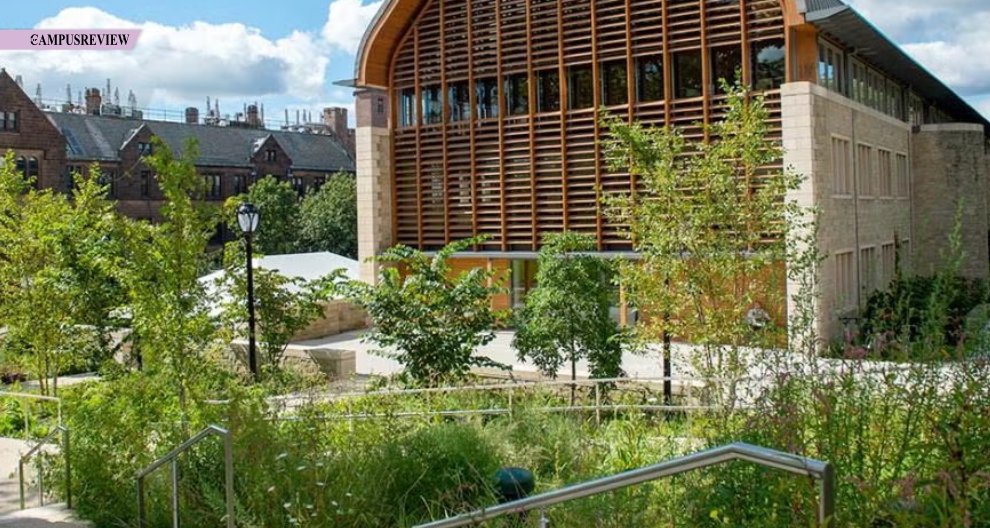
The school sits on Science Hill in New Haven, Connecticut, across seven buildings. Two of them tell its story. Kroon Hall, completed in 2009, is Yale’s first LEED Platinum building and the school’s central hub. Marsh Hall, historic and home to the Forest School, keeps the founding years close.
Beyond the city, the school owns and manages 10,777 acres of forestland in Connecticut, New Hampshire and Vermont. Faculty and students treat it as a living laboratory, and the principles of natural resource management are learned there, among managed stands, not only in lecture halls.
Building Outward
Through the 1990s, Yale continued broadening its reach, establishing centers and initiatives that extended environmental work beyond traditional teaching and faculty-led research. Twenty-five centers, programs, and emerging initiatives now cover subjects such as tropical forestry, environmental communication, and industrial ecology. Students can pursue joint degrees linking the school with Yale’s law, management, public health, and architecture schools, as well as with Pace Law School, Vermont Law School, and Tsinghua University in China.
In 2017 came a new Strategic Plan. It brought a revised curriculum for the Master of Environmental Management, with more emphasis on specialization and its signature flexibility intact. That period also saw the creation of the Yale Center for Environmental Communication and the Yale Environmental Dialogue, creating new forums where experts from different fields could engage with the country’s evolving environmental policy conversation.
Today students choose among ten learning communities, from Business and the Environment to Water Resource Science and Management. Its academic pathways now span the Master of Forestry and Master of Environmental Management, alongside the Master of Environmental Science, Master of Forest Science, executive master’s programs, and doctoral study.
Faculty Who Move the Field
The school’s own history names new voices: Dorceta Taylor and Gerald Torres in environmental justice, Yuan Yao in industrial ecology, Nyeema Harris in wildlife and land conservation, and Luke Sanford in environmental policy. On October 4, 2026, Karen Seto, a pioneer of satellite analysis of urbanization, was honored as the first U.S. woman to win the Vautrin Lud Prize, geography’s top award.
The reach extends to the airwaves. Yale Climate Connections has covered more than 2,960 stories on over 780 radio frequencies across the United States.
Resources have followed ambition. The university also received a $100 million commitment from FedEx for the Center for Natural Carbon Capture, an initiative within Yale’s Planetary Solutions Project. At the School of the Environment, that support is helping create two professorships and provide funding for doctoral and postdoctoral fellows.
Graduates With Work to Do
The Class of 2026 offers a quick portrait of where the school’s graduates are heading. Jenelle Lee ’26 MEM co-founded Oilzyme, which developed a bioremediation system that uses microbes to break down toxic oil sludge aboard tankers. Shipping moves over 80 percent of global trade, yet its waste streams remain underregulated. At Startup Yale 2026, Oilzyme received both the Planetary Solutions Prize Grand Prize and the Audience Choice award. Lee said the recognition reinforces that “shipboard oil waste doesn’t have to be treated as an inevitable pollutant.”
Hassan Alzain ’26 MEM now works in Saudi Aramco’s Green Energy and Environmental Policy Department, where he led project management for the company’s inaugural E&H Roadshow. His work earned him the UK’s Chartered Fellowship of the Chartered Institute of Environmental Health. Olivia Johnson ’26 MEM, during an internship with the National Association of State Energy Officials, co-authored a report on strengthening safeguards for residential solar customers, with a focus on enforceability and the contract phase.
The school’s global reach is reflected in its Three Cairns Scholars from the Class of 2026; the cohort includes students from Panama, India, Kenya, and Mexico.
The Next Chapter
Ingrid C. “Indy” Burke has led the school as dean since 2016. Students begin with a distinctive summer orientation program known as MODs, travel for field research and internships, and can attend global gatherings such as the U.N. Climate Change Conference (COP 26).
That is the quiet argument of this school. It began by teaching people to look after trees. It now teaches them to look after nearly everything else, and it still keeps the trees.
Also Read – Sewanee – The University of the South (The Elite Green Schools of 2026)
