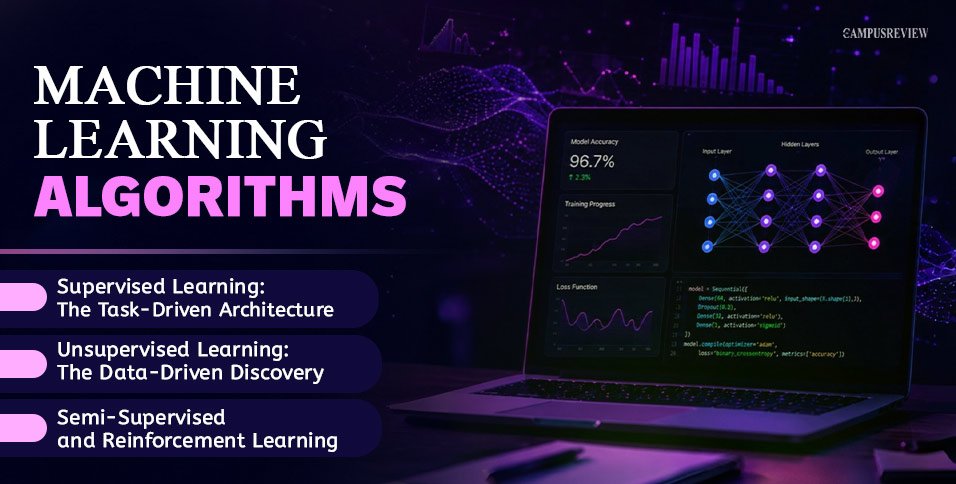
Banks now stop fraud before transactions finish. Hospitals detect diseases faster through image analysis. Retail platforms predict buying behavior within seconds. Behind these systems, machine learning algorithms now operate as active decision engines instead of passive prediction tools. According to McKinsey, more than three-quarters of organizations already use AI in at least one business function. That shift has changed how modern businesses handle automation, risk management, and operational efficiency.
At the same time, companies now choose algorithm families based on speed, infrastructure cost, explainability, and scalability. Therefore, selecting the wrong model can increase latency, raise compute expenses, and reduce business accuracy. This guide explains the latest machine learning algorithms in 2026, their types, enterprise use cases, and the automation trends shaping modern industries.
Types of Machine Learning Algorithms with Examples
Modern machine learning algorithms process data through different learning structures. Some models learn through labeled datasets. Others identify hidden patterns independently. Meanwhile, advanced systems improve through reward-based environments. Therefore, understanding these categories helps businesses deploy accurate and scalable AI systems.
Supervised Learning: The Task-Driven Architecture
Supervised learning remains one of the most widely used branches of machine learning algorithms. These models learn through labeled training data. As a result, the algorithm predicts outputs after studying historical patterns.
Linear Regression predicts continuous numerical values. Financial analysts often use it for revenue forecasting and stock trend analysis. The model identifies relationships between independent variables and target outcomes. Therefore, businesses use it for budgeting and economic planning.
Logistic Regression handles classification tasks instead of numerical prediction. Banks use it to identify loan default probability and customer churn risk. The algorithm converts outputs into probability scores between zero and one.
P(Y = 1) = 1 / (1 + e^-(β₀ + β₁x))
Decision Trees split data into rule-based branches. Because of this structure, they remain highly explainable and easy to audit. Healthcare organizations often prefer them for compliance-sensitive decisions.
Random Forest improves Decision Trees by combining multiple trees into one predictive framework. Consequently, it reduces overfitting and improves accuracy. Modern fintech platforms now use machine learning algorithms like Random Forests for real-time transaction risk scoring and instant fraud prevention.
Moreover, supervised systems continue dominating customer analytics, recommendation systems, and fraud detection because they perform well on structured enterprise datasets.
Unsupervised Learning: The Data-Driven Discovery
Unlike supervised systems, unsupervised machine learning algorithms work without labeled outcomes. Instead, they discover hidden relationships inside raw datasets.
K-Means Clustering groups similar data points together. Retail companies often use it to segment customers based on purchase behavior, browsing history, and spending patterns.
J=∑i=1k∑x∈Ci∣∣x−μi∣∣2
For example, a retail platform may discover that customers buying fitness products also purchase health supplements. Therefore, businesses create highly personalized product recommendations.
Hierarchical Clustering builds layered relationship structures between datasets. Researchers often use it in biological analysis and market segmentation because it reveals deep relational patterns.
Principal Component Analysis, commonly called PCA, reduces data dimensions while preserving important information. Consequently, PCA improves processing efficiency and visualization quality for massive datasets.
Z=XW
Today, enterprise retailers rely heavily on machine learning algorithms using clustering models to map unstructured behavioral patterns. As a result, businesses improve category management and customer targeting simultaneously.
Semi-Supervised and Reinforcement Learning
Some machine learning algorithms operate in environments where labeled data remains limited. Others learn continuously through rewards and penalties.
Semi-supervised learning combines both labeled and unlabeled datasets. Medical researchers often prefer this method because healthcare labeling requires expensive expert review.
Meanwhile, reinforcement learning focuses on decision-making through environmental feedback. The algorithm receives rewards for correct actions and penalties for mistakes. Therefore, the system gradually improves performance over time.
Q-Learning remains one of the most important reinforcement learning methods. It helps systems identify optimal actions within changing environments.
Q(s,a)=Q(s,a)+α[r+γmaxQ(s′,a′)−Q(s,a)]
Deep Q-Networks combine reinforcement learning with neural networks. Consequently, they process highly complex decision environments.
Autonomous vehicles now use machine learning algorithms powered by reinforcement learning for navigation, route optimization, and obstacle detection. Similarly, logistics firms use these systems for automated inventory routing and warehouse robotics.
Google Cloud reports that 84% of organizations now move AI applications from idea to production within three to six months. Therefore, businesses increasingly focus on deployable learning systems instead of experimental AI research alone.
These technologies are also being used in preschool education to create personalized learning experiences for young children through smart educational platforms.
Enterprise Blueprint: Popular Algorithms and Industry Use Cases
Modern enterprises no longer depend on a single AI architecture. Instead, organizations combine traditional machine learning algorithms with neural networks, time-series models, and multimodal systems.
Supply Chain and Logistics
Supply chain operations now depend heavily on predictive machine learning algorithms. Time Series Analysis helps organizations forecast seasonal demand fluctuations and shipping cycles.
yt=Tt+St+Et
Gradient Boosting models improve forecasting accuracy by combining weak predictive models into stronger systems. Consequently, logistics firms reduce inventory shortages and warehouse overflow risks.
Retail companies now predict customer demand weeks earlier than traditional planning systems. Therefore, businesses lower operational waste while improving delivery efficiency.
Healthcare Diagnostics
Healthcare systems increasingly combine Computer Vision with Convolutional Neural Networks, commonly called CNNs. These machine learning algorithms analyze medical images faster than many traditional workflows.
CNNs identify tumors, fractures, and abnormal tissue structures through layered feature extraction. Additionally, hospitals integrate these systems with electronic health records for broader diagnostic accuracy.
y=f(W∗x+b)
However, modern healthcare AI also prioritizes explainability and compliance. Medical institutions now demand transparent model behavior because healthcare regulations require accountable diagnostic systems.
Therefore, explainable machine learning algorithms continue gaining importance across sensitive industries.
Customer Ecosystems and NLP
Customer support systems now process millions of multilingual conversations daily. Consequently, businesses increasingly depend on Natural Language Processing algorithms.
Sentiment classification models analyze emotional tone inside customer messages. Then, routing systems automatically assign tickets to specialized departments.
Transformer architectures now dominate modern NLP because they understand contextual relationships better than older sequential models.
Attention(Q, K, V) = softmax ( QKᵀ / √dₖ ) V
As a result, businesses reduce response times and improve customer satisfaction simultaneously.
Modern machine learning algorithms now support:
- chatbot automation
- multilingual translation
- email categorization
- voice assistants
- search optimization
Therefore, NLP has become one of the fastest-growing enterprise AI categories globally.
The 2026 Frontier: Latest Machine Learning Algorithms and Automation Trends
The latest machine learning algorithms in 2026 focus less on isolated prediction and more on autonomous execution. Therefore, modern AI systems increasingly operate as active workflow engines.
Agentic AI and Autonomous Decision Engineering
Traditional AI systems generated predictions for human review. However, agentic systems now trigger multi-step workflows independently.
For example, an AI system may:
- detect supply shortages
- reorder inventory
- notify vendors
- optimize shipping routes
All actions occur automatically inside connected enterprise systems.
Deloitte predicts that 25% of enterprises using generative AI will deploy AI agents in 2025, while that figure may reach 50% by 2027. Therefore, organizations increasingly invest in autonomous workflow infrastructure.
At the same time, modern machine learning algorithms now integrate with reasoning systems, orchestration layers, and decision pipelines instead of operating independently.
The Rise of Edge ML and Lightweight Models
Cloud computing has transformed AI development for years. However, businesses now increasingly shift toward smaller and faster edge models.
Edge ML deploys machine learning algorithms directly onto local devices instead of remote cloud servers. Consequently, businesses reduce latency, bandwidth costs, and privacy risks.
Smart factories now use edge AI systems for:
- robotic monitoring
- predictive maintenance
- industrial automation
- real-time quality inspection
NVIDIA says Jetson Thor delivers 2,070 FP4 teraflops for robotics, edge computing, and agentic AI workloads. That level of processing power allows lightweight systems to perform advanced inference locally.
Meanwhile, developers increasingly deploy fine-tuned compact models across:
- IoT infrastructure
- autonomous drones
- wearable healthcare devices
- smart surveillance systems
Therefore, Edge ML now represents one of the most important infrastructure shifts in artificial intelligence.
Unified MLOps and Lifecycle Automation
As machine learning algorithms scale, maintaining model accuracy becomes more difficult. Data patterns constantly change. Consequently, models gradually lose predictive quality through data drift.
Modern MLOps frameworks solve this challenge through:
- automated retraining
- version control
- deployment pipelines
- monitoring systems
Platforms like MLflow help organizations track experiments and maintain deployment consistency across environments.
IBM describes MLOps as a standardized assembly line for machine learning deployment and optimization. Therefore, organizations increasingly automate the full AI lifecycle instead of manually maintaining isolated models.
Additionally, continuous learning systems now allow enterprise AI to adapt faster to changing customer behavior and operational conditions.
Strategic Conclusion: Architectural Decision-Making for Modern Data
The future of machine learning no longer depends only on building bigger neural networks. Instead, success increasingly depends on selecting the right architectural balance between accuracy, speed, transparency, and infrastructure efficiency. Simple machine learning algorithms like Decision Trees still perform exceptionally well in explainable environments. Meanwhile, deep neural systems dominate multimodal and large-scale automation workflows.
Therefore, organizations must evaluate models through Precision, Recall, and F1-Score before deployment begins. Businesses should also analyze latency, compute cost, scalability, and governance requirements together. PwC reports that AI is linked to a fourfold increase in productivity growth across industries most exposed to AI. That statistic highlights why algorithm selection now directly shapes operational performance, financial efficiency, and long-term competitive advantage.
Also Read: Best AI Universities 2026: Global Rankings, USA & Asia Guide
Tejas Tahmankar