Imagine your dream university reviewing your profile in 2026. Today, institutions no longer rely only on a degree. Instead, they demand proof of academic integrity. A backlog certificate provides that proof clearly and convincingly. It shows how a student handled failure and improvement over time. Many still believe a degree alone is enough for global admissions. However, that belief often creates rejection risks in competitive environments. A degree shows completion, while a backlog certificate shows consistency, discipline, and recovery.
According to World Education Services, a course-by-course evaluation includes subjects, credits, grades, and GPA. Therefore, institutions assess the full academic journey, not just the final result. This guide explains application steps, SOP strategy, and visa clarity. Before that, understanding this document becomes essential for every student planning ahead.
What is a Backlog Certificate?
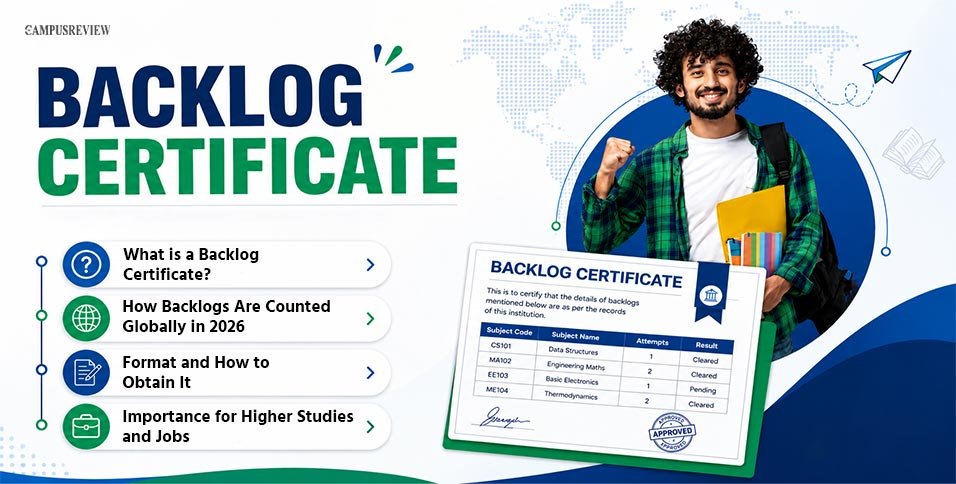
A backlog certificate is an official document issued by a university. It records failed subjects and their clearance attempts clearly. Therefore, it offers a transparent academic history to evaluators. Many students ask, “What is a backlog certificate in the simplest sense?” It is a document that shows how a student recovered academically after setbacks.
This document becomes important because universities value honesty in records. A student may fail initially but improve later. Therefore, the backlog certificate reflects both struggle and progress. This dual insight helps institutions evaluate commitment and discipline.
Even students with no failures often require a Nil Backlog Certificate. Universities in countries like Germany and Australia demand this confirmation. They want proof that no pending subjects exist. Therefore, even top-performing students must secure this document early.
The difference between transcripts and backlog certificates remains critical. A transcript presents a full academic record. It includes subjects, grades, and credits across semesters. In contrast, a backlog certificate isolates failed subjects and attempts. Therefore, both documents complement each other during evaluation.
According to World Education Services, official academic documents must come directly from the issuing institution. Moreover, evaluation cannot proceed until verification is complete. Therefore, a backlog certificate must always remain authentic and officially issued.
How Backlogs Are Counted Globally in 2026
Understanding backlog counting becomes essential for international admissions. Different countries interpret academic records in different ways. Therefore, students must calculate their backlogs carefully.
In subject-wise counting, a subject counts as one backlog regardless of attempts. For instance, failing a subject three times still counts as one backlog. This method appears commonly in the USA and UK. It focuses on final subject completion rather than repeated attempts.
However, attempt-wise counting treats each failure separately. Therefore, failing one subject multiple times increases backlog count. This method appears in several Australian evaluation systems. It highlights repeated academic difficulty instead of final success.
These differences create confusion among applicants. Therefore, students must research each university’s requirements carefully. Blind assumptions often lead to application rejection.
Canada presents a balanced approach. Competitive institutions prefer fewer backlogs. However, universities may still consider strong overall profiles. Germany focuses on credit-based evaluation systems. It examines subject depth and academic alignment closely. Therefore, simple backlog numbers do not always decide outcomes.
This discussion answers when and why it is required. Universities need clarity about consistency and improvement. A backlog certificate removes confusion and provides structured evidence. Therefore, it becomes essential for fair evaluation.
Format and How to Obtain It
Students often feel confused about the format and how to obtain it. However, the process becomes manageable with proper planning. Universities follow standard procedures that ensure document authenticity.
In the offline process, students visit the Registrar or Controller of Examinations. They submit an application with supporting documents. These documents include marksheets, identification, and fee receipts. After verification, the university issues the backlog certificate. However, this process may take time.
In 2026, digital transformation has simplified this process significantly. Universities now offer online portals for document requests. Platforms from Mumbai University and Visvesvaraya Technological University allow students to apply digitally. Students can upload required details and track progress easily. Therefore, digital systems reduce delays and improve transparency.
The application request must remain precise and formal. Students should clearly mention their enrollment number and course details. They must also state the purpose of the request. Attaching correct documents ensures faster processing.
According to World Education Services, transcripts must be sent through approved channels or sealed envelopes. Uploaded copies alone are not accepted. Therefore, students must follow official submission protocols strictly.
Understanding the format also helps in verification. A backlog certificate usually includes student details, subject names, attempts, and final status. Therefore, reviewing the document before submission becomes essential.
Importance for Higher Studies and Jobs
The importance for higher studies and jobs continues to grow in 2026. Universities and employers now prioritize transparency over perfection. Therefore, backlog certificates play a crucial role in decision-making.
For higher studies, universities assess both performance and consistency. A backlog certificate explains academic gaps clearly. It shows whether a student improved over time. Therefore, it supports a more balanced evaluation.
A Nil Backlog Certificate further strengthens a profile. It confirms that the student has no pending subjects. Therefore, it builds immediate trust with admissions committees.
Visa officers also rely on academic clarity. They often question gaps and failures during interviews. A backlog certificate provides structured answers to these concerns. Therefore, it reduces uncertainty and improves approval chances.
Employers have also increased their focus on verification. Companies now conduct detailed background checks before hiring. They compare academic records carefully. Any mismatch can lead to rejection or job loss. Therefore, backlog certificates ensure consistency and credibility.
This document also reflects resilience. Students who overcome academic setbacks demonstrate determination. Therefore, employers often view such candidates positively.
Strategic Impact: SOPs, Visas, and Careers
A backlog certificate should support a strong academic narrative. It should not weaken a profile when used strategically. Therefore, students must present it effectively.
In SOP writing, students should explain backlogs honestly. They should focus on learning outcomes and improvement. This approach converts a weakness into a strength. Therefore, clarity and reflection become important.
A strong redemption arc includes three key ideas. The first explains the challenge faced. The second highlights corrective actions taken. The third shows improved academic performance. Therefore, this structure builds credibility.
During visa interviews, students must remain confident. They should accept past mistakes without hesitation. They should also explain how they improved their performance. Therefore, honesty combined with clarity creates trust.
Corporate verification systems now operate globally. Companies rely on accurate academic data. According to World Education Services, over 4 million evaluations across 48,000 institutions exist worldwide. This network spans more than 200 countries. Therefore, academic verification has become a global standard.
This global system highlights one fact clearly. Institutions value transparency more than perfection. Therefore, a backlog certificate becomes a powerful supporting document.
End Note
A backlog certificate represents more than academic setbacks. It reflects discipline, resilience, and continuous improvement. Students who present accurate records gain trust quickly. Therefore, honesty and preparation remain essential throughout the process. Strong documentation supports admissions, visa success, and career growth. In the long term, consistent progress always outweighs temporary academic challenges.
Also Read: Best 11 Six Sigma Certifications for Students in 2025
Tejas Tahmankar
FAQs
Q1. Can backlog students apply for jobs?
Yes, backlog students can apply for jobs. Most employers focus on final skills, degree completion, and consistency. However, companies may verify academic records during hiring. A backlog certificate helps maintain transparency and trust. Therefore, honest disclosure and strong skills improve employability despite past academic backlogs.
Q2. Is a backlog certificate necessary?
A backlog certificate is often necessary for higher studies, visas, and background verification. Universities and employers require clear academic records. This document confirms failed subjects and their clearance status. Therefore, it removes confusion and strengthens credibility during admissions and hiring processes.
Q3. What are the five types of backlog?
Backlogs are commonly classified into academic categories. These include subject backlog, attempt backlog, internal backlog, external backlog, and credit backlog. Each type reflects different academic issues. Understanding these helps students calculate their backlog count correctly and present accurate records during applications and evaluations.
Q4. What is the purpose of the backlog certificate?
The purpose of a backlog certificate is to provide a transparent academic history. It shows failed subjects and their clearance attempts. Universities and employers use it to assess consistency and improvement. Therefore, it supports fair evaluation, reduces doubts, and strengthens trust during admissions, visas, and hiring processes.