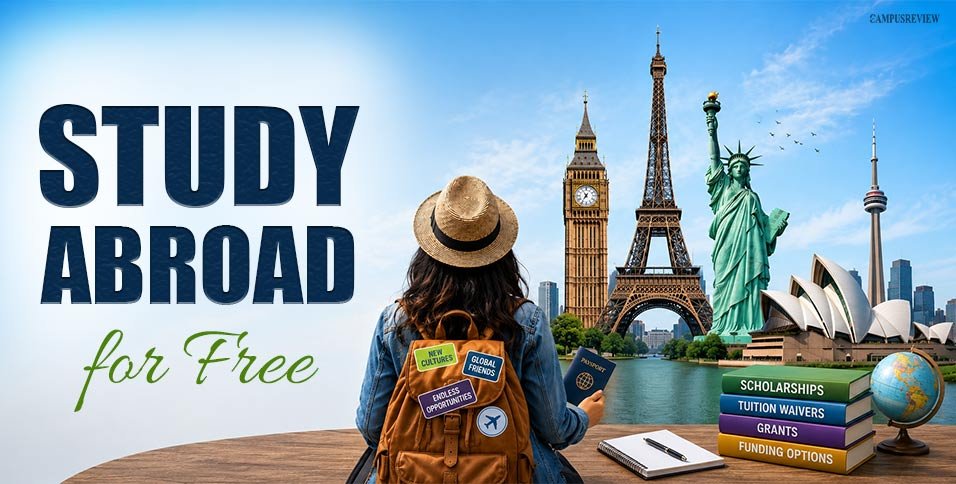
You do not need to be rich to study abroad. You do not need perfect grades either. This is the biggest myth that stops smart students from even trying.
Study abroad for free is real. Thousands of students do it every year. Some pick countries where education is free for everyone. Some win fully funded scholarships from top universities.
This guide explores the four most effective routes to study abroad for free and helps you choose the option that best matches your academic profile, budget, and career goals.
Choose the Best Way to Study Abroad for Free
The best way to study abroad for free depends on your academic achievements and preferred destination. Explore the four proven routes below to find the option that’s right for you.
| Funding Route | Best For | Covers |
| Tuition-Free Universities | Students looking for affordable public education | Tuition or most tuition fees |
| Need-Blind Scholarships | High-achieving students with financial need | Full cost of attendance |
| Government & Foundation Scholarships | Undergraduate and postgraduate applicants | Tuition, living costs, flights, insurance |
| Part-Time Work & Student Benefits | Students with limited budgets | Helps reduce living expenses |
Route 1: Study in Tuition-Free or Subsidized Countries
Some governments treat education as a public good; this can be your best way to study abroad for free. They pay the real cost of your degree, which usually falls between €10,000 and €15,000 a year. You only pay small admin fees. This route works best if you want low risk and long-term stability.
Germany: The Most Popular Choice for Tuition-Free Education
Germany is one of the best destinations for international students because most public universities charge no tuition fees for Bachelor’s and many Master’s programs.
The country is known for world-class engineering, business, and STEM education, with hundreds of English-taught courses and excellent post-study work opportunities.
Key facts
- Tuition: Free at most public universities
- Semester contribution: €70–€430
- APS verification required for students from countries including India
- Student visa proof of funds: €11,904 per year
Best for: Students looking for high-quality education with minimal tuition costs.
Iceland: Small Class Sizes and Tuition-Free Public Universities
Iceland offers tuition-free education at public universities, making it an attractive option for students who prefer smaller campuses and a close-knit academic environment.
Programs focus heavily on sustainability, renewable energy, environmental sciences, and research. While tuition is currently free, living expenses are among the highest in Europe.
Key facts
- Tuition: Free at public universities
- Annual administration fee: €500–€720
- Tuition changes are expected for many non-EEA students from Autumn 2027
Best for: Students interested in research and Nordic education who can manage higher living costs.
Czechia: Learn the Language, Eliminate Tuition
Czechia offers one of Europe’s best hidden opportunities. Public universities waive tuition fees for degree programs taught in Czech, allowing international students to earn a European degree at little to no tuition cost.
Here is how students crack this system:
- Join a one-year Czech language program. Charles University runs one of the best.
- Reach B2 level Czech and clear the entrance exam.
- Move into your degree program with zero tuition.
Best for: Students willing to invest time in learning Czech to significantly reduce education costs.
Austria: Affordable Degrees with a High Quality of Life
Austria combines respected universities with relatively low tuition fees for international students.
Compared with many other European destinations, the overall cost of earning a degree remains affordable, while students enjoy a safe environment, excellent public transport, and easy travel across Europe.
Key facts
- Tuition: €726.72 per semester for most non-EU students
- Student union fee: €25.20
- English-taught programs available at many universities
Best for: Students seeking affordable education in Central Europe without relying entirely on scholarships.
Brazil: Free Public Universities for Portuguese Speakers
Brazil’s public universities charge no tuition for both domestic and international students, making them an affordable option for those comfortable studying in Portuguese.
Government-supported programs such as PEC-G and PEC-PG also provide pathways for undergraduate and postgraduate students.
Key facts
- Tuition: Free at public universities
- Portuguese language proficiency required
- Scholarship opportunities available through government programs
Best for: Students interested in Latin America who are willing to study in Portuguese.
Italy: Low Tuition Plus Generous Financial Support
Italy stands out because many regional governments offer financial aid based on family income rather than nationality.
Through the DSU scheme, eligible international students can receive reduced tuition, accommodation support, meal benefits, and annual cash stipends while studying at globally recognised universities.
Key facts
- Tuition can fall to €140–€200 per year
- Annual stipend: €2,500–€7,900
- Additional university scholarships available
Best for: Students who need both affordable tuition and financial support for living expenses.
Tuition & Proof of Funds in USD
| Country | Tuition (Non-EU) in USD | Funds You Must Show in USD |
| Germany | $0 (most public universities) | $13,094/year (in a blocked account) |
| Iceland | $0 (until Autumn 2027 change) | $1,100/month |
| Czechia | $0 (if taught in Czech) | $5,940/year |
| Austria | $800/semester | $13,200/year |
| Norway | $12,350–$37,050/year | $16,185/year |
| Brazil | $0 (at public universities) | Sponsor/Financial statement |
| Italy (DSU) | $154–$220/year (with DSU waiver) | Based on family income (ISEE |
Route 2: Earn a Fully Funded Need-Blind Scholarship
Some of the world’s most prestigious universities admit international students without considering their financial situation. This is known as need-blind admission.
If you’re accepted, the university meets 100% of your demonstrated financial need through grants and scholarships rather than student loans.
Your financial need is usually assessed through the CSS Profile, which evaluates your family’s income and assets to determine the amount of aid you qualify for.
Universities Offering Need-Blind Admission
Here are the top U.S. universities that currently extend need-blind admission to international students:
- Amherst College
- Bowdoin College
- Brown University
- Dartmouth College
- Harvard University
- Massachusetts Institute of Technology (MIT)
- Princeton University
- University of Notre Dame
- Washington and Lee University
- Yale University
These universities are highly selective, but successful applicants can receive funding that covers tuition, accommodation, meals, and other essential education costs.
What Does the Scholarship Cover?
While benefits vary by institution, many need-blind aid packages include:
- Full or partial tuition
- On-campus housing
- Meal plans
- Mandatory university fees
- Health insurance (at some universities)
- Limited travel or personal expense support
Route 3: Apply for Full-Ride Fellowships and Foundation Scholarships
If you want to study abroad for free, fully funded fellowships and foundation scholarships are one of the best options. These programs typically cover tuition fees, living expenses, airfare, health insurance, and other study-related costs.
While many government-funded scholarships require recipients to return to their home country after graduation, most university and foundation-funded scholarships do not.
Top Fully Funded Scholarships to Study Abroad For Free
| Scholarship | Country | Covers |
| Chevening | UK | Tuition, flights, living stipend |
| Fulbright | USA | Tuition, airfare, health insurance, monthly stipend |
| MEXT | Japan | Tuition, travel, monthly stipend |
| Global Korea Scholarship (GKS) | South Korea | Tuition, airfare, insurance, stipend |
| Australia Awards | Australia | Tuition, travel, living allowance |
| Swiss Government Excellence Scholarships | Switzerland | Monthly stipend, research support |
| Erasmus Mundus | Europe | Tuition waiver + up to €1,400/month |
| Taiwan ICDF / MOE | Taiwan | Tuition, housing, insurance, stipend |
| Gates Cambridge | UK | Full tuition, living costs, airfare |
| Knight-Hennessy Scholars | USA | Tuition and living expenses |
| Clarendon Fund | UK | Full tuition and living grant |
| Schwarzman Scholars | China | Tuition, accommodation, travel, stipend |
Government vs. Foundation Scholarships
| Government Scholarships | Foundation & University Scholarships |
| Funded by governments | Funded by universities or private foundations |
| May require you to return home after graduation | Usually no return obligation |
| Often support national development goals | Focus on academic excellence and leadership |
| Examples: Chevening, Fulbright, MEXT, Australia Awards | Examples: Gates Cambridge, Clarendon, Knight-Hennessy |
Graduate Assistantships: An Overlooked Funding Option
If you’re planning a Master’s or PhD, graduate assistantships can be just as valuable as scholarships. Universities, especially in the United States, often provide Teaching Assistant (TA) and Research Assistant (RA) positions that include:
- Full or partial tuition waiver
- Monthly stipend
- Research or teaching experience
- Professional networking opportunities
These positions are highly competitive but can significantly reduce the cost of postgraduate study.
Before You Apply
Most fully funded scholarships look beyond academic performance. Strong applicants usually demonstrate:
- Excellent academic records
- Leadership experience
- Community involvement
- A compelling Statement of Purpose
- Relevant work or research experience (where required)
Always check the latest eligibility criteria and application deadlines on the official scholarship website, as requirements vary by program.
Route 4: Reduce Your Study Abroad Costs With Part-Time Work and Student Benefits
If you don’t qualify for a fully funded scholarship, you can still make studying abroad much more affordable.
Many countries allow international students to work part-time during their studies, while others offer housing subsidies or financial support that helps reduce everyday living expenses.
Germany: Earn While You Study
Germany is one of the best destinations for students who want to offset living expenses through part-time work.
International students can work up to 140 full days (or 280 half-days) per year, making it possible to earn enough to cover a significant portion of accommodation, food, and daily expenses.
Key facts
- Work limit: 140 full days or 280 half-days per year
- Minimum wage: €13.90 per hour (2026)
- Tax-free mini-job limit: €603 per month
Best for: Students studying at tuition-free public universities who want to manage living costs independently.
France: Save Money With Housing Assistance
Although France charges tuition at many public universities, international students may qualify for CAF (Caisse d’Allocations Familiales), a government housing benefit that can reduce monthly rent by 30–50%.
Before applying, students should budget for initial costs such as the Études en France (EEF) application fee (where applicable) and the CVEC student contribution.
How CAF works
- Secure accommodation.
- Apply through CAF after moving in.
- Submit your required documents.
- Receive housing support once your application is approved.
Best for: Students planning to study in France who want to reduce monthly living expenses.
Australia: Strong Work Opportunities
Australia allows international students to work up to 48 hours per fortnight during study periods and unlimited hours during scheduled breaks.
Combined with relatively high minimum wages, many students can cover a large share of their living expenses while studying. This way you can manage your expenses and study abroad for free.
Key facts
- Work up to 48 hours per fortnight
- Unlimited hours during official holidays
- High hourly wages compared to many study destinations
Best for: Students with partial scholarships or enough savings to cover initial expenses.
Canada: Combine Study and Work
International students at eligible institutions can usually work up to 24 hours per week off-campus during academic sessions and full-time during scheduled breaks. Many universities also offer paid co-op or internship programs that provide valuable work experience alongside income.
Key facts
- Up to 24 hours/week during classes
- Full-time during scheduled breaks
- Paid co-op programs available at many universities
Best for: Career-focused students looking for work experience alongside their degree.
Your Study Abroad Timeline: What to Do and When
Use this simple timeline to track your study abroad for free plan. Start early, and each step gets easier.
| Timeline | Action |
| 12 months before | Choose your destination, shortlist universities, prepare for culture and start preparing for IELTS/TOEFL (if required). |
| 9–10 months before | Prepare your SOP, CV, transcripts, and recommendation letters. |
| 6–8 months before | Submit university and scholarship applications. Complete any country-specific verification steps. |
| 3–4 months before | Accept your offer, arrange proof of funds, and apply for your student visa. |
| 1–2 months before | Book accommodation, buy health insurance, and plan your travel. |
End Note
Luck does not help you to study abroad for free. Plan does. Pick your destination, match it with a funding method, whether that is a tuition-free country, a fully funded scholarship, a government or foundation fellowship, or a mix of smart work and subsidies.
Start your prep at least a year ahead. Line up your documents early. Your free degree is closer than you think.
Frequently Asked Questions
1. Which countries offer free education for international students?
Germany, Iceland, Czechia, and Brazil offer near-zero tuition at public universities. Austria and Italy charge small, income-based fees. Each has its own living-cost and visa rules, so check the comparison table above before you shortlist.
2. Can I really study abroad without money?
You need some money for flights, visas, and the first few months. But full tuition-free routes and paid work rights can bring your total cost down close to zero over time.
3. What makes a scholarship fully funded?
A fully funded scholarship covers tuition, housing, food, and often flights and a monthly stipend. You should not need extra family funds to survive.
4. Are there hidden costs at tuition-free universities?
Yes. Most charge a small semester or admin fee. Some countries add gatekeeper costs too, like Germany’s APS fee or France’s EEF processing fee. You also need to show proof of funds for your visa, even if tuition itself is free.
5. Is it easier to get free public tuition or a scholarship?
Yes, free public tuition in places like Germany is easier to access since it applies to almost everyone who is admitted. Scholarships are more competitive but cover living costs too.