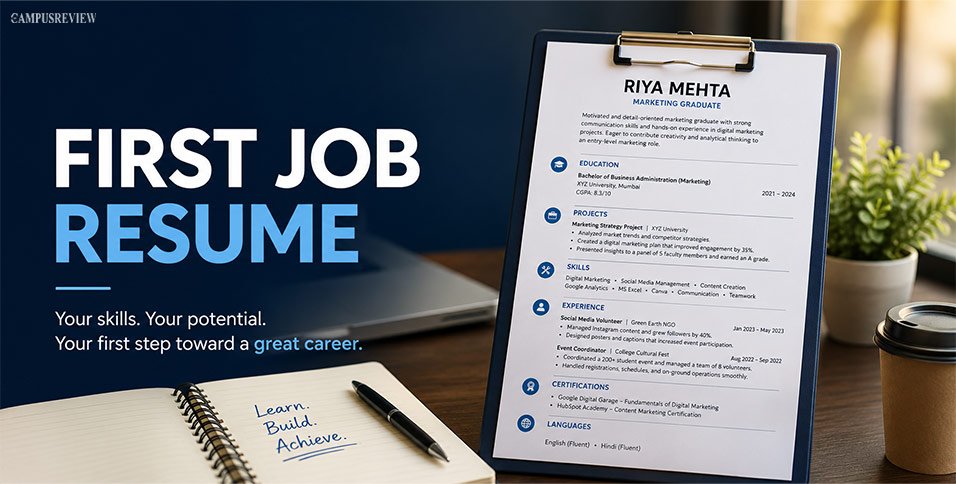
Your resume does not need years of work experience to look strong. It needs the right structure and honest proof of your skills. Most students freeze at this step. They open a blank page and think, “I have nothing to add.”
That is not true. Your classes, projects, and volunteer work count as real experience. Recruiters read many resumes for entry-level roles each week. Few of those resumes stand out. Yours can.
This guide walks you through how to write a first job resume, from choosing the right format to writing a strong resume summary, highlighting relevant skills, and showcasing your achievements.
You’ll also find first job resume examples to help you build your first resume with no experience.
How to Write a Resume for Your First Job
1. Use a clean, single-column, one-page format.
2. Place your education section near the top.
3. Write a three-line resume summary instead of an objective.
4. List skills that match the job description, not generic ones.
5. Turn coursework, projects, and volunteer work into achievement bullets.
6. Add numbers wherever you can.
7. Save the file as a .docx and check it in plain text before you send it.
Focus on Your Best Achievements: The Trailer Rule
Picture your resume as a movie trailer. A trailer never shows the whole film. It picks the best three or four scenes and makes people want more.
Your resume works the same way. You do not need to list everything you have ever done. Pick your three or four strongest wins. Show each one with a clear number or result. Save the rest of your story for the interview.
How to Write a First Job Resume
A strong first job resume isn’t about filling every section; it’s about presenting your skills, education, and achievements in the right way. Follow these steps to build one from scratch.
1. Decide the Best Format for a First Job Resume
Pick your layout before you write a single line. Format decides whether a computer or a real person reads your resume properly.
Why layout matters
Many companies use software called an Applicant Tracking System, or ATS. This software scans resumes before a human ever sees them. A messy layout confuses this software.
Multi-column designs, text boxes, and tables inside your resume often get scrambled during scanning.
Keep your resume:
- Single column
- One page
- Saved as a .docx file for online applications
- Set in a simple font, such as Calibri, Arial, or Times New Roman
- Set with 0.5 to 1 inch margins
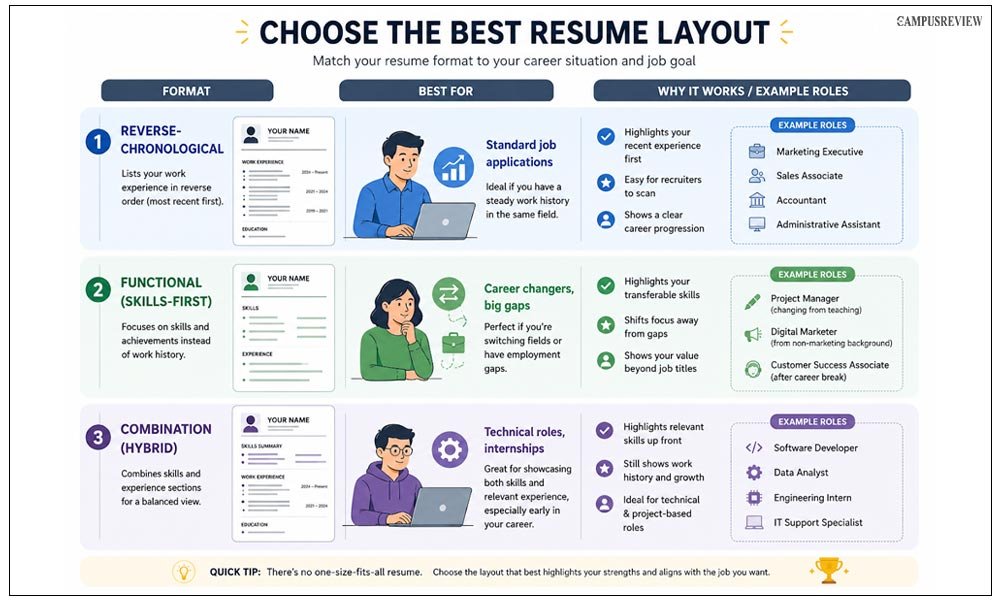
Choosing a resume format: three options compared
Most students should pick reverse-chronological. Simply lead with education and projects instead of jobs.
2. Contact Details and Header
Put your name, phone number, email, and one professional link at the top of the page. A LinkedIn profile or a portfolio link both work well.
Type this information directly into the body of your document. Do not place it inside a header or footer tool in Word. Many ATS programs skip text placed in headers, and your phone number may never reach the recruiter.
Keep it simple:
Your Full Name
City, State | Phone Number | Email Address | linkedin.com/in/yourname
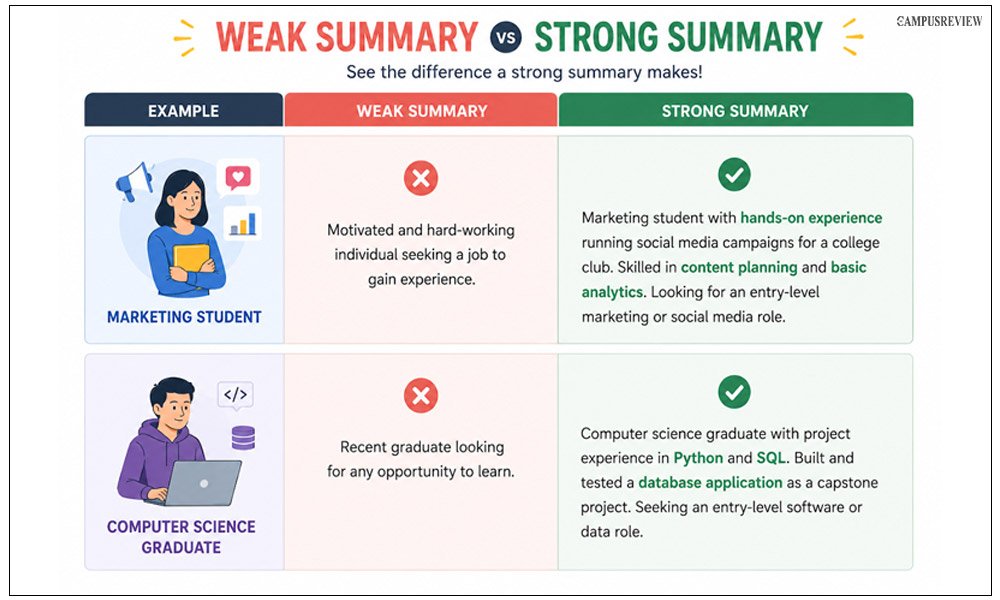
3. How to Write a Resume Summary for Your First Job
Skip the old-style objective statement. Lines like “Seeking an entry-level position to grow my skills” tell a recruiter nothing new. Every applicant wants that.
Write a short resume summary for your first job instead. Keep it to two or three lines. Cover three things:
1. Who you are (your field of study or focus)
2. What you can do (your top one or two strengths)
3. What you want (the type of role you are seeking)
Resume summary for first job: examples
Write your summary last. It gets easier once the rest of your resume is done.
4. Skills for a First Job Resume
Recruiters and ATS software both scan for skills. Keep this section specific, not generic.
Match the job description
Read the job posting closely. If it lists “SQL” and “data cleaning,” use those exact words. Do not swap them for a broader term like “database management.” ATS software often matches exact terms, not similar ideas.
Group your skills clearly
Split your skills into short categories. This keeps them easy to scan.
| Category | Examples |
| Technical skills | Excel, Python, SQL, Canva, Google Analytics, HTML basics |
| Software and tools | Google Workspace, Microsoft Office, Slack, Notion |
| Soft skills | Communication, time management, teamwork, problem-solving |
| Languages | English, Hindi, French (mention your fluency level) |
Skills for a first job resume with no technical background
No technical skills yet? That is fine. Focus on strong soft skills backed by a real example. Do not just list “leadership.” Show where you used it.
PROJECTS
Marketing Strategy Project | XYZ University
- Led a team of 5 classmates to develop a marketing campaign, earning an A grade.
Weak verbs vs strong verbs: an easy swap
Small word changes can make your resume sound sharper. Swap weak, passive verbs for strong action verbs.
| Instead Of | Use |
| Helped with | Coordinated, supported, assisted |
| Was responsible for | Managed, led, owned |
| Did | Built, created, delivered |
| Worked on | Developed, designed, executed |
| Learned | Applied, practiced, mastered |
Building practical skills through skill-based education can also strengthen your resume and improve your employability.
5. How to Show Experience With No Job History
This step stops most students. You do not need a job title to prove you can work. You need proof of impact.
Where to find your “experience”
Look at these areas of your own life:
- Academic projects or your final year capstone
- Volunteer work or community service
- College clubs, fests, or student council roles
- Freelance or informal work, such as tutoring or content writing
- Online courses or certifications tied to the job
- Personal projects, such as a blog, an app, or a small business
The formula that makes bullets strong
Use this simple structure for every bullet point:
What you did + how you did it + what happened as a result
People call this the XYZ formula. It shows up often in tech and business resumes. It forces you to add a number or a clear outcome, which makes your resume feel like proof instead of a guess.
Weak bullet vs strong bullet: side-by-side examples
| Weak, Generic Bullet | Strong, Quantified Bullet |
| Helped organize a college event | Coordinated logistics for a 200-student college fest and managed a team of 8 volunteers |
| Worked on a group project using Excel | Built an Excel model to track a INR 50,000 club budget and cut reporting time by 3 hours a week |
| Volunteered at a local NGO | Tutored 15 school students in math twice a week and raised average test scores by 12% |
| Managed social media for a club | Grew a college club’s Instagram following by 40% in one semester through a weekly content calendar |
| Did an internship in customer service | Resolved 20+ customer queries daily during a 2-month internship and kept a 90% satisfaction rating |
Notice the pattern. Every strong bullet carries a number. Numbers do not need to be exact. Even an estimate, like “around 15 students” or “roughly 3 hours a week,” beats no number at all.
6. First Job Resume Example: A Simple Model to Follow
Here is a short example resume layout you can adapt. This one fits a student applying for an entry-level marketing role with no formal job experience.
RIYA MEHTA
Pune, India | +91 98XXX XXXXX | riya.mehta@email.com | linkedin.com/in/riyamehta
SUMMARY
Marketing student with hands-on experience planning content and running
small campaigns for a college club. Skilled in Canva, basic analytics,
and copywriting. Seeking an entry-level marketing or content role.
EDUCATION
Bachelor of Business Administration, XYZ University, 2022 to 2026
PROJECTS AND ACTIVITIES
Social Media Coordinator, College Marketing Club
– Grew Instagram following by 40% in one semester using a weekly content calendar
– Designed 30+ posts in Canva for events and announcements
– Tracked engagement data weekly and shared results with a 6-member team
Campus Fest Volunteer, Annual Cultural Festival
– Coordinated logistics for 200+ attendees alongside 8 fellow volunteers
– Managed an INR 15,000 vendor budget with zero overspend
SKILLS
Content Planning | Canva | Basic Analytics | Copywriting | Team Coordination
This structure fits almost any entry-level resume. Swap in your own education, projects, and skills. Keep the same clean shape.
How to Keep Your Resume ATS Friendly
A resume can look great to a human and still fail an automated scan. Run through this checklist to keep your resume ATS-friendly.
- Avoid tables, columns, and text boxes inside the resume. These often scramble during parsing.
- Use standard headings. Stick to “Education,” “Experience,” and “Skills.” Skip creative titles like “My Journey.”
- Save your file as .docx for online job portals. PDF works well for email, but some older ATS tools struggle with certain PDF exports.
- Match keywords from the job posting. Use the exact tool or skill name they mention.
- Test your resume in plain text. Paste it into Notepad or a similar tool. If the text looks scrambled or out of order, fix your layout.
Many employers also use skills assessments alongside resumes to evaluate candidates during the hiring process.
The 5-Minute Resume Sprint
Run this quick check right before you hit submit.
- Read your resume out loud. Awkward lines stand out fast this way.
- Check every bullet point for a number.
- Confirm your contact details sit in the main body, not the header.
- Match your skills section to the job posting one more time.
- Save the final file with your name in the title, like Riya_Mehta_Resume.docx.
Final Thoughts
Your first job resume does not need a long work history to look strong. It needs a clear structure, honest details, and proof shown through numbers. Pick a clean format, write a short summary, list skills that match the role, and turn your projects into real achievements.
Update your resume for every job you apply to. Small changes in wording can make a big difference in getting noticed. Once your resume feels ready, move on to your cover letter and start preparing for the interview that follows.
FAQs
1. How long should a first job resume be?
A first job resume should be one page long. Recruiters spend only a few seconds on an initial scan, so keep it tight and relevant.
2. Do I need work experience to write a resume?
No, you don’t need work experience to write a resume. Coursework, projects, volunteer work, and college activities all count as experience on an entry-level resume.
3. What is the best resume format for a first job?
The best resume format is a single-column, reverse-chronological format that lists education near the top, followed by projects and skills.
4. Should I include my GPA on my resume?
Yes, you should include GPA in your resume. If it sits at 3.5 or higher on a 4.0 scale, or a strong equivalent on your grading system. Leave it off if it is not a strength.