The Campus Review
October 30, 2026
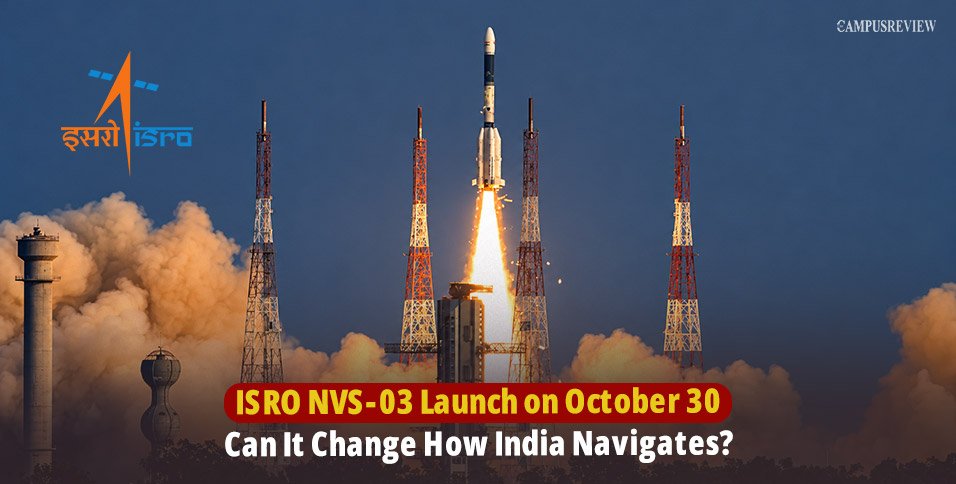
The Indian Space Research Organisation (ISRO) is scheduled to conduct the ISRO NVS-03 launch tonight, October 30, at 11:51 PM IST. The satellite will travel aboard the GSLV-F18 rocket from the Second Launch Pad at the Satish Dhawan Space Centre in Sriharikota.
The mission aims to strengthen NavIC, India’s regional satellite navigation system. NavIC currently has only three satellites providing positioning, navigation and timing (PNT) services. It needs at least four operational satellites to provide standalone positioning.
NVS-03 will add an L1 navigation signal and an indigenous atomic clock to the system. If the satellite reaches its intended orbit and completes commissioning, it could help restore NavIC’s standalone positioning capability.
Key Facts About the ISRO NVS-03 Launch
| Mission Detail | Information |
| Launch date | October 30, 2026 |
| Scheduled time | 11:51 PM IST |
| Launch vehicle | GSLV-F18 |
| Satellite | NVS-03 |
| Launch site | Second Launch Pad, Sriharikota |
| Mission number | 20th GSLV flight |
| Target orbit | Geosynchronous Transfer Orbit (GTO) |
| Navigation signals | L1, L5 and S-band |
| Coverage | India and around 1,500 km beyond its borders |
ISRO confirms that NVS-03 is the third satellite in its next-generation navigation series. The mission will place the satellite into GTO before it begins its orbit-raising operations.
Why Is ISRO Launching NVS-03?
The main reason for this mission is to strengthen NavIC’s operational satellite network.
NavIC was designed to provide independent navigation services across India and approximately 1,500 km beyond the country’s borders. However, the system has faced problems with ageing satellites and onboard equipment.
A government reply in Parliament on July 29, 2026, confirmed that only three satellites were providing PNT services:
- IRNSS-1B
- IRNSS-1I
- NVS-01
The government also confirmed that NavIC could not provide standalone positioning with only three operational satellites. Its timing service, however, remained functional.
Why does NavIC need four satellites?
A navigation receiver calculates its position by measuring the time taken for signals to travel from satellites. It generally needs signals from at least four satellites to determine its three-dimensional position and correct its own clock.
The ISRO NVS-03 launch aims to increase the number of satellites providing navigation services through NavIC. However, NVS-03 must first reach its operational orbit and complete commissioning before it can contribute to the network.
What Makes NVS-03 Different?
NVS-03 introduces two important upgrades to India’s NavIC system.
1. L1 Navigation Signal
Earlier NavIC satellites used L5 and S-band signals. NVS-03 adds the L1 civilian signal, also used by GPS. This improves compatibility with other navigation systems and could help compatible smartphones and wearables receive NavIC signals.
2. Indigenous Atomic Clock
NVS-03 carries an indigenously developed atomic clock alongside procured clocks. Atomic clocks provide the precise timing needed to calculate locations. Developing this technology in India also reduces dependence on imported components.
What Is NavIC and How Is It Used?
NavIC stands for Navigation with Indian Constellation. Earlier known as the Indian Regional Navigation Satellite System (IRNSS), it provides positioning, navigation, and timing services.
Unlike GPS, which provides global coverage, NavIC focuses on India and the surrounding region.
Other major navigation systems include:
- GPS: Operated by the United States.
- GLONASS: Operated by Russia.
- Galileo: Operated by the European Union.
- BeiDou: Operated by China.
NavIC supports several practical applications:
| Application | How NavIC Helps |
| Road transport | Supports location tracking in compatible vehicle devices. |
| Fisheries | Provides emergency weather warnings and information for fishing communities. |
| Telecommunications | Supports accurate timing and synchronisation applications. |
| Disaster management | Supports emergency message broadcasts to compatible receivers. |
| Navigation | Helps compatible devices determine location and movement. |
NavIC is used in vehicle-tracking applications, but the government has clarified that NavIC itself has not been made mandatory for all commercial vehicles.
Why Did the NVS-02 Mission Fail?
ISRO launched NVS-02 on January 29, 2025, and successfully placed it into an elliptical transfer orbit. However, the satellite could not complete its orbit-raising manoeuvres because a pyrotechnic valve in the oxidiser line failed to receive its electrical drive signal.
ISRO’s investigation identified disengaged connector contacts in both the main and backup electrical paths as the most likely cause.
What did ISRO change after the failure?
The review committee recommended improvements to the reliability of the pyrotechnic system. ISRO confirmed that these measures were successfully implemented on the CMS-03 satellite in November 2025. PTI also reported that NVS-03 would fly with its pyrotechnic valves already open to avoid a similar activation problem.
How Will GSLV-F18 Place NVS-03 in Orbit?
GSLV-F18 is a three-stage launch vehicle. Its flight will take place in three broad stages:
- First stage: The rocket uses a solid motor and four liquid strap-on boosters to lift off.
- Second stage: The liquid stage continues accelerating the vehicle after the first stage separates.
- Third stage: The cryogenic upper stage provides the final thrust needed to place NVS-03 into its planned Geosynchronous Transfer Orbit.
After separation from the rocket, NVS-03 must perform additional orbit-raising manoeuvres using its onboard propulsion system. It will then undergo checks and commissioning before providing navigation services.
This distinction is important. Reaching GTO does not mean that the satellite is already operational.
What’s Next for India’s NavIC Programme?
NVS-03 is the third of five second-generation NavIC satellites. ISRO launched NVS-01 in May 2023, while NVS-04 and NVS-05 were in advanced stages of development as of July 2026.
The ISRO NVS-03 launch could help restore NavIC’s standalone positioning services once the satellite reaches its operational orbit and completes commissioning. Further satellite launches will strengthen the system’s long-term reliability.
Pranjal Kharche
Also Read – CSU President to Resign After Nearly Four Years: Who Will Lead Colorado State Next?