The Campus Review
October 29, 2026
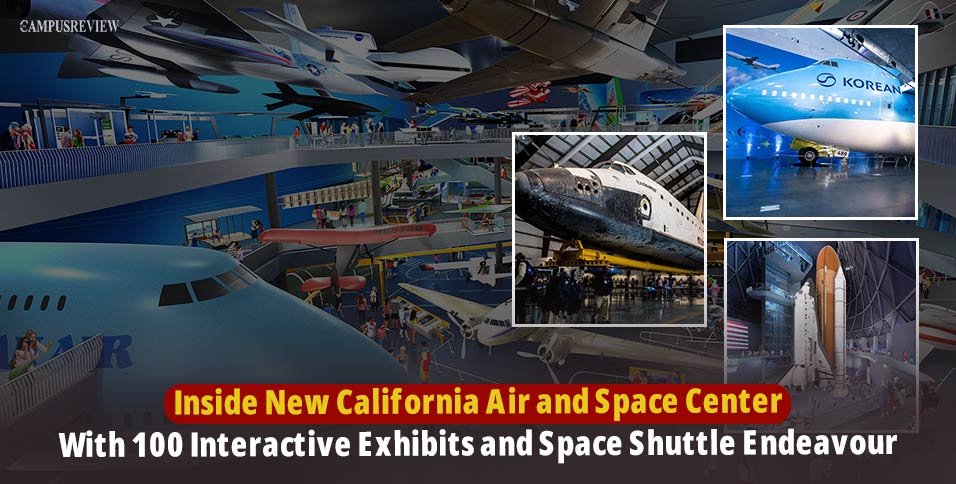
The New California Air and Space Center, officially named the Samuel Oschin Air and Space Center, opens to the public on November 13, 2026, at the California Science Center in Los Angeles.
The 200,000-square-foot expansion features 100 new hands-on exhibits, 100 historic aerospace artifacts, and Space Shuttle Endeavour displayed upright with its solid rocket boosters and external tank.
The facility nearly doubles the science center’s existing exhibit space and completes the final phase of a 30-year master plan. Visitors can explore three galleries covering spaceflight, aviation, and space exploration.
Key Facts About the New California Air and Space Center
| Feature | Details |
| Opening date | November 13, 2026 |
| Location | Exposition Park, Los Angeles, California |
| Facility size | 200,000 square feet |
| Interactive exhibits | 100 |
| Historic artifacts | 100 |
| Main attraction | Space Shuttle Endeavour in launch configuration |
| Galleries | Samuel Oschin Shuttle Gallery, Korean Air Aviation Gallery, Kent Kresa Space Gallery |
| General admission | Free |
| Advance reservation fee | $4 per person |
The California Science Center Foundation announced the opening date and exhibit details on October 28. According to the foundation, this is the only place in the world where visitors can see a complete, authentic space shuttle system displayed in its launch configuration.
Why Space Shuttle Endeavour Is the Main Attraction
The biggest draw is Space Shuttle Endeavour, which stands in a nearly 200-foot-tall, 20-story launch configuration inside the new gallery.
The display includes three major components:
- The orbiter: The spacecraft that carried astronauts into orbit and returned them to Earth.
- Solid rocket boosters: The two large rockets that helped lift the shuttle from the launch pad.
- External tank: The large tank that supplied fuel to the shuttle’s main engines during launch.
NASA retired the space shuttle fleet in 2011. Endeavour completed its final mission, STS-134, that year and arrived in Los Angeles in 2012. It remained on horizontal display while the science center developed the building needed to house it upright.
The final installation involved a complex, six-month process to assemble the shuttle components in their vertical configuration. Visitors will now be able to see the spacecraft as a complete launch system rather than as a separate orbiter.
What visitors can experience
The shuttle gallery combines the historic display with interactive attractions.
- 140-foot elevator ascent: Visitors can travel alongside the shuttle stack and view its components from different heights.
- Glass-floor viewing platform: The elevated platform gives visitors a view above Endeavour’s nose.
- Shuttle descent slide: Two 115-foot-long slides take visitors from the upper gallery to the base of the shuttle, dropping 45 feet in elevation.
- Replica flight deck: Visitors can explore a detailed model of the shuttle’s cockpit and its many controls.
- Orbiter landing simulator: Guests can try to guide a simulated shuttle orbiter toward a runway.
What to See in the Three Galleries of New California Air and Space Center
The Samuel Oschin Air and Space Center divides its collection across three galleries. Each focuses on a different part of aerospace history and exploration.
1. Samuel Oschin Shuttle Gallery
This gallery focuses on Endeavour and NASA’s space shuttle program.
Visitors can explore:
- Endeavour’s complete launch configuration.
- Displays covering all 135 space shuttle missions.
- The shuttle’s thermal protection system, including the tiles that helped protect it from extreme heat during reentry.
- Tributes to crews who lost their lives during the program.
- The replica flight deck and orbiter landing simulator.
These exhibits connect the shuttle’s engineering design with the history of human spaceflight.
2. Korean Air Aviation Gallery
The aviation gallery explores how aircraft developed and how people travel by air today.
Its main attractions include:
- More than a dozen aircraft, including historic gliders and fighter jets.
- The forward section of a Korean Air Boeing 747-400.
- A simulated five-minute video journey from Los Angeles to Seoul.
- Flight simulators that let visitors experience flying from a pilot’s perspective.
The gallery gives visitors a closer look at aircraft design, aviation history, and the technology behind commercial and experimental flight.
3. Kent Kresa Space Gallery
This gallery focuses on spacecraft, planetary exploration, and the technology used to study space.
Highlights include:
- The Mercury-Redstone 2 capsule, which carried the chimpanzee Ham on a suborbital flight in 1961.
- The Gemini 11 capsule, which carried astronauts Charles Conrad Jr. and Richard Gordon in 1966.
- The Apollo-Soyuz Command Module, associated with the 1975 joint US-Soviet space mission.
- Models of Mars rovers and other space exploration vehicles.
- A miniature Mars rover that visitors can program and operate.
- The International Space Station Fly-Through Simulator, which uses real astronaut footage to showcase life aboard the ISS, where Russian cosmonauts also conduct spacewalks.
Together, these exhibits show how space exploration has progressed from early human spaceflight to robotic missions and research aboard the International Space Station.
How New California Air and Space Center Makes STEM Learning Interactive
The new facility combines historic aerospace artifacts with activities that let visitors test ideas and operate simulated equipment. These experiences can help children and adults connect science concepts with real-world applications.
| Exhibit | What visitors can do |
| Wing Shape and Distance | Launch aircraft models with different wing shapes and compare how far they travel. |
| Wear-a-Wing | Wear foam wings in a wind tunnel and experience the force of moving air. |
| Launch a Drone Mission | Guide simulated drone missions over a miniature Los Angeles cityscape. |
| Mars rover activity | Program and drive a miniature rover across a simulated Martian surface. |
| Orbiter landing simulator | Try to guide a simulated shuttle to a runway. |
The activities cover topics such as flight, robotics, programming, and space exploration. Instead of only reading about these subjects, visitors can interact with models and simulations to see how different systems work.
The center’s approach also connects historical achievements with current technology. The shuttle display shows the engineering behind human spaceflight, while the rover and drone activities introduce visitors to technologies used in exploration and navigation.
Tickets, Entry Fees, and Visitor Information
Here is what visitors should know before planning a trip to the New California Air and Space Center
- General admission: Free, including entry to the new Air and Space Center.
- Timed reservations: Advance reservations are planned because of expected demand. A $4 service fee applies per person.
- Opening ceremony: The event will feature approximately 30 astronauts, including all six crew members from Endeavour’s final mission, STS-134.
- Additional attractions: Some experiences, including the elevated shuttle viewing platform and Air Race flight simulators, require separate paid tickets.
- Booking: Visitors can check availability and reserve entry through the official California Science Center website.
The foundation has raised more than $415 million toward its $450 million EndeavourLA campaign goal. The project completes the final phase of the California Science Center’s three-phase, 30-year master plan.
Pranjal Kharche