Campus Review
October 30, 2026
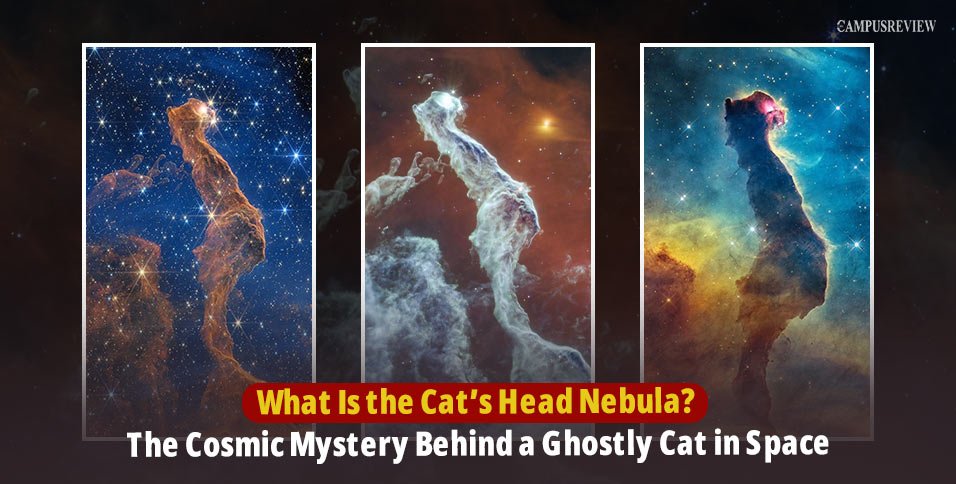
Astronomers have released new images of a ghostly cat in space, nicknamed the Cat’s Head Nebula. Located about 7,500 light-years from Earth, this unusual structure sits inside the Carina Nebula (NGC 3372).
It looks like a cat sitting with its back turned and looking over its shoulder.
The Hubble Space Telescope and James Webb Space Telescope have captured different views of this region. Their observations show how massive stars shape the surrounding gas and dust.
The Cat’s Head Nebula isn’t a newly discovered, standalone nebula. It is a small, dusty structure inside a much larger star-forming region.
Quick Facts: The Ghostly Cat in Space
| Feature | Scientific Detail |
| Object Name | Cat’s Head Nebula (nickname) |
| Location | Carina Nebula (NGC 3372) |
| Distance from Earth | Approximately 7,500 light-years |
| Main Structure | Dense pillar of gas and dust |
| Glowing Eye | Possible young star hidden in dust |
| Shaping Forces | Ultraviolet radiation and stellar winds |
| Observatories | Hubble and James Webb |
| Webb Instruments | NIRCam and MIRI |
| Hubble Instrument | Wide Field Camera 3 (WFC3) |
What Creates the Ghostly Cat in Space?
The ghostly cat in space is a natural formation. Its appearance is an example of pareidolia, which happens when our brains recognise familiar shapes in random patterns. It is the same reason we sometimes see animals in clouds.
But what gives the structure its unusual shape?
- Ultraviolet radiation: Nearby massive stars release powerful radiation that heats the surrounding gas.
- Stellar winds: Fast-moving particles from these stars push against nearby gas and dust.
- Dust erosion: These forces gradually remove less dense material.
- Dense pillars: Thicker pockets of gas and dust resist erosion for longer, leaving behind the cat-like structure.
What Is the Glowing Eye?
The bright reddish spot that looks like the cat’s eye is another intriguing feature.
Astronomers believe it may contain a young star still hidden inside thick dust. However, its identity has not yet been confirmed.
Why Does the Cat’s Head Nebula Look Different in Each Video?
Exploring the Ghostly Cat Nebula
Video courtesy of NASA, featuring observations of the Ghostly Cat Nebula captured by the Hubble and James Webb Space Telescopes.
The images look different because Hubble and Webb observe different wavelengths of light.
- Visible light: Thick dust absorbs and scatters much of this light. This makes the pillar appear dark and solid in Hubble’s image.
- Near-infrared light: Webb can detect light passing through some dust, revealing stars and structures hidden from visible-light observations.
- Mid-infrared light: MIRI detects emissions from warm dust, helping scientists study the material inside the nebula.
Why Do the Images Have Different Colours?
The colours help scientists distinguish different features.
Astronomers assign visible colours to selected wavelengths that human eyes cannot see directly. These colour combinations make it easier to identify dust, stars, and glowing gas.
How Hubble and James Webb View the Nebula
Hubble and Webb observe different wavelengths of light. Each telescope reveals details that help astronomers understand the nebula.
1. Hubble Space Telescope: Visible Light
- Uses the Wide Field Camera 3 (WFC3).
- Captures the dark, dusty pillar against glowing background gas.
- Shows a bright yellowish rim along the structure.
- Reveals blue and cyan regions containing glowing gas and starlight scattered by dust.
2. Webb NIRCam: Near-Infrared Light
- Observes light that can pass through some dust more easily than visible light.
- Reveals more details inside the dusty pillar.
- Shows stars across the region and distant background galaxies.
- Helps astronomers examine structures hidden in visible-light images.
3. Webb MIRI: Mid-Infrared Light
- Detects infrared emissions from warm dust and carbon-based molecules.
- Reveals delicate filaments and glowing clouds.
- Shows smaller structures along the pillar.
- Helps scientists study the material inside the nebula.
What Lies Ahead for the Nebula?
The Cat’s Head Nebula will not keep its current shape forever.
- Radiation and stellar winds continue to erode its outer layers.
- Dense parts of the pillar gradually lose material.
- Over time, the structure is expected to break apart and disperse into the surrounding Carina Nebula.
Until then, this ghostly cat in space offers astronomers a fascinating view of how massive stars shape clouds of gas and dust.
What looks like a mysterious cat in space is actually a changing cosmic structure that helps scientists understand star formation.
Also read – ISRO NVS-03 Launch on October 30: Can It Change How India Navigates?