The Campus Review
November 3, 2026
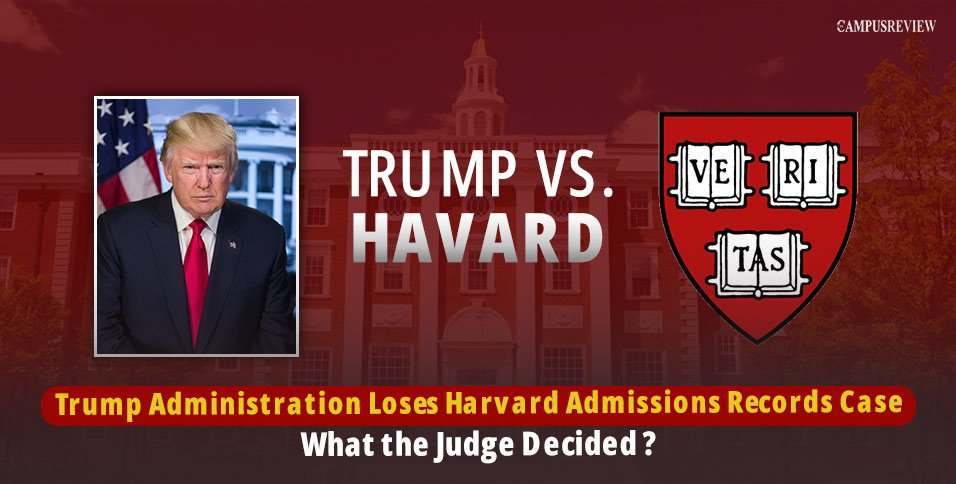
A federal judge in Boston has dismissed the Trump administration’s lawsuit seeking Harvard University’s admissions records. Judge Myong Joun ruled that the Department of Justice (DOJ) had not followed the required procedures to secure Harvard’s voluntary compliance before filing the case.
The DOJ sought five years of applicant data to investigate whether Harvard considered race in admissions after the US Supreme Court’s 2023 affirmative action ruling.
The records included grades, test scores, essays, extracurricular activities, admissions ratings, and demographic details. The Harvard Admissions records case was dismissed without prejudice, allowing the government to pursue legal action again after meeting procedural requirements.
Quick Summary of the Harvard Admissions Records Lawsuit
Case Element | Key Detail |
| Court and Judge | US District Court for the District of Massachusetts; Judge Myong Joun |
| Plaintiff | US Department of Justice; the Department of Education later joined the enforcement action |
| Defendant | Harvard University (President and Fellows of Harvard College) |
| Scope of Request | Five years of applicant-level admissions data across three schools |
| Legal Basis | Title VI of the Civil Rights Act of 1964 and related enforcement procedures |
| Final Decision | Lawsuit dismissed without prejudice on procedural grounds |
Why the Judge Dismissed the Harvard Admissions Records Case
The decision focused on whether federal agencies had satisfied the procedural requirements for judicial enforcement.
Under Title VI of the Civil Rights Act of 1964 and its implementing regulations, agencies must take steps to secure an institution’s voluntary compliance before seeking judicial enforcement of certain information demands.
Judge Joun identified two major shortcomings in the government’s complaint:
- Lack of Notice of Intended Litigation: The complaint did not adequately establish that the government had informed Harvard that it would file a lawsuit if the university failed to comply.
- Failure to Identify Specific Compliance Issues: The government did not adequately show that it had communicated the specific compliance failure to Harvard before seeking judicial enforcement.
In his written opinion, Judge Joun explained:
“A deadline and a threat to sue, standing alone, do not necessarily demonstrate compliance with the regulatory voluntary-compliance process”
The judge also found that the Department of Education had not completed the required voluntary compliance steps before joining its investigation to the DOJ’s lawsuit in May.
As a result, the court dismissed the case without deciding whether Harvard had violated federal civil rights requirements or whether the government could ultimately obtain the requested records.
What Admissions Records Did Federal Regulators Demand?
Federal officials argued that individual applicant records were necessary to investigate Race in Harvard Admissions following the US Supreme Court’s 2023 ruling.
The government requested five years of admissions records across Harvard’s undergraduate, medical, and law schools. These included:
- Academic and Personal Information: Applicants’ grades, GPA, standardized test scores, personal essays, and teacher recommendations.
- Student Backgrounds: Extracurricular activities, economic indicators, and demographic information, including race and ethnicity.
- Admissions Evaluations: Internal ratings, interview feedback, committee assessments, and admissions outcomes.
According to Harvard’s court filings, the university had already provided thousands of pages of documents, including aggregated admissions data, admissions guidelines, and instructional materials for admissions personnel.
However, the government argued that these documents did not provide the individual-level information needed to examine how Harvard evaluated applicants.
Why Are Harvard and the Trump Administration Disputing Admissions Records?
The dispute highlights tensions between federal oversight of university admissions and the privacy of individual applicants.
The main disagreements involve three areas:
- Student Privacy: Harvard argued that handing over identifiable applicant files, including personal essays and academic records, could expose sensitive student information.
- Scope of the Investigation: Harvard challenged the government’s demand for extensive applicant-level records across three schools, arguing that it was overly broad.
- Retaliation Allegations: Harvard claimed that the Trump administration filed the lawsuit because the university refused to follow its demands about university policies and management.
A similar admissions dispute emerged at Ohio State University, where the Department of Justice alleged racial bias in medical school admissions, while the university disputed the findings.
What Happens Next in the Harvard Admissions Records Case?
The judge dismissed the Harvard admissions records case without prejudice, allowing the government to refile after addressing the procedural shortcomings.
- Further Steps: Federal agencies must follow the required notice and voluntary compliance procedures.
- Possible Lawsuit: The DOJ can seek judicial enforcement again.
- Investigation Continues: The court has not ruled on whether Harvard violated Title VI or must disclose the requested records.
The ruling gives Harvard a procedural victory but leaves the wider Harvard admissions dispute unresolved.
Pranjal Kharche