The Campus Review
November 2, 2026
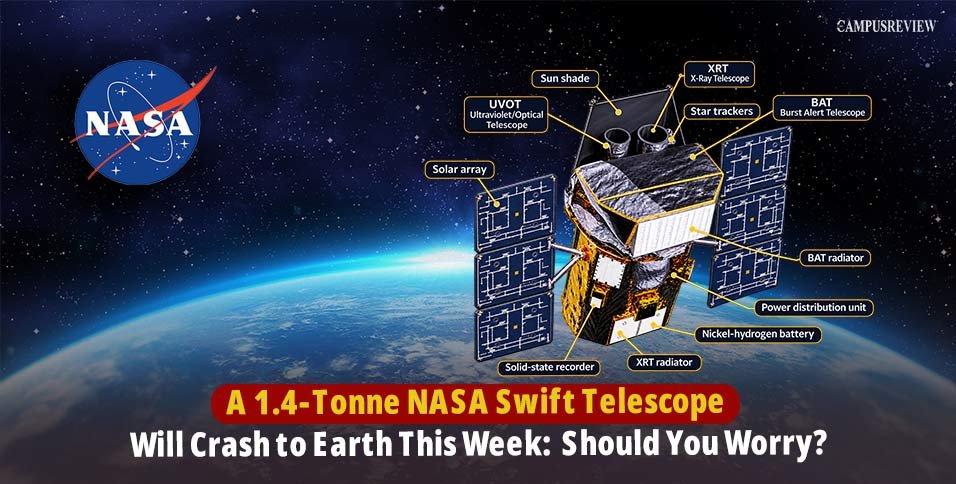
NASA’s Swift Telescope is expected to fall back to Earth in early November 2026 after more than 21 years in orbit. The space telescope will make an uncontrolled re-entry, meaning scientists cannot determine its exact landing point in advance.
Most of the spacecraft is expected to burn up in the atmosphere. However, some heavy components could survive and reach the ground. Its orbital path also places several countries across different continents within the broad potential debris zone.
At a Glance: Key Facts About NASA’s Swift Re-Entry
| Detail | Information |
| Spacecraft | Neil Gehrels Swift Observatory |
| Launch date | November 20, 2004 |
| Approximate mass | 1,470 kg |
| Science operations ended | October 23, 2026 |
| Lowest reported altitude | 275 km on October 20, 2026 |
| Re-entry type | Uncontrolled |
| Possible debris zone | Between 20.6°N and 20.6°S |
When Will NASA Swift Space Telescope Re-Enter Earth?
Forecasts place Swift’s re-entry in the first week of November, although the predicted time continues to change.
- The Aerospace Corporation: Estimated a window from November 3 at 2:30 a.m. to November 5 at 4:30 a.m. Eastern Time.
- NASA’s Space Weather Operational Readiness Development Center: Forecast a 24-hour window beginning November 3 at 12:18 a.m. Eastern Time.
- Associated Press reporting: Put the expected return around November 6.
These are estimates, not confirmed timings. Changes in atmospheric conditions can shift the forecast.
Where Could NASA’s Swift Space Telescope Debris Fall?
Swift’s orbital inclination is approximately 20.6 degrees. Its ground track can therefore extend between 20.6° north and 20.6° south latitude.
This broad band crosses parts of several continents, including:
| Region | Countries and areas within the broad latitude band |
| North America | Southern Mexico, Guatemala, Honduras, Nicaragua, Costa Rica and Panama |
| South America | Colombia, Venezuela, Ecuador, Peru, Bolivia, Brazil, Paraguay and northern Chile |
| Africa | Senegal, Ghana, Nigeria, Cameroon, Democratic Republic of the Congo, Kenya, Tanzania and Madagascar |
| Asia | India, Sri Lanka, Bangladesh, Thailand, Cambodia, Vietnam, Malaysia and Indonesia |
| Oceania | Northern Australia and parts of nearby Pacific island regions |
In India, Mumbai, Hyderabad, Bengaluru and Chennai fall within Swift’s broad potential debris zone. Delhi, Kolkata and much of northern India lie outside this latitude band. Being within the zone does not mean debris will land in these cities.
Important: This list identifies areas within the possible orbital latitude range, not confirmed debris landing locations.
Swift could pass over these places, but its actual re-entry point and the direction in which surviving fragments travel cannot be known precisely in advance. Much of the potential ground track also passes over oceans.
Why Is NASA Swift Telescope Falling Back to Earth?
Swift has spent more than two decades studying gamma-ray bursts and other powerful cosmic events. However, increased solar activity has heated and expanded Earth’s upper atmosphere.
This has increased atmospheric drag on the spacecraft, slowing it down and lowering its orbit.
The process is straightforward:
- Solar activity increases: The upper atmosphere expands as it absorbs more solar energy.
- Atmospheric drag rises: Swift encounters more resistance as it travels through the expanded atmosphere.
- Its orbit drops: The spacecraft gradually loses altitude.
- The spacecraft enters safe mode: At around 275 km, Swift could no longer compensate for the increased drag and maintain stable pointing.
NASA ended Swift’s science operations on October 23, 2026.
Reflecting on the mission’s natural conclusion, Penn State astronomer John Nousek noted the inevitable physics of orbit:
“We’ve known this day would come since before Swift was launched. At least in low-Earth orbit, what goes up must come down. And that end is catastrophic.”
Why Did the Attempt to Rescue Swift Fail?
NASA and Katalyst Space Technologies attempted to extend Swift’s life through a rescue mission called LINK. The spacecraft launched on July 3, 2026, aboard a Pegasus XL rocket.
LINK was designed to approach Swift, attach to it using robotic arms, and raise its orbit.
However, technical problems prevented the planned capture and boost.
- An electrical power fault left two of LINK’s three reaction wheels unavailable.
- The spacecraft used its remaining reaction wheel and thrusters to recover attitude control.
- Its Hall-effect thrusters helped reduce its rotation, but the recovery process consumed significant propellant.
- LINK approached Swift to within approximately 12–15 km and conducted proximity and technology demonstrations.
- NASA and Katalyst cancelled the capture and orbit-raising objective on August 19, 2026.
- LINK re-entered Earth’s atmosphere on September 25, 2026.
The failed rescue meant Swift would continue towards an uncontrolled re-entry.
What Parts of Swift Could Survive Re-Entry?
Most of Swift’s structure is expected to burn up as it passes through the atmosphere. However, some dense and heat-resistant components may survive.
Possible surviving components include:
- Tungsten parts: Their high density and heat resistance make some pieces potential survivors.
- Reaction wheels: These heavy components may withstand parts of the re-entry process.
- Optical components: Some mirror and telescope parts could potentially reach the ground.
Swift also carries a lead-tile mask containing approximately 52,000 tiles. These tiles are expected to melt during re-entry.
NASA has not released a detailed Swift-specific casualty-risk assessment. The often-cited 1-in-10,000 figure is a general NASA orbital-debris safety requirement, not a confirmed estimate of the risk from Swift.
What Did NASA Swift Telescope Discover?
Since its launch in 2004, NASA’s Swift has helped scientists study some of the universe’s most energetic events.
Its achievements include:
- Detecting more than 2,000 gamma-ray bursts.
- Observing approximately 1,400 supernova explosions.
- Studying stars being torn apart by black holes.
- Tracking comets, asteroids and active galaxies.
Swift also sends alerts to observatories such as the Hubble and James Webb Space Telescopes, allowing scientists to investigate cosmic events soon after they occur.
Its return to Earth will end a mission that has helped researchers understand powerful and short-lived events across the universe.
Pranjal Kharche