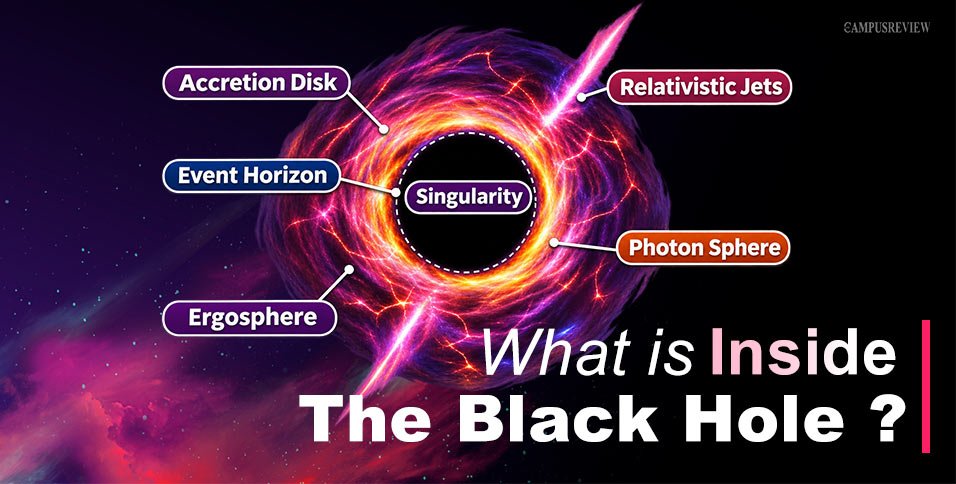
You cannot see inside a black hole. No telescope or probe can look beyond its edge. Yet scientists have developed theories to explain what happens inside a black hole.
Inside the event horizon, space-time bends so strongly that every path leads inward. At the center lies the singularity, where our current understanding of physics breaks down. The space between them is curved, not a solid ball of matter.
Based on Einstein’s theory of general relativity, this guide explains black hole structure, what happens to falling matter and the mysteries scientists are still trying to solve.
What Is Inside a Black Hole?
A black hole holds an event horizon, a singularity, and mostly empty, bent space-time in between. That is the standard answer in general relativity. A black hole is not a tunnel packed with matter. It is a region where gravity wins every race.
Most black holes form when massive stars collapse, crushing their cores into extremely small spaces. Their gravity becomes so strong that not even light can escape.
Inside a black hole, even the direction of time changes. UC Davis astrophysicist Brenna Mockler explains that moving toward the center becomes as unavoidable as moving toward tomorrow. No matter which direction you turn, the center remains in your future.
A black hole is not actually a hole. NASA describes it as an enormous amount of matter packed into a tiny space. Physicist John Wheeler popularized the name in the 1960s.
What Are the Main Parts of a Black Hole?
A black hole has several key features that shape its structure and behaviour. Understanding these parts helps explain what happens inside a black hole, from the moment matter crosses its boundary to its journey toward the center.
| Part | What it is | Can we observe it? |
| Accretion disk | Hot, glowing gas that circles outside the black hole | Yes |
| Shadow | The dark patch in telescope images | Yes |
| Event horizon | The point of no return | Only its effects |
| Interior | Bent space-time, mostly empty | No |
| Singularity | The center, where known physics breaks | No |
What Happens Inside a Spinning Black Hole?
Most real black holes spin. In 1963, mathematician Roy Kerr developed a model to explain how a rotating black hole behaves.
Unlike a non-spinning black hole, the Kerr model has two horizons:
- Outer horizon: The point beyond which nothing can escape.
- Inner horizon: A deeper boundary inside the black hole.
The singularity also changes shape. Instead of a point, it becomes a ring.
The mathematics suggests that a traveler might pass through the ring and reach another region of space-time. However, scientists believe this may not happen in reality.
Light and matter can build up near the inner horizon, making it unstable. This process is called mass inflation and could destroy any possible route to another universe.
In short: A spinning black hole may look like it offers a way to another universe in theory, but real black holes are unlikely to allow it.
Key Components Inside a Black Hole
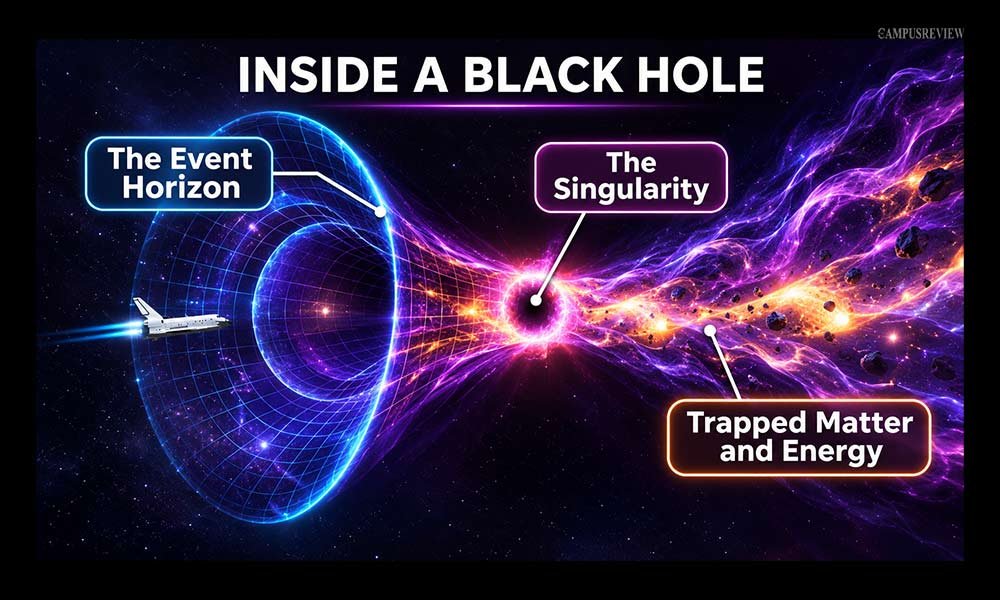
Three pieces explain most of the physics about what happens inside the black hole: the horizon, the center, and the matter in between.
The Event Horizon
The event horizon is the point of no return. It is not a physical wall or surface. Once you cross it, escaping would require moving faster than light, which is impossible.
Consider these facts:
- Sagittarius A*: The supermassive black hole at the centre of our galaxy has about 4.3 million times the Sun’s mass.
- Its size: Its event horizon spans roughly 16 million miles (25 million km), about 17% of the Earth-Sun distance.
- What you experience: At a supermassive black hole, you could cross the event horizon without noticing anything unusual.
- What an outside observer sees: You appear to slow down, turn red and gradually freeze near the event horizon.
How Does a Black Hole’s Size Affect You?
A small, stellar-mass black hole has much stronger tidal forces near its event horizon. These forces can stretch and tear an object apart before it crosses the boundary.
A supermassive black hole has weaker tidal forces at the horizon. You could survive the crossing, but the forces would become stronger as you travelled deeper inside.
The Singularity
The singularity is the center of a black hole, where density and space-time curvature become infinite according to general relativity. It is not necessarily a physical object. It marks the point where our current understanding of physics breaks down.
Here is what scientists know:
- An extreme center: In the simplest black hole model, the singularity has infinite density and curvature.
- An unavoidable destination: Once matter crosses the event horizon, it eventually reaches the singularity.
- A limit of physics: General relativity cannot explain what happens at the singularity.
- An unanswered question: Many physicists believe quantum mechanics may provide a better explanation and resolve the apparent infinities.
Roger Penrose and Stephen Hawking proved that singularities arise from gravitational collapse under broad conditions. Their work showed that singularities are not just mathematical curiosities, but a serious prediction of general relativity.
Trapped Matter and Energy
Anything that crosses the event horizon is pulled toward the center and cannot escape. In NASA’s simulation, a camera falling into a black hole reaches its destruction just 12.8 seconds after crossing the horizon. The center is about 79,500 miles (128,000 km) away.
Why does the black hole keep its gravity?
- The star that formed the black hole collapsed long ago.
- Its mass shaped the surrounding space-time.
- That curved space-time continues to produce gravity.
- Any new matter or light crossing the horizon is pulled inward.
The Strange Mystery of a Black Hole’s Growing Interior
Surprisingly, the interior of a black hole keeps growing. Research by physicists Christodoulou and Rovelli suggests that a black hole’s interior volume can grow even when its event horizon stays the same size.
This means the space inside a black hole can become larger over time without its visible boundary expanding.
What Happens to Matter Inside a Black Hole?
Gravity stretches it, shreds it, and pulls it into the singularity within moments. Physicists call the stretching spaghettification. The pull on the near end of an object is far stronger than the pull on the far end. The object grows longer and thinner while the sides squeeze in.
The scale of the black hole decides when this happens.
| Black hole type | Example | Mass | Before crossing the horizon | Time to reach the center |
| Stellar-mass | Cygnus X-1 | 21 times the Sun’s mass | Strong gravity can tear you apart before you enter. | Less than a second |
| Supermassive | Sagittarius A* | 4.3 million Suns | You may cross without noticing anything unusual. | About 13 seconds |
| Giant | M87* | 6.5 billion Suns | Weaker gravitational stretching lets you cross more safely. | Several hours |
The times are illustrative estimates, not universal values. They depend on the black hole and the falling object’s path.
As you approach the center, tidal forces become stronger. They can:
- Tear molecules apart.
- Break atoms into smaller particles.
- Push matter into conditions that current physics cannot explain.
Scientists still do not know what happens at the singularity.
How Does Time Behave Near a Black Hole?
- For you: You cross the event horizon in finite time.
- For distant observers: You appear to slow down and fade near the horizon.
- For light: You can still see light from the outside universe as you fall in.
A NASA simulation found that an astronaut making a six-hour close approach and returning would be 36 minutes younger than crewmates who stayed farther away.
Inside a Black Hole: Empty Space or Hidden Matter?
In Einstein’s theory, most of the space inside a black hole is empty. Many people imagine a black hole as a solid ball filled with extremely dense matter. However, scientists describe it differently.
In 1939, physicists J. Robert Oppenheimer and Hartland Snyder studied how a massive star collapses into a black hole. As the star collapses, its outer surface passes through the event horizon, and its matter moves toward the center. This leaves most of the space inside the black hole empty.
But if the inside is empty, where does the gravity come from?
Gravity comes from the way the collapsed star bends space-time. This curved space-time continues to produce the black hole’s gravitational pull.
However, this is only the traditional explanation based on Einstein’s theory. Scientists still cannot explain what happens at the center, where the equations predict infinite density. This has led physicists to develop other ideas about what might exist inside a black hole.
| Theory | Scientists behind it | What it suggests | Status |
| Classic model | Schwarzschild, Oppenheimer and Snyder | Mostly empty space with a singularity at the center. | Fits outside observations, but the interior remains untested. |
| Regular black hole | Bardeen, Hayward and others | A smooth core instead of a singularity. | Theoretical |
| Gravastar | Pawel Mazur and Emil Mottola | A dark-energy-like core instead of a traditional black hole interior. | Theoretical |
| Fuzzball | Samir Mathur | The interior is filled with tangled strings rather than empty space. | Theoretical |
| Planck star | Carlo Rovelli and Francesca Vidotto | Matter collapses and eventually bounces back out. | Theoretical |
Each theory offers a different explanation of what might exist inside a black hole. However, none has been confirmed through observations.
Can Scientists See Inside a Black Hole?
Scientists cannot directly see inside a black hole because nothing, not even light, can escape its event horizon. Instead, they study black holes using telescopes, gravitational waves and computer simulations.
Two major tools help researchers:
| Tool | What it revealed |
| Event Horizon Telescope (EHT) | Captured images of the black hole shadows of M87* (2019) and Sagittarius A* (2022). |
| LIGO | Detected gravitational waves from two merging black holes in 2015, helping scientists study their mass and spin. |
The EHT connects radio telescopes worldwide to create an Earth-sized virtual telescope. Its images show a dark shadow surrounded by glowing light, not the black hole’s interior.
LIGO detects ripples in space-time produced by merging black holes. These signals reveal information about the black holes but cannot show what happens inside.
Scientists also use mathematical models and computer simulations. NASA’s black hole falling-camera simulation took five days to create using the Discover supercomputer.
The Biggest Mysteries Scientists Are Still Trying to Solve
Scientists understand how black holes behave from the outside, but their interiors remain a mystery. The biggest challenge is understanding how gravity and quantum mechanics work together. Three major questions remain.
The Black Hole Information Paradox
In 1974, physicist Stephen Hawking discovered that black holes can slowly release radiation and eventually shrink. This raised a major problem: what happens to the information about everything that falls inside?
Quantum mechanics says information cannot simply disappear. This conflict is known as the
black hole information paradox.
In 2019, researchers made progress using a concept called quantum islands. Their calculations suggested that information could be preserved in the radiation. However, scientists are still working to understand exactly how this happens.
The Mystery Behind the Singularity
Does every black hole have an infinitely dense center? Scientists are not sure.
Two theories offer different possibilities:
- Fuzzball theory: The center may not exist as a singularity. Instead, strings could fill the black hole.
- Loop quantum gravity: Matter may eventually stop collapsing and bounce back instead of reaching infinite density.
Neither idea has been confirmed through observations.
The Possibility of Black Holes Without Horizons
Some scientists have proposed alternatives called gravastars. These objects could have a dense, dark-energy-like core without a traditional event horizon.
However, current observations are consistent with ordinary black holes. Scientists need better evidence to determine whether these alternatives exist.
Final Words
What Happens Inside a Black Hole? Today’s best answer is a one-way region of bent space-time that ends at a singularity. The black hole interior is mostly empty, and matter that falls in reaches the center fast. Our theories fail at that center. That failure is exactly why the field is so exciting. Every new image, wave, or calculation tests an idea that no one can visit in person.
- The event horizon is a point of no return, not a solid surface.
- The singularity marks where general relativity stops working.
- No instrument can look inside, so scientists rely on math and outside clues.
- Quantum ideas like fuzzballs and islands may soon rewrite the picture.
Start with a NASA simulation, read from the trusted sources below, and follow the next discovery as it arrives.
Pranjal Kharche
Also read – How to Write a Case Study: A Step-by-Step Guide With Examples and Tips