
Your case study is finished, but the formatting is a mess. Sound familiar? Here is the quick answer. An APA format case study follows APA 7th Edition rules for layout and citations. Your subject and your instructor decide the sections inside it.
APA Style, from the American Psychological Association, controls margins, fonts, headings, and references. It does not give one fixed case study template. That gap confuses many students.
This guide covers nine common sections, five heading levels, citations, references, and a complete fictional clinic case study with examples. Always follow your instructor’s requirements.
What Is an APA Format Case Study?
A case study is a close look at one person, group, company, or event. You study a real situation in detail. You explain what happened, why it happened, and what should happen next.
Students write case studies in business, nursing, psychology, education, and social work. Researchers describe the method as an in-depth study of a current situation in its real-world setting (Yin, 2018).
APA Formatting Requirements
These rules apply to papers following the current APA 7th Edition guidelines, from the title page to the final reference. Use this checklist to format your paper correctly.
- Margins: Set 1 inch (2.54 cm) on all four sides.
- Font: Pick one readable font and use it everywhere. Good choices are 11-point Calibri, 11-point Arial, 10-point Lucida Sans Unicode, 12-point Times New Roman, 11-point Georgia, and 10-point Computer Modern. Your instructor may name a font.
- Line spacing: Double-space the whole paper. Do not add extra blank lines between paragraphs or headings.
- Alignment: Align text to the left. Leave the right edge uneven. Do not justify text.
- Paragraph indent: Indent the first line of each paragraph by 0.5 inch. Press the Tab key.
- Page numbers: Put them in the top right corner. Start with 1 on the title page.
- Running head: Skip it in a student paper unless your instructor asks. Professional papers need one.
Most students use the APA student paper format for college assignments and coursework. Professional papers are generally prepared for academic publications and research purposes.
They may include a running head and author note. Always check your instructor’s requirements before choosing a format.
What Is the Structure of an APA Format Case Study?
Most case studies use the nine parts below. This is the common APA case study structure and case study writing format.
| Sections |
| 1. Title page |
| 2. Abstract |
| 3. Introduction |
| 4. Case background |
| 5. Methodology and analysis |
| 6. Findings or results |
| 7. Discussion and recommendations |
| 8. Conclusion |
| 9. References |
1. Title Page
An APA student title page includes seven key elements. Add the following details in the order shown:
- Title: Bold, centered, and in title case. Place it three or four lines below the top margin.
- Your name: Centered, one blank line below the title.
- Affiliation: Your department and university.
- Course: Course number and name.
- Instructor: Name with a title, such as Dr.
- Due date: Month, day, and year.
- Page number: Top right corner, starting at 1.
| Example (fictional student):Slow Check-Ins After a Software Switch: A Case Study of Delta HealthTaylor A. MorganDepartment of Health Sciences, Midwestern State UniversityHCA 401: Healthcare Systems AdministrationDr. Evelyn VanceOctober 24, 2026 |
2. Abstract
An abstract is a brief summary of your paper that highlights its main purpose, key points, methods, and findings. It helps readers understand what your paper covers before reading the full content.
Most APA student papers do not require an abstract unless your instructor asks for one.
- Start on page 2.
- Center and bold the word Abstract.
- Write one paragraph. Do not indent it.
- Keep it between 150 and 250 words.
- Cover the problem, method, main findings, and conclusion.
- Add keywords on a new line. Indent the line, italicize Keywords:, and use lowercase terms.
| Example:This case study explains why patient check-in times rose after a clinic changed its record system. It uses staff interviews and clinic records. The study finds that poor message routing caused the delays. Keywords: case study, electronic health records, change management |
3. Introduction
In APA format case study, you do not need to add a separate Introduction heading. Your opening paragraph serves as the introduction.
Start the first text page by repeating your paper title in bold, centered, title case. Begin your introduction in the next line and include the following points:
- The topic and background
- The problem
- The purpose of the case study
- Your research question
| Example:Delta Health is a small clinic network. Check-in times rose after a new record system started. This case study asks one question: Why did the new system slow patient care? |
4. Case Background
The case background explains the situation leading up to the main problem. It gives readers the context they need to understand the case. Use a Level 1 heading, such as Case Background, and include the following points:
- The history of the person, group, or company
- Key people, teams, and rules
- A short timeline
- Starting numbers and facts
Protect privacy. Use pseudonyms or hide details that identify people, unless you have written permission.
| Example:The clinic opened in 1984. It serves about 35,000 residents in three counties. |
5. Methodology and Case Analysis
This section explains how you examined the case, what information you used, and how you analysed the problem. Use a Level 1 heading, such as Methodology and Case Analysis, and cover the following points:
- Research design: for example, a single-case study.
- Data collection: interviews, observations, and records.
- Framework: a tool such as SWOT analysis or thematic analysis.
Some courses skip this section for pre-written business cases. Check your rubric. Use Level 2 headings for parts, such as Data Collection.
| Example:The researcher used a single-case study, interviewed 10 employees, and applied SWOT analysis to identify the company’s key challenges. |
6. Findings or Results
This section presents the main findings from your case study. Report the results clearly, using facts and evidence rather than personal opinions. Use a Level 1 heading, such as Findings or Results, and include the following points:
- Your main findings
- The evidence behind them
- Patterns across the data
- Numbers in APA tables, not long lists
Quote participants when a quote helps. APA does not ask for an in-text citation or a reference entry for quotes from your own participants. Just state that the quote comes from a participant.
7. Discussion and Recommendations
This section explains the importance of your findings and connects them to previous research. It also suggests practical ways to address the problem. Use a Level 1 heading, such as Discussion and Recommendations, and Level 2 headings to separate the two parts:
- Discussion: Explain what the findings mean and compare them with earlier research. Cite relevant sources.
- Recommendations: Suggest practical steps to solve the problem or improve the situation.
Observation-only cases may not need recommendations. However, business and healthcare cases usually benefit from them.
8. Conclusion
This section brings your case study to a close by highlighting the main lesson from your findings. Briefly mention one limitation, such as studying only one organisation, and suggest what future research could explore.
Do not introduce new data, arguments, or sources. Short decision memos may end with recommendations instead of a separate conclusion.
9. References
Start the references on a new page with References centered and bold at the top. Double-space all entries and arrange them alphabetically by the first author’s last name.
Apply a 0.5-inch hanging indent to each entry. Include only sources cited in your paper. Do not include interviews with your own participants, as these are treated as personal communications in APA style.
How to Use APA Headings in a Case Study
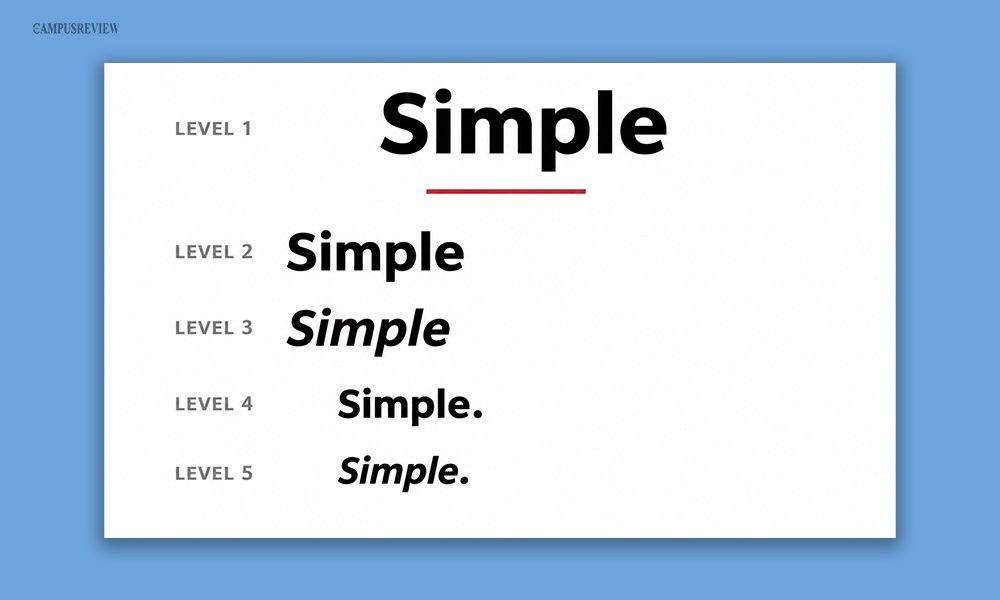
Many students struggle with headings. Five APA heading levels exist. This table shows the format of each level.
| APA heading level | Formatting |
| Level 1 | Centered, Bold, Title Case |
| Level 2 | Left-Aligned, Bold, Title Case |
| Level 3 | Left-Aligned, Bold Italic, Title Case |
| Level 4 | Indented, Bold, Title Case, Ends With a Period |
| Level 5 | Indented, Bold Italic, Title Case, Ends With a Period |
- Never skip a level. Do not jump from Level 1 to Level 3.
- Use at least two headings at any level. One lone subheading breaks the rule.
- Text after Levels 1 to 3 starts on the next line.
- Text after Levels 4 and 5 starts on the same line, right after the period.
From top to bottom, these lines show Levels 1 to 4. In a real paper, each level needs at least two headings.
How to Write APA In-Text Citations in a Case Study
APA citation style uses the author-date system. Cite every quote, paraphrase, number, and idea that comes from a source. APA in-text citations come in two forms.
- Parenthetical: Put the author and year in brackets.
Example: New computer systems can create new safety risks (Koppel et al., 2005).
- Narrative: Use the author’s name in your sentence. Example: Koppel et al. (2005) found 22 types of medication error risks linked to one hospital order entry system.
How do you cite multiple authors?
Two authors: Use “and” in a sentence and “&” in brackets. Example: Braun and Clarke (2019) explain reflexive thematic analysis. Or: (Braun & Clarke, 2019).
Three or more authors: Write the first author plus et al. from the very first citation. Example: (Koppel et al., 2005). Always put a period after al.
Group author: Spell out the name the first time and add the abbreviation. Example: (American Psychological Association [APA], 2020). Later, write (APA, 2020).
Several sources: List them alphabetically and separate them with semicolons. Example: (Braun & Clarke, 2019; Koppel et al., 2008; Weick, 1995).
How do you handle quotes and paraphrases?
- Short quote (under 40 words): Use quotation marks and add a page number. Pattern: (Author, 2020, p. 12).
- Long quote (40 words or more): Start a new line and indent the block 0.5 inch. Skip the quotation marks. Place the citation after the final punctuation.
- Paraphrase: Explain the idea in your own words and add the author and year.
- Participant quote: Add no citation. Say the quote comes from a participant.
How to Format the APA Reference List
The APA reference page lists every source you cite. Follow these rules:
- Start on a new page.
- Center and bold the word References.
- Double-space everything. Add no extra blank lines.
- Sort entries alphabetically by the first author’s last name.
- Add a 0.5-inch hanging indent. The first line stays at the margin. Later lines move in.
- Order works by the same author from oldest to newest.
- Write DOIs and URLs as full links that start with https://.
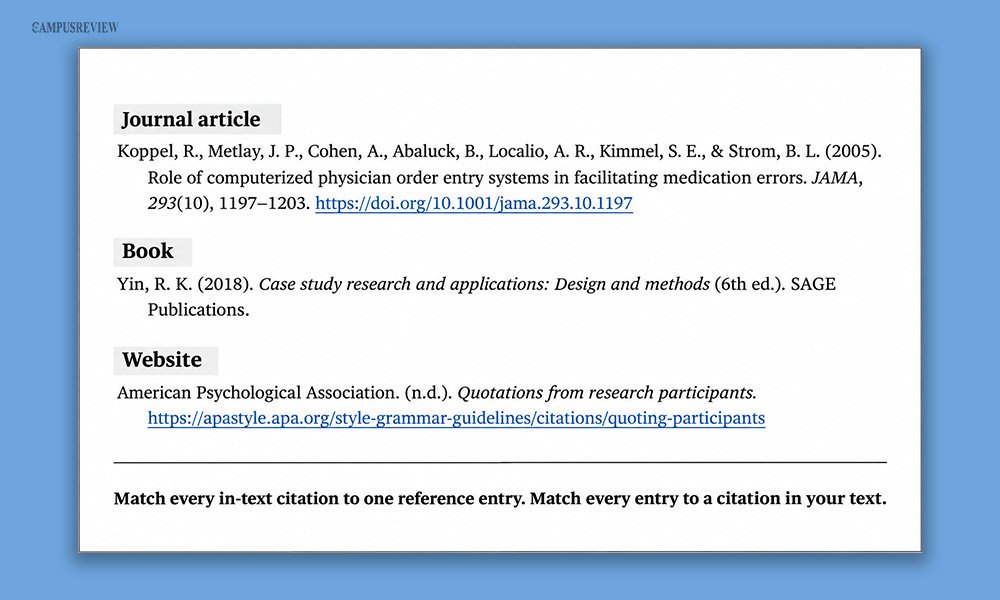
Here is one verified example for each source type. Italicize the book title, the journal name, the volume number, and the webpage title.
APA Format Case Study Example
Below is a short academic case study example of APA format case study. Improving Study Habits to Support Academic Performance, and all numbers are fictional.
Where can you get trusted help?
APA Style website: The American Psychological Association offers free student paper setup guides and sample papers at apastyle.apa.org.
Purdue OWL: This free writing lab explains APA 7th Edition with clear examples.
Your university writing center and library: Staff can review your draft and answer rubric questions.
Final Words
An APA format case study combines APA layout rules with the sections your assignment needs. Use APA 7 for margins, fonts, headings, citations, and references. Use your rubric to choose the sections.
Start with the title page, write each section under a Level 1 heading, cite as you go, and check the reference list last. When a rule is unclear, ask your instructor before you submit.
Pranjal Kharche