You have three assignments due. An exam is next week. Somehow, the day still slips away. This is not unusual. Most students face it. But the real issue is not time itself.
Every student gets the same 24 hours. The students who manage well are not necessarily more motivated. They run a system, and they follow it even on days when motivation is low.
Most students plan their day around whatever feels urgent that morning. There is no order, no clear structure, just one task pulling them toward the next.
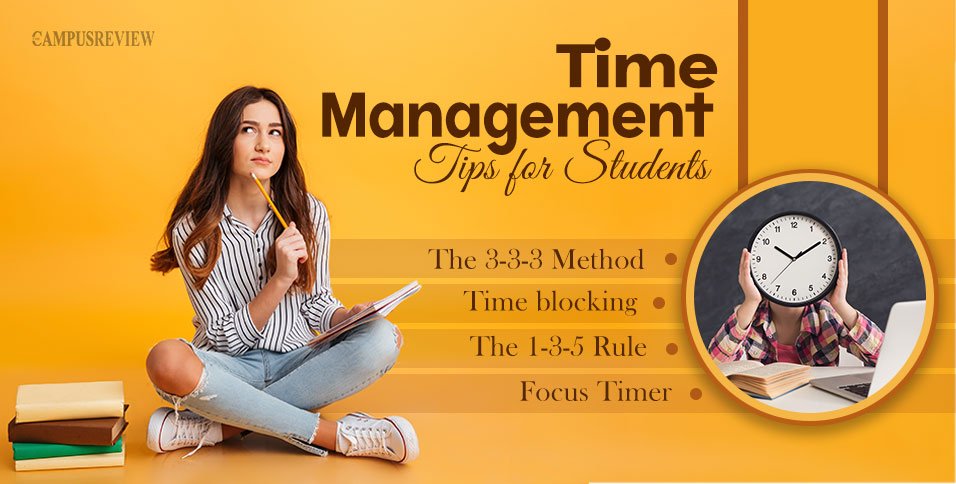
This guide will show simple time management tips for students, proven time management techniques, and practical steps for exams so that you can manage time effectively.
Understanding Your Time First
Before you read these Time Management Tips for Students, it is important to first understand where your time actually goes.
Most students feel they do not have enough time. But the real problem is time leaks. Small habits slowly reduce your productive hours.
Common time leaks:
- Phone scrolling between study sessions
- Delaying hard subjects
- Multitasking during study hours
- No clear plan for the day
Multitasking feels productive, but it is not. Your brain cannot focus on two hard tasks at once. When you switch between studying and texting, your focus breaks again and again.
This creates attention residue. It lowers focus and slows your work. Studies show it can reduce productivity by up to 40 percent.
Try this today:
Write down:
- What do you do each hour?
- When you switch tasks?
- When you lose focus?
Do not change your habits yet. Just observe.
This simple exercise shows where your time really goes. Now, let’s explore Time Management Tips for Students
8 Time Management Tips for Students
Now, let us break this down into simple and practical steps.
1. Use the 1-3-5 Rule for Daily Tasks
The 1-3-5 Rule is the best technique to manage time effectively. It splits your day into one big task, three normal study tasks, and five small support tasks, so you always know exactly what to do next instead of guessing or switching between things.
How to implement it:
Every morning, write your tasks in this format:
1 major task: This is your most important work for the day. It takes deep focus. Example: writing an essay draft or solving a full math problem set.
3 medium tasks: These are important but not heavy tasks. Example: completing a worksheet, revising one chapter, or preparing notes.
5 small tasks: These are quick tasks that support your day. Example: replying to emails, organizing your desk, or reviewing flashcards.
Once you fill all nine slots, stop adding more tasks. Do not expand the list. Stick to what you planned.
2. Block Your Time
A to-do list only tells you what needs to be done, but it doesn’t tell you when to do it. That’s why most tasks get delayed or pushed to later in the day.
Time blocking fixes this by turning your tasks into fixed time slots so your day becomes structured instead of random.
How to implement it:
Open your calendar or planner and assign each task a specific time instead of writing it as a loose goal. For example, instead of writing “study math,” block 9:00 AM to 10:00 AM and write “solve math problems.” Do the same for other tasks, like 2:00 PM to 3:30 PM for “read history chapter.”
Treat each block like a real class or appointment. Once a time slot is fixed, do not move it unless necessary. This helps you stop guessing what to do next and builds a clear study routine for your day.
3. Protect 3 Hours for Deep Work (The 3-3-3 Method)
This method fixes your schedule by giving your day a clear structure instead of scattered study time.
You divide your day into three clear parts:
- 3 hours for deep study
- 3 small admin tasks
- 3 personal tasks
How to implement it:
Start by blocking 3 uninterrupted hours in your day for your hardest academic task. Use this time only for deep work like solving long problem sets, writing assignments, or studying difficult chapters.
After that, complete 3 small admin tasks such as updating notes, organizing your study material, or checking deadlines.
Finally, add 3 personal tasks like a walk, exercise, meals, or rest. This is important because it prevents burnout and keeps your study routine sustainable.
4. Use a Focus Timer That Fits the Task
A focus timer solves this by breaking study time into structured sessions so your brain can stay sharp and consistent.
Different tasks also need different focus lengths. Short tasks work better in quick bursts, while deep tasks need longer, uninterrupted time to build real understanding.
How to implement it:
Choose your timer based on the type of work you are doing:
| Method | Work Time | Break Time | Best For |
| Pomodoro | 25 min | 5 min | Flashcards, quick revision, small tasks |
| 52/17 Rule | 52 min | 17 min | Essays, problem sets, and focused study |
| Flowtime | Until focus drops | Short break after | Deep reading, research, and long writing |
Use Pomodoro for small or low-energy tasks, 52/17 for heavy focused study sessions, and Flowtime when you are fully engaged in deep work.
5. Sort Tasks With the Eisenhower Matrix
The Eisenhower Matrix helps you separate what truly needs your attention from what can wait or be removed completely.
You sort every task based on two factors: urgency and importance.
This creates four clear categories, so you stop reacting to everything at once and start focusing on what actually matters.
How to implement it:
Draw a simple four-box grid and place your tasks into it:
| Urgent | Not Urgent | |
| Important | Do it now (e.g., assignment due tomorrow) | Schedule it (e.g., weekly study for exams) |
| Not Important | Delegate it (e.g., group coordination emails) | Drop it (e.g., unnecessary browsing or organizing old files) |
Focus most of your energy on the “Important but Not Urgent” box. This is where consistent studying happens and where most students lose control, leading to last-minute stress.
6. Remove One Distraction at a Time
Most students try to fix all their distractions at once and end up failing within a few days. When you change too many habits together, your brain feels overloaded, and your focus drops quickly.
Trying to remove everything at the same time also creates mental pressure and decision fatigue.
But when you remove just one major distraction, your focus improves immediately, and the habit becomes much easier to stick to.
How to implement it
Start by identifying your biggest distraction, usually your phone. During study time, remove it completely from your space or switch it off so you are not tempted to check it.
Stick to this one change for a few days before adding anything else. Once this becomes normal, you can move on to the next distraction.
7. Plan Your Week
Using time management tips for students, like weekly planning, helps you see your full workload clearly so exams, assignments, and free time feel controlled instead of rushed. Daily planning keeps you reactive because you only think about today.
Weekly planning gives you a 7-day view so you can spread tasks properly and avoid last-minute pressure.
How to implement it:
Spend 15 minutes every Sunday reviewing your full week. Check your syllabus, upcoming exams, assignment deadlines, and any fixed commitments.
First, place big tasks like exams and submissions on your calendar. Then fill in smaller study tasks around them so your week feels balanced instead of rushed.
8. Run a 10-Minute Weekly Review
Most students keep planning every week but never check what actually worked. Without reflection, even a good schedule slowly stops working and turns into a list of unfinished tasks.
A weekly review helps you pause and check your progress.
How to implement it:
Take 10 minutes on Friday or Sunday evening and review your week honestly. Ask yourself three simple questions:
- What did I actually finish?
- What got delayed and why?
- What should I change next week?
Write short answers in your notebook and adjust your next week’s plan based on them. This keeps your system realistic and helps you improve every week instead of repeating the same mistakes.
Time Management Tips for Students During Exams
Now that you understand the time management tips for students, it is important to shift focus toward managing time effectively during exam periods, when pressure, deadlines, and workload increase significantly.
- Build a revision plan
List every topic from your syllabus and track what you complete each day. Focus on finishing topics instead of just counting study hours.
- Prioritize weak subjects first
Mark your topics as red, yellow, and green. Spend most of your energy on red topics so you can improve weak areas before the exam.
- Practice with real mock tests
Solve past papers in a timed, exam-like setup. This helps you manage time better and reduces panic during the actual exam.
- Avoid last-minute cramming
Studying everything in one night increases stress and weakens memory. Short daily revision is more effective for long-term recall.
- Balance your revision schedule
Do not study only your favorite subjects. Rotate subjects daily so every topic gets equal attention before exams.
Student Time Management Tools
Important tools for time management that will help students.
| Category | Tools | What they do |
| Planning | Google Calendar, Notion | Help you schedule study time and track deadlines in a structured way. |
| Focus | Pomofocus, Forest | Help you maintain focus by using timed study sessions and reducing distractions. |
| Study | Quizlet, Anki, Grammarly | Help you revise efficiently and improve the quality of notes and writing. |
| Habits | Habit trackers, Notion, Sheets | Help you monitor daily consistency and build long-term discipline. |
7-Day Action Plan
Reading time management tips for students alone will not create results. You need to apply them through a structured action plan to build consistency and real improvement.
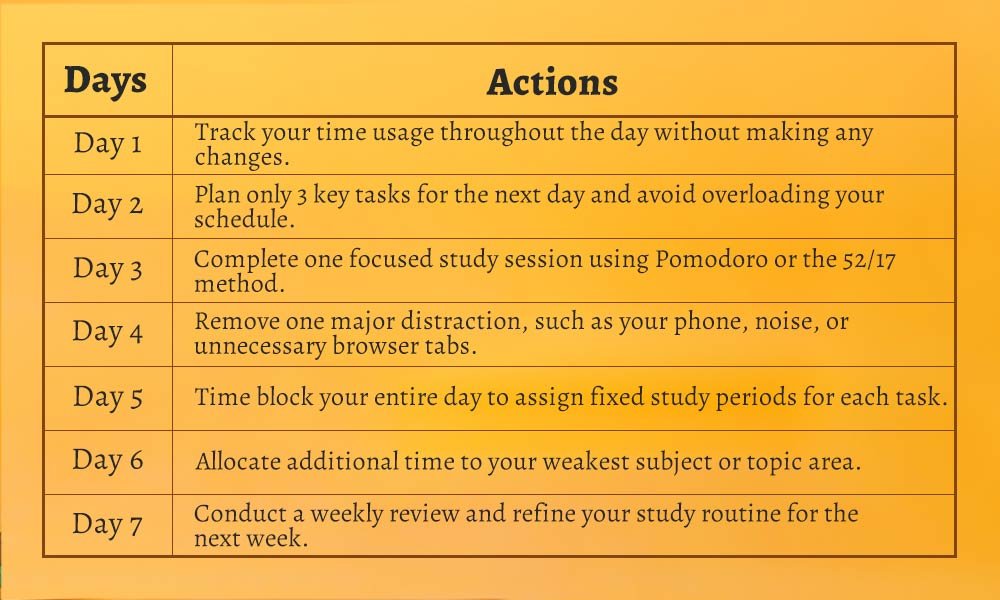
Maintain this system consistently each week until it becomes a stable part of your routine.
Conclusion
Time management is not about studying more hours. It is about using your time with a clear system. With the right Time Management Tips for Students, you can plan your day, block your study time, and focus on the right tasks so your workload feels lighter and more controlled.
Start small. Pick one method from this guide and apply it consistently. Over time, these small habits build structure, reduce stress, and improve your exam performance.
Once you manage your time well, exams stop feeling stressful and start feeling manageable.
Frequently Asked Questions
1. How many hours should a student study in a day?
There is no fixed number. What matters is focused study time. Even 3–5 hours of deep, distraction-free study can be more effective than 8–10 hours of unfocused learning.
2. What is the best time of day for studying?
Most students perform better when they study during their peak focus hours, often in the morning or early evening. The key is consistency, not a perfect time slot.
3. What are 5 effective time management tips for students?
The most effective tips include using structured daily planning methods like the 1-3-5 rule, time blocking your study schedule, prioritizing important tasks first, studying in focused time sessions, and planning your week instead of only focusing on daily tasks.
4. Should I study one subject per day or mix subjects?
Mixing subjects works better for most students. It improves memory and prevents boredom. However, during exams, you should prioritize subjects based on urgency and weak areas.
5. What should I do if I constantly fail to follow my study plan?
Start smaller. Reduce your daily plan, remove distractions first, and focus on consistency instead of perfection. A simple plan that you follow is better than a perfect plan you ignore.