We often associate college with new friends, knowledge, and fresh memories, which rings true for many. Still, a significant number of students are crushed under exams, extracurricular activities, assignments, and unrealistic expectations of parents and teachers, resulting in student burnout. The reality is more serious than most people acknowledge.
According to High5 Test studies, more than one in three college students have thought about dropping out within just the last six months alone. Burnout is no longer just a personal wellness issue; it has become a student retention crisis. The situation is equally alarming among adolescent girls, with 52.6% experiencing persistent sadness or hopelessness, meaning more than half are showing clear signs of burnout-linked emotional distress.
Moving to a different college sometimes leaves students with a completely new life, new people, and a new place. It can either help a student grow or leave them exhausted, both mentally and physically.
What is Student Burnout?
Burnout is a state where a student is exhausted both mentally and physically. It goes beyond a difficult week or a tough exam; it is a prolonged breakdown of energy, motivation, and emotional resilience. A student experiencing burnout often becomes unable to concentrate, loses interest in subjects they once enjoyed, and falls into patterns of negative self-talk, doubting their own abilities and worth.
Students who have constantly scored high marks and met the expectations of their parents can get overwhelmed by a single failure; such students are far more prone to burning out. According to Crowncounselling, 55% of students experience academic burnout, while 79% feel overwhelmed by academic workload. If you or someone you know is facing burnout, the following section can help you identify them early.
5 Signs of Student Burnout
Burnout does not announce itself all at once. It builds gradually through a combination of physical, emotional, and behavioural changes that are easy to dismiss early on. Below are the five most common signs that a student may be experiencing burnout.
1. Loss of Interest
Students experiencing burnout easily lose interest in subjects they once were excited to learn about. Even activities they once loved, like watching a favourite film or listening to music, start to feel empty and uninteresting.
2. Physical and Mental Exhaustion
Students can get sick often, experience headaches, and fatigue. Mental exhaustion can come in the form of anxiety, self-doubt, and helplessness.
3. Difficulty Concentrating
Students become incapable of focusing on day-to-day tasks due to constant pressure. They may zone out between lectures, stare at a textbook for long stretches without absorbing a single word, or miss deadlines despite their best intentions.
4. Losing Enthusiasm:
Students come with fresh minds and energy, but burnout can make them lose their spark. The activities and student clubs they once eagerly participated in no longer feel worth the effort.
5. Detachment from Family and Friends
Student burnout separates students from their loved ones. They feel exhausted from the expectations of family and the prospect of meeting friends that once brought joy begins to feel like another obligation they cannot face.
Causes of Academic Burnout
Understanding what causes burnout is just as important as recognising the signs. Burnout rarely happens for one reason; it is almost always the result of multiple pressures overlapping over time. Here are the most common causes.
- Academic stress:
Competitive exams, assignments, and constantly changing education policies create burnout. It depletes the energy of students.
- Lack of proper sleep:
Reducing sleep directly affects their ability to regulate emotions and amplify stress. Lack of sleep lowers their resilience, making it difficult for them to face failure.
- Disinterest in subjects:
In some cases, parents pressure their kids to choose particular subjects, but students who lack interest in that subject face difficulty in coping, which results in burnout.
- Lack of mentorship:
Mentors guide students in career decisions, and students share their concerns with mentors, providing them with a sense of being understood and supported. A student without mentorship develops loneliness and career stress.
- Managing multiple responsibilities:
Managing studies with internships or jobs takes most of the students’ time, leaving very little time to follow their interests and hobbies. This becomes overwhelming for students at some point.
7 Steps to Overcome Student Burnout
Recovery from burnout is not about doing more; it is about doing things differently. These seven steps are practical, manageable, and designed to help students rebuild their energy, motivation, and confidence one day at a time.
1. Set Boundaries and Manage Expectations
Learning to say no to unnecessary commitments is one of the simplest yet most powerful ways a student can protect their time and energy. Having clear boundaries about work and studies can easily help to differentiate whether a student should say yes or no. Expectations of parents and teachers create unnecessary stress; be clear about your capability to meet those expectations.
2. Set Realistic and Achievable Goals
Unrealistic goals create stress, and this stress soon gets converted into burnout. Realistic goals, on the other hand, provide confidence and a sense of achievement, which boost students’ interest and willingness to work. For example, aiming to improve one grade at a time is a realistic goal. Aiming to top every subject while managing a part-time job is not, and that gap between expectation and reality is where burnout begins.
3. Break Goals Into Smaller Tasks
Divide goals into small tasks and set deadlines for each task. For example, instead of writing “complete my science project” on your to-do list, break it down into:
- Find research sources — Day 1
- Make notes and outline — Day 2
- Write the first draft — Days 3 and 4
- Review and edit — Day 5
- Final submission — Day 6
Each task takes less than an hour. Progress feels visible and manageable every single day.
This approach helps to achieve goals without procrastinating and stressing about progress.
4. Follow the 42% Rest Rule
The 42% rest rule, developed by health researcher Emily Nagoski and music conductor Amelia Nagoski, states you must roughly dedicate 42% of your time, which is approximately 10 hours a day, to rest and recovery. It does not mean sleeping for 10 hours. Students should spend quality time with friends and family, build hobbies, and relax.
5. Eat Well and Exercise Regularly
As Dr Mark Hyman explains, “Food is not just a source of energy or calories. Food is information. It contains instructions that affect every biological function of your body.”
What we eat affects our thoughts and mind. A solid combination of good food and exercise reduces mental and physical exhaustion, directly reduces stress, and improves mood.
6. Reconnect With People You Trust
People who calm you are the best place to go for recovery. Expressing emotions reduces the heaviness a student is experiencing. Teachers and parents can guide in such situations, while friends can help ease negative emotions and remind you that you are not alone. Even a small chat with the people you trust helps recovery.
7. Build a Daily Routine With a Simple Checklist
Create a daily routine based on the tips mentioned above and follow this routine as consistently as you can. Below is the checklist that can help to track the daily progress of your routine.
Student Burnout Recovery Checklist
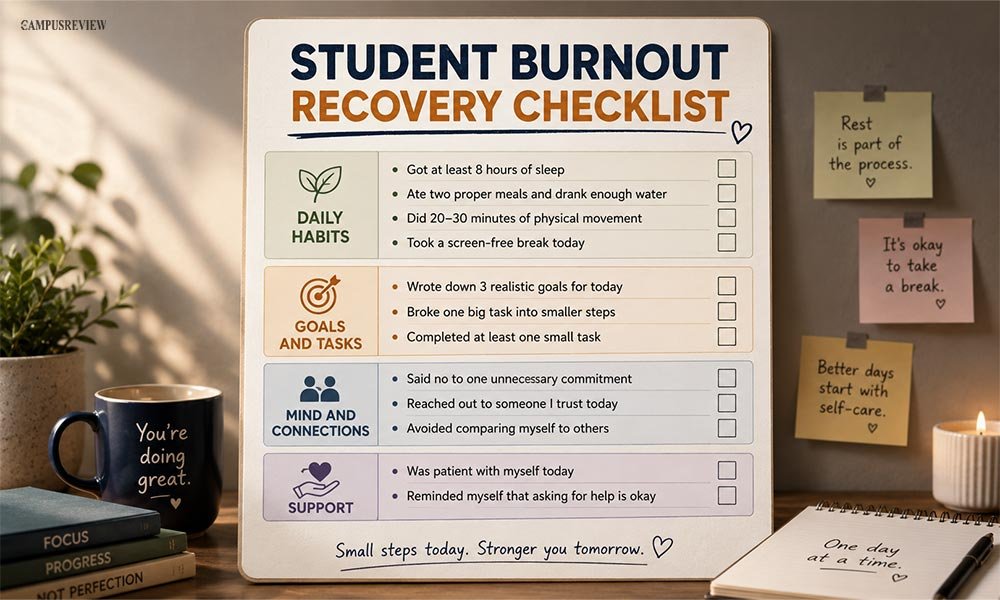
Recovery does not happen overnight. Work through it at your own pace, and trust the process.
Where to Get Help for Burnout in Students
Recovery does not always happen on your own, and it does not have to. If burnout is significantly affecting your studies, relationships, or daily life, reaching out for support is one of the most important steps you can take.
Talk to Someone at Your College First
Most universities have a counselling or student wellness centre on campus. Your academic advisor, a trusted lecturer, or a student support officer can point you in the right direction and may be able to help adjust your workload while you recover. Many schools are also increasingly using creative ways to support student mental health, from art therapy to music programs as part of their student wellness approach.
Dedicated Mental Health Support Services
- Befrienders Worldwide is a global emotional support network with volunteer-run centres in over 50 countries, including India, the UK, the USA, and Australia. If you are feeling overwhelmed, anxious, or burned out, trained volunteers are available to listen without judgment. Visit befrienders.org or search “Befrienders helpline” to find a centre near you.
- The International Association for Suicide Prevention (IASP) maintains a global directory of crisis centres and mental health helplines across more than 60 countries, making it easy for any student anywhere in the world to find local support. Search “IASP crisis centres” or visit iasp.info to find support in your country.
- 7 Cups is a free online platform available globally where students can connect with trained listeners for emotional support at any time of day. No phone call required, entirely text-based and anonymous. Search “7 Cups” on Google or visit 7cups.com to connect with a trained listener instantly.
Conclusion
Overall, student burnout is a state where students are mentally and physically exhausted, which is caused by academic stress and poor lifestyle habits. To recover from student burnout or help someone who is experiencing it, plan a schedule where students get maximum rest, lower the pressure of expectations by setting realistic goals, and divide those goals into smaller tasks so that the achievement of those tasks would boost students’ confidence. Work through the checklist shared above at your own pace and return to it daily as a gentle reminder of your progress.
Remember, it’s okay to feel burdened by academics or any other reason. The good point is that if a student is feeling burdened by academics, that means they are studying and growing. Pressure comes when expectations increase, and that means students must have fulfilled those expectations before. All youth need at this point is a little time for their recovery and self-care.
Pranjal Kharche
FAQs
- What is scholastic fatigue?
Scholastic fatigue is the mental and physical exhaustion that builds up from prolonged academic demands, making it difficult to concentrate and stay motivated. It is one of the earliest warning signs that a student is approaching burnout.
- How long does recovery from burnout take?
Recovery from burnout depends on how severe the burnout is. Mild burnout can take 2 to 4 weeks with proper rest and reduced pressure. Moderate burnout may take 1 to 3 months, while severe cases can take up to a year. The key is to stop pushing through it. Rest is not laziness; it is the recovery itself.
- What is study exhaustion, and how is it different from burnout?
Study exhaustion is the feeling of being completely drained after intensive studying and can be recovered with adequate rest. Burnout, however, is deeper and longer-lasting; if study exhaustion is left unaddressed, it frequently develops into full burnout over time.
- What is the difference between college student stress and burnout?
College student stress is a short-term response to academic pressure that typically eases once the deadline or exam passes. Burnout, however, is what happens when that stress never fully goes away; it accumulates over time until a student’s energy, motivation, and emotional resilience completely break down.
- How do I know if I am burned out?
Ask yourself honestly: Are you exhausted even after sleeping? Have you lost interest in things you once enjoyed? Are you struggling to focus or pulling away from people around you? If most of these have been true for several weeks, you are likely experiencing burnout, and it is worth speaking to a counsellor or trusted person in your life.