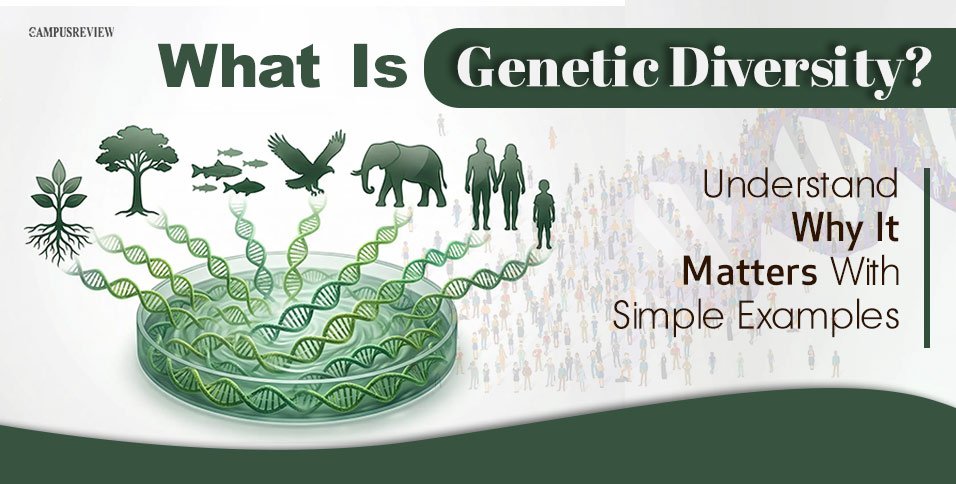
Why can one disease devastate a population while another survives? One answer is genetic diversity.
Genetic diversity refers to the differences in genes and alleles within a species or population. These differences help organisms adapt, resist diseases, and maintain healthy populations. When diversity falls, species can face greater risks from environmental change, disease, and inbreeding. This guide explains how genetic diversity works and why it is essential for survival.
What Is Genetic Diversity?
Genetic diversity is the variety of genes and alleles within a species or population. A gene is a section of DNA that influences a trait, while an allele is a specific version of a gene.
Across a species, genetic diversity includes all the different alleles found in its populations. Within a population, it refers to the genetic variations carried by that local group. These differences can affect how well a population responds to diseases, environmental changes, or dry conditions.
Genetic diversity also explains why individuals from the same parents can have different traits. It is the genetic level of biodiversity: biodiversity describes differences among living organisms, while genetic diversity describes differences within a species.
Key Concepts of Genetic Diversity
Gene Pool
A gene pool is the complete set of genes and alleles found in a breeding population. It represents the genetic variation available within that population.
- Role of alleles: More alleles give a population a wider range of traits, increasing its ability to adapt to changing conditions.
- Rare alleles matter: A rare allele may become useful when the environment changes.
- Bigger pool, more options: A varied gene pool gives the population more ways to handle change.
Example: A wolf pack with many immune gene versions has a richer gene pool than a pack where every wolf shares one version.
Mutations
A mutation is a permanent change in DNA that can create new genetic variation. Mutations can result from DNA-copying errors or environmental factors such as radiation.
- New alleles: Mutations can create new versions of genes.
- Different effects: Most mutations have little or no effect, some are harmful, and a few can be beneficial.
- Gene duplication: A copied gene can develop a new function while the original continues its existing.
Example: A mutation in a mouse can create a new fur color allele. If the new color hides the mouse from owls, the allele can spread.
Genetic Recombination
Genetic recombination creates new combinations of existing alleles during meiosis, the cell division that produces sperm and egg cells.
- Crossing over: Paired chromosomes exchange matching DNA segments.
- Independent assortment: Maternal and paternal chromosomes are distributed randomly into sex cells.
- Unique offspring: These processes create millions of possible chromosome combinations, helping explain why siblings can have different traits.
Genotype vs. Phenotype
Genotype is an organism’s genetic makeup, while phenotype refers to the traits it shows or expresses.
- Genotype: The alleles an organism carries, such as alleles linked to tall growth.
- Phenotype: The observable trait, such as the organism’s actual height.
- Role of the environment: Genes and environmental conditions both influence phenotype. For example, a plant with genes for tall growth may remain short if it lacks enough nutrients or water.
Example: Two corn plants carry the same alleles for tall growth. One grows in rich soil and reaches full height. The other grows in poor soil and stays short. The genotype matches, but the phenotype differs.
Why Is Genetic Diversity Important?
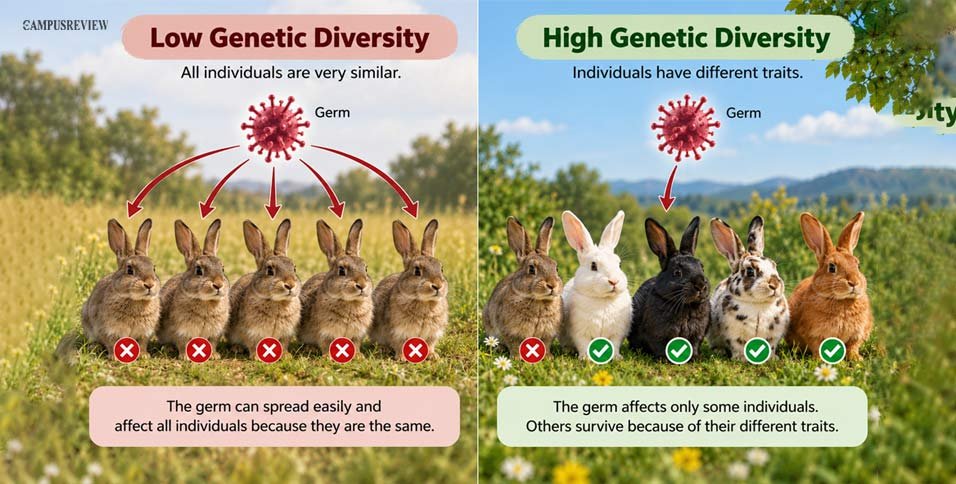
Genetic diversity protects a species in four main ways. The table gives the quick view.
| Benefit | What it does | Without it |
| Adaptation | Gives some individuals the right traits when conditions change | The whole group suffers when the climate shifts |
| Disease resistance | Gives the group many immune defenses | One germ can infect almost everyone |
| Less inbreeding | Keeps harmful alleles hidden | Fertility and survival drop |
| Evolution | Gives natural selection real choices | The group cannot change over time |
Helps Species Adapt to Environmental Changes
A diverse population often holds a few individuals whose alleles suit new conditions, such as heat, drought, or a changed habitat. Those individuals survive and breed.
This genetic adaptation works faster than waiting for a new mutation. These adaptations vary across types of ecosystems, from forests and grasslands to deserts and oceans.
Example: After a heatwave, wild plants with heat-tolerant alleles survive and set seed.
Improves Disease and Pest Resistance
Different individuals have different immune genes, helping populations resist a wider range of diseases. In vertebrates, MHC genes help detect germs, while diverse MHC alleles recognize different pathogens. Similarly, growing different crop varieties can prevent one pest from destroying an entire harvest.
Reduces Inbreeding Depression
Inbreeding depression is reduced health and fertility caused by mating between close relatives. In small, isolated populations, harmful recessive alleles are more likely to pair up, causing higher death rates, lower fertility, and physical defects in offspring.
Supports Evolution
Natural selection can only act on traits that already exist. Greater genetic variation gives populations more traits to adapt to changing conditions. Without enough variation, a population has less ability to adapt and evolve.
Genetic Diversity Examples
Genetic diversity can appear as differences in traits, disease resistance, adaptation, and DNA among individuals of the same species.
1. Similipal Tigers: Different Coat Patterns
A small tiger population in India’s Similipal Tiger Reserve has an unusually high frequency of pseudomelanism, giving some tigers darker coats with broad, connected stripes. Researchers linked this rare trait to a specific genetic variant concentrated in the isolated population.
2. Indian Brine Shrimp: Different Coastal Populations
Populations of the brine shrimp Artemia franciscana along India’s southeastern coast carry different genetic signatures. Researchers found distinct DNA variations and unique haplotypes among populations living in separate hypersaline habitats.
3. Indian Tigers: Genetic Differences Between Populations
Indian tiger populations are not genetically identical. Research identified distinct genetic clusters across regions, with some populations carrying more genetic variation than others. This shows how geographic isolation can shape genetic diversity within one species.
4. Brown Tree Snakes: Hidden Genetic Variation
Brown tree snakes introduced to Guam came from a small founding population, yet researchers recently found more than 19,000 large genetic differences in their genomes. Some of this hidden variation occurs in genes linked to immunity and smell.
5. Common Yarrow: Adaptation to Different Habitats
Common yarrow populations can show genetically determined differences across environments. Plants growing in areas such as the Sierra Nevada and Pacific Coast developed distinct forms suited to their local conditions.
How Does Genetic Diversity Develop?
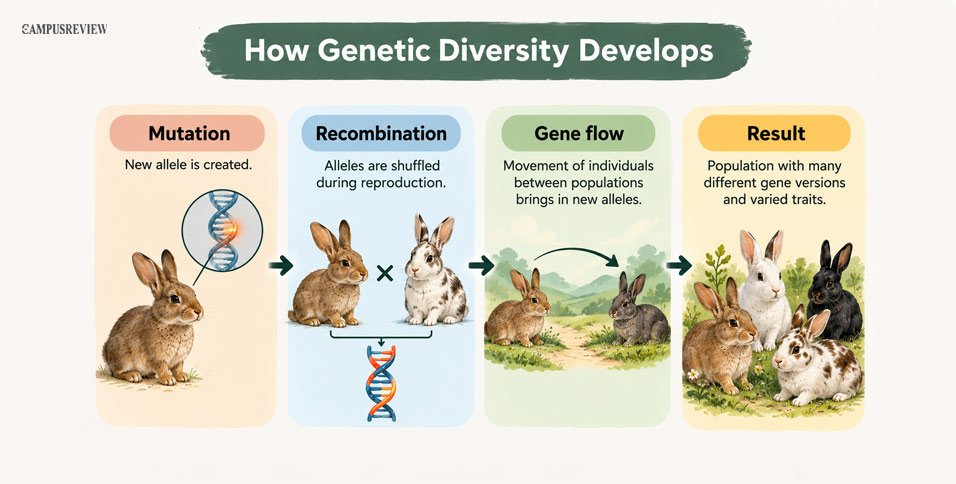
Three processes build genetic diversity. Mutations create new alleles. Genetic recombination shuffles alleles into new combinations in every generation.
Inherited variation then passes these alleles to the young, and gene flow carries them between populations when individuals migrate. Together, these processes give each individual a different genetic combination. Genetic drift works the other way, because random chance can erase alleles in small groups.
| Process | What happens | Simple example |
| Mutation | DNA changes create new alleles | A copying error creates a new fur color allele |
| Recombination | Sex cells shuffle existing alleles | Siblings inherit different mixes from the same parents |
| Gene flow | Moving individuals bring alleles to a new population | A wolf joins a different pack and breeds there |
Genetic Diversity vs. Genetic Variation
Genetic variation refers to the differences in genes and traits between individuals of the same species. Genetic diversity describes the overall range of these genetic differences and alleles within a population or species.
The two terms are closely related, but genetic diversity looks at the broader genetic richness of a group. It is also one level of biodiversity, alongside species diversity, which refers to the variety of species found in a particular area.
| Feature | Genetic variation | Genetic diversity |
| Scale | Differences between individuals | Whole populations or a full species |
| Focus | Specific genes and DNA changes | Overall richness of alleles |
| Used most in | Genetics and inheritance studies | Conservation and ecology |
What Happens When Genetic Diversity Is Low?
Loss of genetic diversity can trigger an extinction vortex, where smaller populations lose more genetic variation, become weaker, and decline further. Four major effects are:
Greater vulnerability to environmental change: Genetically similar animals may share the same weaknesses, so heatwaves, pollutants, or habitat changes can affect many individuals at once. Small populations can also lose alleles through genetic drift.
Increased disease risk: Low genetic diversity can make populations more vulnerable to diseases. According to the National Academies, about 70% of U.S. corn had the T-cms background in 1970, and the resulting blight destroyed about 15% of the crop. Tasmanian devils also have low MHC diversity, which contributed to the spread of contagious cancer, DFTD.
Greater risk of inbreeding depression: Small populations increase the chance of close relatives mating, exposing harmful recessive traits. Florida panthers showed severe health problems until eight Texas pumas were introduced in 1995. Their hybrid offspring survived at higher rates, an example of genetic rescue.
Reduced ability to adapt: Once alleles are lost, populations have less genetic variation for future adaptation. Cheetahs experienced population bottlenecks thousands of years ago and now have very similar genes, which is associated with poor sperm quality and weaker disease defenses.
The Kunming-Montreal Global Biodiversity Framework uses an effective population size of 500 as a conservation indicator, roughly equivalent to 5,000 mature individuals in the wild. This is a general guideline because genetic needs vary between species.
Genetic Diversity and Evolution
Genetic diversity gives natural selection the choices it needs. Genetic variation and evolution link through a simple cycle. Genetic diversity and natural selection work together at every step:
- Genetic variation: The gene pool holds many alleles.
- Natural selection: When the environment changes, individuals with helpful alleles survive and breed more.
- Adaptation: Helpful alleles become more common in the next generation. Scientists call this shift microevolution.
- Survival across generations: The cycle repeats. Populations with enough variation keep adapting. Those without it may disappear.
Example: Green and brown beetles live on a forest floor. Birds spot green beetles on brown soil and eat them. Brown beetles leave more young. After a few generations, most beetles are brown. A group with only green beetles would crash.
End Note
Genetic diversity gives a species the variation it needs to survive disease, environmental changes, and other threats. When diversity declines, populations become more vulnerable to inbreeding and sudden changes. The Florida panther shows how conservation efforts can help restore lost genetic diversity and strengthen a population.
Pranjal Kharche
FAQs
1. What are some examples of genetic diversity?
Dog breeds, crop varieties, and human blood groups are common examples. Differences in genes and alleles create variations in size, traits, resistance, and blood groups.
2. How do scientists protect genetic diversity?
Scientists use in situ conservation to protect species in their natural habitats. Ex situ conservation uses zoos, seed banks, botanical gardens, and cryopreservation.
3. How do scientists measure genetic diversity?
Scientists compare DNA samples from different individuals and study their alleles. Allelic richness and heterozygosity are commonly used measures of genetic diversity.
4. Do humans have genetic diversity?
Yes, humans have genetic diversity, even though about 99.9% of their DNA is shared. Small genetic differences influence traits, blood groups, and disease responses.