The Campus Review
November 20, 2026
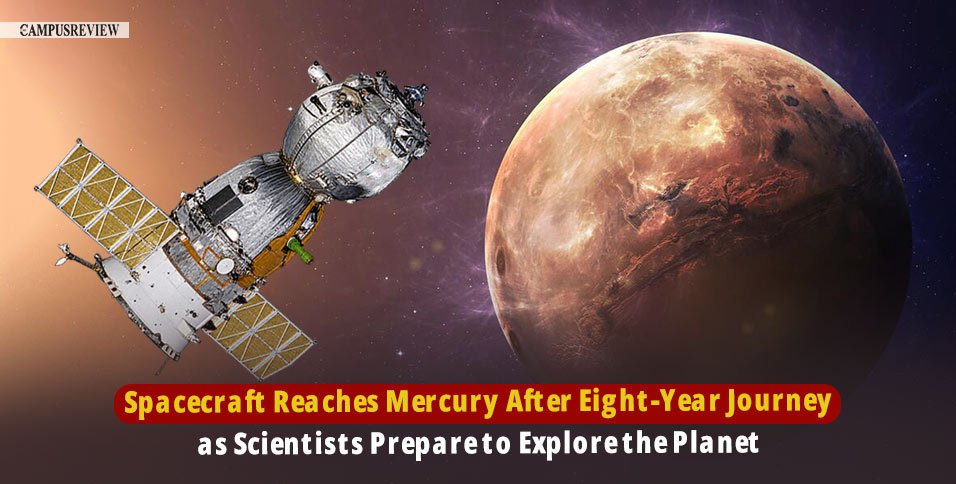
The BepiColombo spacecraft is approaching a major milestone as the spacecraft reaches Mercury after an eight-year journey through the inner Solar System. The joint European Space Agency mission and Japan Aerospace Exploration Agency effort is scheduled to perform its Mercury orbit insertion on November 21, 2026.
This milestone will make BepiColombo only the second mission ever to orbit the smallest planet in our solar system, following NASA’s MESSENGER mission. Its two scientific orbiters will enter orbit together, still stacked, and later separate to launch a new chapter in the exploration of planet Mercury.
Why Reaching Mercury Takes Eight Years
Many people wonder why a spacecraft reaches Mercury after eight years when the planet is relatively close to Earth. The answer comes down to the Sun’s massive gravity. As a probe travels toward the Sun, solar gravity pulls it faster and faster.
To enter orbit instead of flying straight past Mercury, the BepiColombo mission had to brake constantly. The spacecraft used solar electric propulsion and nine planetary flybys to adjust its trajectory and gradually reduce its orbital energy:
- 1 flyby of Earth to adjust its initial path.
- 2 flybys of Venus to shed orbital energy.
- 6 flybys of Mercury to match the planet’s speed.
Engineers switched off the electric propulsion system in June 2026. For the final approach, engineers will use the chemical thrusters on ESA’s Mercury Planetary Orbiter (MPO) to prepare for Mercury orbit insertion.
The mission also faced a technical challenge in 2024 when an issue with its solar arrays reduced the power available to its electric propulsion system. Engineers redesigned the flight path, delaying the planned BepiColombo arrival at Mercury from December 2025 to November 2026.
Key Timeline: From Launch to Science Operations
The ESA and JAXA Mercury mission completes its arrival in stages. Both orbiters will undergo commissioning before full scientific operations begin in April 2027.
| Date | Mission Milestone | What Happens |
| October 20, 2018 | Launch | BepiColombo launches aboard an Ariane 5 rocket from Kourou. |
| January 8, 2025 | Final Mercury Flyby | The spacecraft completes its sixth and final Mercury flyby. |
| September 3, 2026 | Transfer Module Separation | The Mercury Transfer Module separates from the MPO and Mio stack. |
| November 21, 2026 | Mercury Orbit Insertion | The connected MPO and Mio spacecraft enter an initial polar orbit around Mercury. |
| December 9 to 10, 2026 | Orbiter Separation | JAXA’s Mio separates from ESA’s MPO. |
| December 16, 2026 | Sunshield Separation | MPO releases Mio’s Sunshield and Interface Structure (MOSIF). |
| March 10, 2027 | MPO Reaches Science Orbit | ESA’s orbiter reaches its planned science orbit. |
| April 6, 2027 | Science Operations Begin | The mission begins its planned scientific observation phase. |
What Happens After the Spacecraft Reaches Mercury
Unlike previous missions, BepiColombo brings two specialized orbiters to work at the same time. Once the spacecraft reaches Mercury and settles into its initial orbit, the two probes will split up to handle distinct scientific roles.
| Orbiter Name | Space Agency | Primary Focus |
| Mercury Planetary Orbiter (MPO) | ESA | Maps Mercury surface composition, craters, and internal structure. |
| Mercury Magnetospheric Orbiter (Mio) | JAXA | Studies Mercury’s magnetic field and how solar wind hits the planet. |
MPO will investigate Mercury’s surface, composition, and internal structure, while Mio will study its magnetosphere and interaction with the solar wind. Operating simultaneously allows scientists to gather complementary data from two different orbits at the same time.
Surviving a World of Extremes
Mercury is one of the harshest environments in our solar system. Because the planet rotates very slowly, a single Mercury solar day lasts 176 Earth days. That means a spot on the ground experiences roughly three Earth months of continuous daylight followed by three months of darkness.
- Daytime temperatures climb up to approximately 430 degrees Celsius.
- Nighttime temperatures drop as low as minus 180 degrees Celsius.
- Planned science schedule runs nominally from April 2027 to April 2028, with an extended mission planned through December 2029.
What Scientists Expect to Discover
This Mercury exploration mission aims to answer big questions about how rocky planets form and evolve close to their parent stars. Researchers will study Mercury’s unusually large metal core, its surface craters, and its thin surrounding atmosphere.
Prof. Geraint Jones, BepiColombo Project Scientist at the European Space Agency (ESA), shared his outlook on the upcoming Mercury scientific exploration:
“As well as cameras covering a wide range of wavelengths to study the surface, we’ll be ‘tasting’ the gases around the planet, sensing the magnetic field, probing the interior with ultrasensitive instruments, and mapping the shape of the whole planet with a laser.”
As the spacecraft reaches Mercury and prepares for orbit insertion, researchers are ready to begin a detailed study of our solar system’s innermost planet. Once commissioning wraps up next spring, BepiColombo will start sending back fresh data on one of the least explored worlds in our cosmic neighborhood.
Pranjal Kharche
Also Read – Scientists Successfully Grow Potatoes on the Moon’s Simulated Soil Using Worm Compost