Survival of the fittest does not mean the strongest survive. It means organisms with traits best suited to their environment are more likely to reproduce and pass those traits to the next generation.
In evolutionary biology, fitness refers to reproductive success, not strength or speed. Herbert Spencer coined the phrase in 1864, and Charles Darwin later used it to describe natural selection. This guide explains its meaning, origin, four steps, and real-world examples, from tuskless elephants to city lizards.
What Is Survival of the Fittest? (Survival of the Fittest Meaning)
Survival of the fittest is the idea that organisms best suited to their local environment live long enough to reproduce. They then pass their advantageous inherited traits to the next generation. Scientists use the phrase as a short way to describe differential survival and reproduction in a population.
The word “fitness” causes most of the confusion. In daily life, fit means strong, fast, or athletic. Fitness in evolutionary biology means reproductive success. An organism is fit when its traits help it find food, avoid danger, and raise young that also survive.
Survival alone does not determine evolutionary fitness. An animal that lives long but produces no offspring has zero reproductive success. A small insect that avoids predators and produces many offspring may have higher fitness. Traits like camouflage, disease resistance, and heat tolerance matter when they improve reproductive success.
Origin of Survival of the Fittest: Who Said It First?
The phrase has an interesting history, beginning with Charles Darwin’s theory of natural selection and later gaining popularity through Herbert Spencer.
Herbert Spencer Coined the Phrase in 1864
Many people credit Charles Darwin, but Herbert Spencer came up with the phrase. Spencer was a British philosopher, sociologist, and biologist. He used it in his two-volume book Principles of Biology in 1864. He wrote it after reading Darwin’s On the Origin of Species, which came out in 1859.
Spencer saw a link between nature and human society. He compared the struggle for existence in nature to economic competition among people. That comparison later caused real harm, and we cover it in the Social Darwinism section below.
Why Darwin Adopted the Phrase
Darwin first used only the term “natural selection”. Alfred Russel Wallace, who independently reached the same theory of evolution, raised a concern. He told Darwin that “natural selection” might suggest a conscious selector guiding nature. Wallace suggested Spencer’s wording instead.
Darwin agreed. He added “survival of the fittest” to the fifth edition of On the Origin of Species in 1869. He used it as a direct synonym for natural selection. He described it as the preservation of helpful differences and the destruction of harmful ones.
How Does Survival of the Fittest Work in Evolution?
Survival of the fittest works through four connected stages of natural selection. These stages explain how environmental conditions influence which individuals reproduce and pass on their traits.
Step 1: Genetic Variation
Individuals in a population have different inherited traits. Mutations, reproduction and gene flow create these genetic differences. This variation gives natural selection different traits to act on.
Step 2: Environmental Pressure
Food shortages, predators, diseases, and climate changes create challenges. These environmental pressures make some traits more useful than others.
Step 3: Differences in Survival and Reproduction
Individuals with traits better suited to their environment are more likely to survive, find mates, and produce offspring. This gives them higher evolutionary fitness.
Step 4: Inheritance of Advantageous Traits
Successful individuals pass their inherited traits to their offspring. Over generations, helpful genetic variants become more common in the population, leading to adaptation.
| Step | What happens | Example |
| Variation | Individuals have different traits | Some aphids carry pesticide resistance |
| Pressure | The environment creates challenges | Farmers spray pesticides |
| Selection | Resistant aphids survive and reproduce | Susceptible aphids die |
| Inheritance | Resistance passes to offspring | More aphids become resistant |
Survival of the Fittest Examples in Nature
Survival of the fittest in nature is not just a textbook idea. Scientists have recorded it in many species. The table gives a quick view. The sections after it add the details.
| Example | Pressure | Trait that helped |
| Aphids | Pesticides | Genes that detoxify poison |
| Mosquitoes | Insecticides | Changes in nerve targets |
| Corals | Ocean heatwaves | Heat-tolerant algae partners |
| Elephants | Ivory poaching | Natural lack of tusks |
| Lizards | City buildings | Longer limbs and bigger toe pads |
Insects Developing Resistance to Pesticides
The green peach aphid (Myzus persicae) has become resistant to more than 70 synthetic insecticides worldwide. When farmers spray a crop, most aphids die. A few survive because of a genetic mutation.
In resistant aphids, an extra copy of a gene called CYP6CY3 helps them make large amounts of enzymes that break down the poison before it harms their nerves.
The survivors reproduce, and their young inherit the same ability. After a few generations, the whole local group can resist the chemical. Farmers then need stronger doses, and food supplies face more risk.
Mosquitoes Developing Insecticide Resistance
Health workers use insecticides to control mosquitoes that spread dengue, malaria, and Zika. Some mosquitoes carry knockdown resistance mutations, known as kdr. These mutations change a part of the nervous system, so the insecticide cannot attach to it. Other mosquitoes make extra enzymes that break the poison down.
As sensitive mosquitoes die, resistant ones take over. This makes disease control more expensive and more difficult.
Coral Reefs Adapting to Warmer Oceans
Corals live with tiny algae inside their bodies. When the water gets too hot, corals push the algae out, and the reef bleaches. Not all corals suffer equally. Corals that host a heat-tolerant algae called Durusdinium trenchii survive marine heatwaves more often.
There is a trade-off, though. These corals often grow more slowly and build their skeletons more slowly in cooler periods. Fitness always depends on the setting, and every advantage has a cost.
Tuskless Elephants Surviving Poaching Pressure and Lizards Adapting to Urban Environments
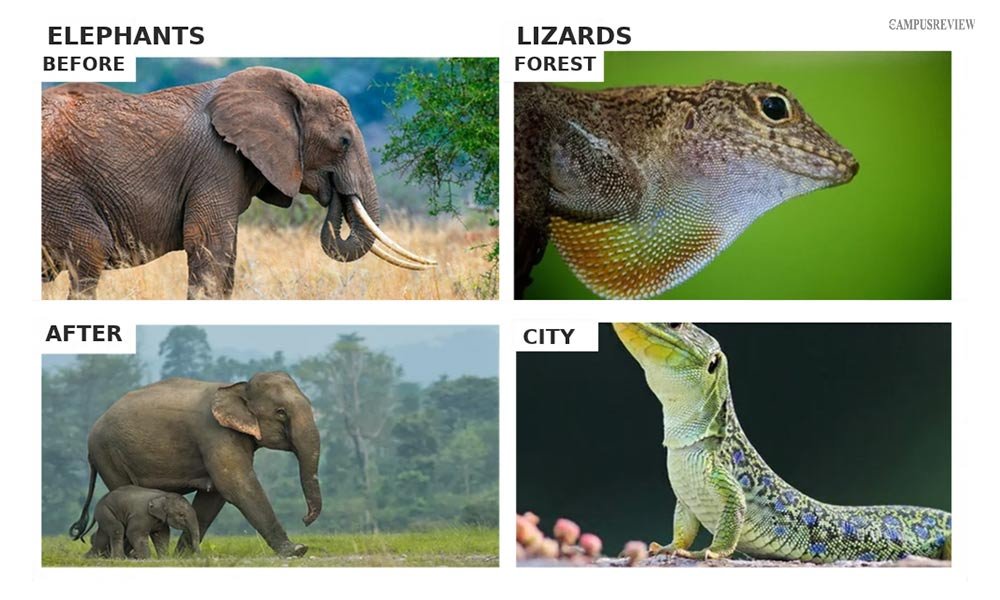
Human activities can influence which traits help animals survive and reproduce. Two examples show how this happens in different environments.
At Gorongosa National Park in Mozambique, ivory poaching during the civil war (1977-1992) killed many elephants with large tusks. Female elephants born without tusks because of an inherited mutation were less likely to be targeted. They survived and reproduced, increasing the frequency of tusklessness.
A 2021 study published in Science found that tuskless females increased from about 18% of the studied population before the war to about 51% afterward. Researchers linked the trait to changes involving the AMELX gene. This shift also affects the ecosystem because elephants use their tusks to strip bark and dig for water, influencing surrounding vegetation.
A similar process can be seen in Puerto Rican crested anoles (Anolis cristatellus). Lizards living in cities developed longer limbs and larger toe pads with more grip scales, helping them climb smooth walls and glass. A 2023 genome study published in PNAS found genetic changes associated with these urban adaptations across separate city populations.
Together, these examples show how human activities can change environmental pressures and influence the evolution of animal populations over generations.
Survival of the Fittest vs Natural Selection
People use both terms as if they mean the same thing. Biologists treat them differently. Natural selection is the scientific process. Survival of the fittest is a popular phrase that sums up the result.
| Feature | Survival of the fittest | Natural selection |
| What it is | A short phrase for differential survival and reproduction | The process that filters genetic variation |
| Where you see it | Media, books, daily talk | Scientific papers and textbooks |
| Focus | The end result: reproductive success | How inherited variation changes a population over time |
| Scope | Often sounds like a fight between individuals | Also includes cooperation and mate choice |
The phrase can hide the bigger picture. Natural selection also covers sexual selection, where a trait helps an animal win a mate even if it hurts survival. A peacock’s tail is a good case. For this reason, textbooks use “survival of the fittest” as shorthand and “natural selection” as the precise term.
Survival of the Fittest and Social Darwinism
Social Darwinism applied Spencer’s phrase to human society. In the late 1800s and early 1900s, some writers argued that poverty and inequality were natural results of the struggle for existence. People used this idea to defend rigid class systems, unfair business practices, and imperial conquest. They claimed rich people and powerful nations were “fitter” and so deserved to rule.
The same thinking fed the eugenics movement, championed by Francis Galton, Darwin’s half-cousin. Eugenics promoted forced sterilisation and controlled breeding. Tens of thousands of people were sterilised in the United States, and Nazi Germany pushed these ideas to a terrible extreme.
Modern science rejects all of this. It commits the naturalistic fallacy, which wrongly assumes that whatever happens in nature is morally right. Biological fitness only measures how well genes pass on in a given environment. It says nothing about the worth of a person, a group, or a nation.
Reliable Sources for Understanding Survival of the Fittest
Use credible scientific and educational sources to understand the concept, check common misconceptions, and verify the evidence behind real-world examples.
| Trusted source type | Best for |
| Encyclopaedia Britannica | Clear definitions of survival of the fittest and Social Darwinism |
| National Center for Science Education (NCSE) | Checking quotes and common myths |
| Peer-reviewed journals such as Science and PNAS | Original research data behind examples like elephants and lizards |
| University and museum education pages | Student-friendly explanations and diagrams |
End Note
Survival of the fittest does not mean the strongest wins. It means the best match for the environment leaves the most offspring. Herbert Spencer coined the phrase, and Charles Darwin adopted it with Wallace’s advice. Remember the four steps: variation, pressure, differential survival, and inheritance.
Use real examples like aphids and tuskless elephants to explain them. Reject the myths, and never use the phrase to defend social inequality. Check your sources, and you will understand this topic well.
Pranjal kharche
Frequently Asked Questions
1. What is the Red Queen Hypothesis?
The Red Queen Hypothesis states that species must continuously evolve to survive against changing predators, prey, and parasites. Leigh Van Valen proposed it in 1973.
2. What is inclusive fitness?
Inclusive fitness measures how an organism passes on its genes through both offspring and relatives. W. D. Hamilton developed this concept to explain behaviours such as worker bees protecting their hive.
3. Can organisms adapt without changing their DNA?
Yes, organisms can adapt through epigenetic changes that switch genes on or off without altering their DNA sequence. These changes can help them respond to environmental stress.
4. Does evolution happen slowly or in bursts?
Evolution can happen gradually or in short bursts. The theory of punctuated equilibrium, proposed by Stephen Jay Gould and Niles Eldredge, describes long periods of little change interrupted by rapid evolutionary shifts.
5. What is bet-hedging in evolution?
Bet-hedging is an evolutionary strategy in which organisms produce offspring with different traits to increase the chances that some will survive unpredictable environmental changes.