The Campus Review
October 9, 2026
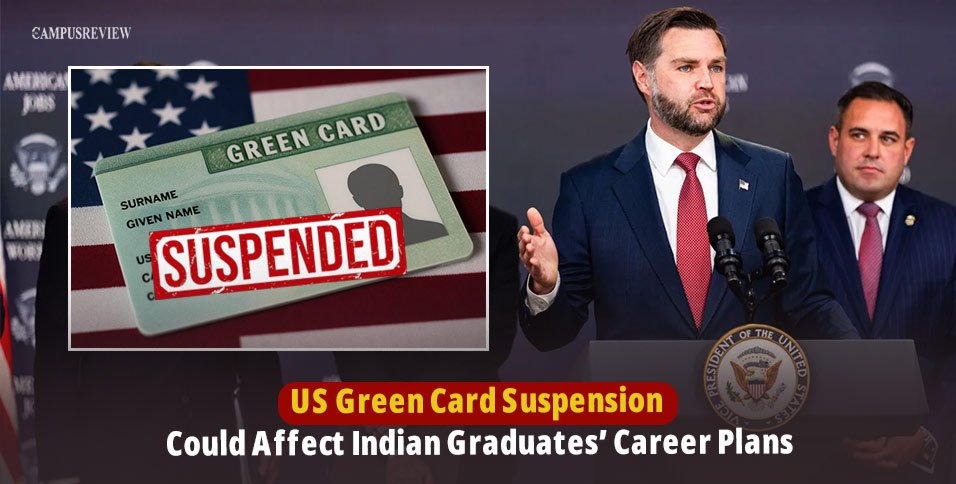
The US Green Card Suspension, announced on October 8, 2026, could affect foreign professionals seeking permanent residency through eight major technology companies. The US Department of Labor has suspended new and pending Permanent Labor Certification (PERM) applications involving Microsoft, Adobe, Cognizant, Infosys, Tata Consultancy Services (TCS), Wipro, HCL, and Capgemini, according to recent reports.
The decision raises concerns for Indian graduates planning long-term careers in the United States. However, it does not automatically cancel student status or work authorization for eligible graduates. The suspension primarily affects green card sponsorship through the named companies, not all US employment or immigration options.
US Green Card Suspension at a Glance
| Key detail | Information |
| Announcement | October 8, 2026 |
| Agency | US Department of Labor |
| Affected process | Permanent Labor Certification (PERM) |
| Companies | Microsoft, Adobe, Cognizant, Infosys, TCS, Wipro, HCL, Capgemini |
| Main concern | Employer-sponsored permanent residency |
What Is the US Green Card Program?
The US Green Card Program allows eligible foreign nationals to become lawful permanent residents of the United States. A green card lets them live and work permanently in the country. Many professionals apply through employer-sponsored routes, such as the EB-2 and EB-3 employment-based categories.
These routes may require employers to complete the Permanent Labor Certification (PERM) process.
What Does the US Green Card Suspension Cover?
PERM is a key step in many employer-sponsored green card applications. The US Department of Labor requires employers to show that enough qualified US workers are not available for the job and that hiring a foreign worker will not harm the wages and working conditions of similarly employed US workers.
The administration says the suspension aims to protect US workers and address alleged misuse of the programme. Vice President JD Vance criticised employers he said used visa programmes to undercut domestic wages. These are the administration’s allegations, not final findings of wrongdoing against every company.
The action targets the eight named companies. It does not suspend every employment-based immigration route or automatically cancel existing H-1B status.
How Could It Affect Indian Graduates?
The impact depends on a graduate’s education, employer, and immigration stage.
| Situation | Possible effect |
| Planning to study in the US | The suspension does not itself cancel university admission or F-1 student status. |
| Completing a degree | Eligible students may still apply for post-study work authorization. |
| Working on H-1B status | The suspension does not automatically cancel existing status. |
| Seeking an employer-sponsored green card | A PERM case involving an affected company may be delayed or unable to proceed during the suspension. |
Can Students Still Use OPT and STEM OPT?
Eligible F-1 students can apply for Optional Practical Training (OPT), which allows work related to their field of study. Eligible graduates with qualifying science, technology, engineering, and mathematics degrees may also apply for a 24-month STEM OPT extension.
Students must meet the relevant eligibility and application requirements.US Immigration and Customs Enforcement provides official practical training guidance.
OPT and STEM OPT provide temporary work authorization. Neither guarantees an H-1B visa or permanent residency.
Why the H-1B Six-Year Limit Matters
H-1B status generally allows a worker to remain in the United States for up to six years, although certain workers qualify for extensions under specific legal provisions.
Under the American Competitiveness in the Twenty-First Century Act (AC21), some workers may qualify for extensions if a qualifying labor certification or immigrant petition has been pending for at least 365 days. Certain workers with approved I-140 petitions may also qualify for extensions when an immigrant visa is unavailable because of per-country limits.
These rules do not apply to everyone. Workers approaching the usual six-year limit should ask their employer’s immigration team or a qualified immigration attorney how the suspension affects their individual case.
What TCS Says About the Suspension
Tata Consultancy Services said on October 9 that it did not expect the suspension to have a material impact on its workforce strategy or client engagements.
According to Reuters, TCS said its PERM applications had been in the single digits over the previous two years. The company also reiterated plans to hire 15,000 additional employees in the United States over five years, with a focus on local and campus recruitment.
This is TCS’s assessment. The impact on other affected companies may differ depending on their use of PERM sponsorship.
What Indian Students and Professionals Should Do
Indian graduates can take several practical steps:
- Check employer sponsorship policies: Ask whether a company supports temporary work visas and long-term green card applications.
- Understand each immigration stage: F-1 status, OPT, STEM OPT, H-1B status, PERM, and I-140 serve different purposes.
- Review ongoing applications: Employees with pending cases should ask their employer’s immigration team about their options.
- Consider other eligible pathways: EB-1 and the EB-2 National Interest Waiver may suit some applicants, but each has specific eligibility requirements and is not a universal replacement for PERM.
- Compare costs and career goals: Consider tuition, living expenses, employment prospects, and immigration uncertainty before choosing a study programme.
What the Suspension Means for Future Career Plans
The US Green Card Suspension creates uncertainty for Indian graduates who hope to obtain permanent residency through the eight affected employers. However, it does not automatically prevent eligible students from studying in the United States or applying for post-study work authorization.
Students and professionals should distinguish temporary work permission from permanent residency, check official guidance, and review employer sponsorship policies before making long-term decisions.
Pranjal Kharche