Have you ever wondered why poems look different? Some have three lines, while others fill an entire book.
The types of poetry differ in structure, rhyme, rhythm, length, and purpose. English poets mainly use the sonnet, limerick, ballad, elegy, ode, blank verse, free verse, and acrostic. They also borrowed the haiku, villanelle, and ghazal from other cultures. Together, these make up the main types of poems in English.
This guide explains 12 poetry forms with simple rules, original examples, and fun facts about famous poets, helping you understand poetry and write your first poem.
Types of Poetry and Examples at a Glance
The 12 main types of poetry are the sonnet, haiku, limerick, villanelle, ghazal, epic, ballad, elegy, ode, free verse, blank verse, and acrostic. This table shows how they differ.
| Type of poem | Structure | Origin | Best for |
| Sonnet | 14 lines with a rhyme pattern | Italy | Love, beauty, big ideas |
| Haiku | 3 lines, 5-7-5 syllables | Japan | Nature, one moment |
| Limerick | 5 lines, AABBA rhymes | English tradition | Jokes and silly stories |
| Villanelle | 19 lines, repeating lines | France | Strong feelings |
| Ghazal | Separate couplets, repeating end word | Arabic and Persian traditions | Love and longing |
| Epic | Very long story poem | Ancient world | Heroes and journeys |
| Ballad | Story poem in 4-line stanzas | Folk tradition | Dramatic stories |
| Elegy | Poem about loss | Ancient Greece | Grief and memory |
| Ode | Poem of praise | Ancient Greece | Honoring a person or thing |
| Free verse | No set rhyme or beat | Modern tradition | Everyday life |
| Blank verse | Steady beat, no rhyme | English tradition | Speeches and serious thoughts |
| Acrostic | First letters spell a word | Old technique | Names and ideas |
Poetry Words in Plain English
You only need a few simple terms to follow this guide.
- Stanza: A group of lines in a poem. Think of it as a paragraph.
- Rhyme scheme: The pattern of rhyming sounds at the end of lines. Letters show the pattern. In ABAB, lines 1 and 3 rhyme. Lines 2 and 4 rhyme too.
- Meter: The beat of a line. It depends on how many syllables the line has and which ones sound strong.
- Iambic pentameter: A line with 10 syllables and a da-DUM beat five times. Try it: “I WALK the QUI-et ROAD that LEADS to SCHOOL.”
- Refrain: A line or phrase that repeats.
- Couplet, tercet, quatrain: Stanzas with two, three, and four lines.
- Lyric poetry and narrative poetry: Lyric poems share feelings. Narrative poems tell stories.
Fixed and Structured Forms of Poetry
Fixed forms follow set rules, like a game. This traditional poetry has a clear poetic structure. The limits make you choose each word with care.
Sonnet
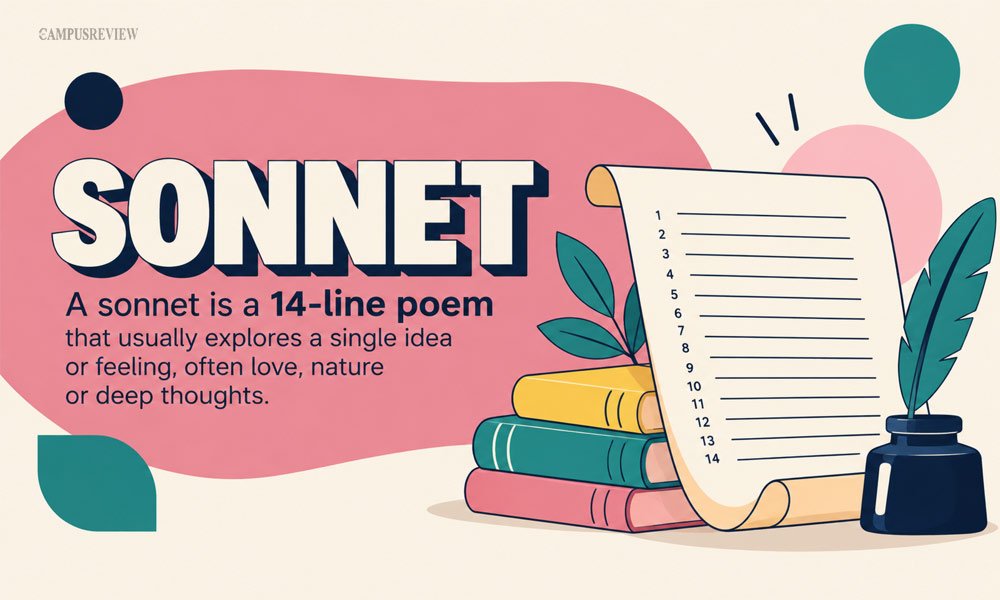
A sonnet is a 14-line poem about one idea. Most sonnets use iambic pentameter. They also have a turn, called a volta, where the idea shifts. The structure of a sonnet has 14 lines, a set rhyme pattern, and a turn.
Rules: There are two main types.
- Shakespearean sonnet: Three four-line stanzas and a final couplet. The rhyme scheme is ABAB CDCD EFEF GG. The turn often comes at line 13.
- Petrarchan sonnet: The first 8 lines show a problem or question. The last 6 lines answer it. The rhyme scheme is ABBAABBA, then CDECDE or CDCDCD.
Example: an original Shakespearean sonnet about a late-night study session. The letters show the rhyme scheme.
The lamp burns low above my pile of books, A
The clock strikes one, and still I cannot write. B
My tea goes cold. I cast some weary looks A
Then glance at shelves and wish away the night. B
Yet one small line begins to make some sense, C
Then two, then three, then rhythm finds its way. D
My worried mind grows calm and less intense, C
And ink flows freely till the break of day. D
The words I wrote may not be great or grand, E
But each new page I finish eases pain. F
I learn to trust the pen inside my hand, E
And let the small steps count, and count again. F
So write one plain line first, then write one more. G
Each poem waits for you behind a door. G
Fun fact: Francesco Petrarca (Petrarch) wrote many sonnets about a woman he called Laura. William Shakespeare wrote 154 sonnets. Nobody knows for sure who “Mr. W.H.” was, the person named in the 1609 dedication.
Haiku
A haiku is a short poem that captures one moment, usually from nature. Think of it as a tiny photograph made of words.
Rules of a haiku:
- Write three lines.
- Follow the syllable count: 5 in line 1, 7 in line 2, and 5 in line 3.
- Skip the rhyme.
- Hint at a season, like rain, snow, or blossoms.
- Add a small pause or surprise in the middle.
Japanese haiku count short sound units, which are shorter than English syllables. So many English poets treat 5-7-5 as a guide, not a strict rule.
Example: an original haiku.
Monsoon rain at dusk
Chai steam curls beside my book
The old street grows soft
Fun fact: Matsuo Bashō (1644 to 1694) took his pen name from a banana tree, called a bashō, that a student planted near his hut.
Ghazal
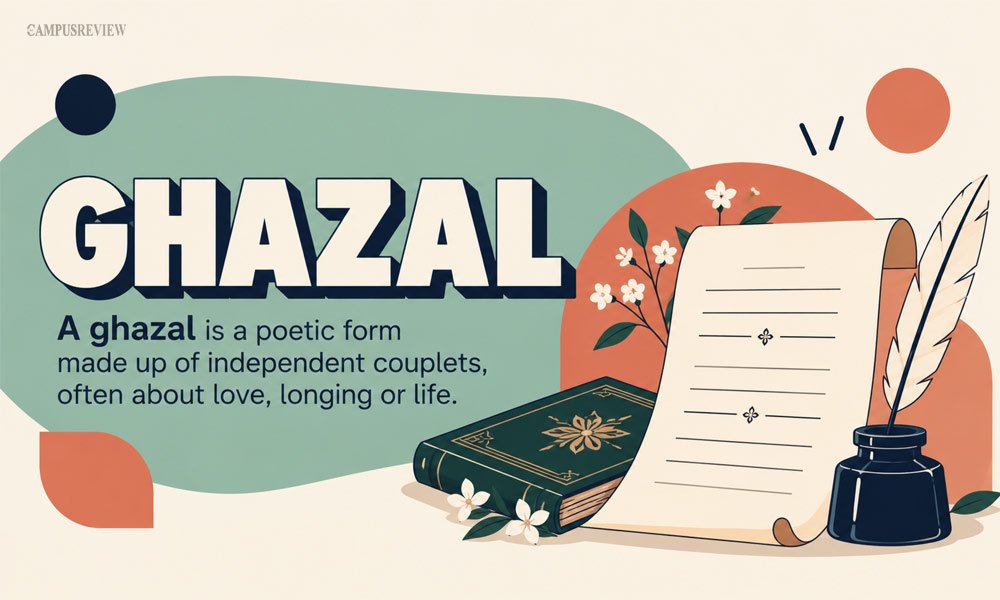
A ghazal is a poem made of five to fifteen separate couplets. Each couplet works like its own mini poem. A repeating ending ties them together.
Rules:
- Write each couplet so it makes sense alone.
- End both lines of the first couplet with the same refrain.
- Repeat that refrain at the end of the second line in every later couplet.
- Rhyme the word just before the refrain.
- Add the poet’s pen name in the last couplet.
Example: the first two couplets of an original ghazal. The refrain is “tonight.”
The rain falls soft, the city lights glow tonight.
My old guitar hums low, so low tonight.
No one has told me what this silence means.
Still, every quiet star seems to know tonight.
Fun fact: Ghazals began in 7th-century Arabia and grew in Persian and Urdu poetry. Mirza Ghalib (1797 to 1869) was born Mirza Asadullah Baig Khan. He first wrote under the pen name Asad, then switched to Ghalib.
Limerick
A limerick is a funny five-line poem. It has a bouncy rhythm and a surprise ending.
Rules:
- Write five lines with an AABBA rhyme scheme.
- Make lines 1, 2, and 5 longer, about 7 to 10 syllables.
- Make lines 3 and 4 shorter, about 5 to 7 syllables.
Example: an original limerick.
A student said, “Poems are hard!” A
Then she wrote five lines in her yard. A
Two short ones came quick, B
Both neat and both slick, B
And she grinned as she signed her new card. A
Fun fact: Edward Lear made limericks famous with A Book of Nonsense in 1846. He also gave drawing lessons to Queen Victoria.
Villanelle
A villanelle is a 19-line poem where some lines come back again and again. It suits feelings you cannot stop thinking about.
Rules:
- Write 19 lines: five tercets, then one quatrain.
- Use only two rhyme sounds in the whole poem.
- Repeat line 1 as lines 6, 12, and 18.
- Repeat line 3 as lines 9, 15, and 19.
Example: the opening stanza of an original villanelle. Lines 1 and 3 will return later.
I keep one small lamp burning in the night. A (repeats)
The dark is long, but dawn is on its way. B
My hope stays steady, and my heart stays bright. A (repeats)
Fun fact: French poet Jean Passerat helped shape the form with a poem about a lost turtledove. Dylan Thomas and Elizabeth Bishop later wrote famous villanelles in English.
Narrative and Thematic Types of Poems
Narrative poems tell stories. This narrative verse often runs long. Thematic poems focus on one big feeling or subject.
Epic
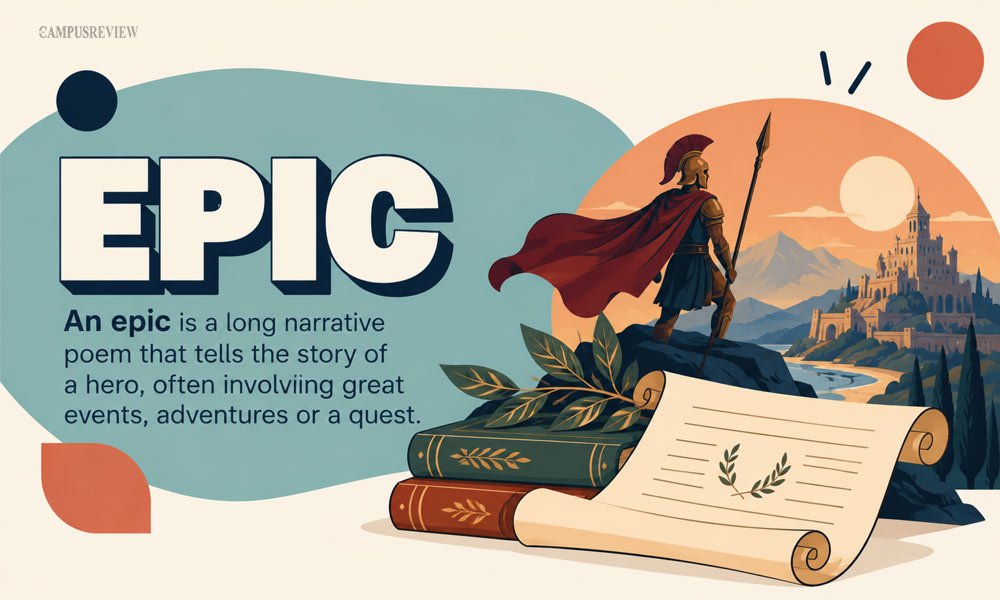
An epic is a very long poem about heroes, gods, and huge events. Think of it as a blockbuster movie written in verse.
Key features:
- A brave hero and a giant setting.
- Grand, serious language.
- Themes like courage, fate, duty, and war.
Famous examples: Homer’s Iliad and Odyssey from Greece, Valmiki’s Ramayana and the Mahabharata from India, and Dante’s Divine Comedy from Italy. The Odyssey follows Odysseus on his ten-year trip home after the Trojan War.
Fun fact: Dante Alighieri wrote in Italian instead of Latin, so everyday people could read his work. Scholars still debate whether one poet named Homer wrote both Greek epics.
Ballad
A ballad tells a story in a song-like way. That is why many modern love songs carry the name “ballad.”
Rules:
- Write in four-line stanzas.
- Use an ABCB or ABAB rhyme scheme.
- Alternate longer and shorter lines to create a musical beat.
Example: an original ballad stanza.
The river rose at midnight hour A
And swept away the town. B
A boy rang out the village bell C
Before the walls came down. B
Fun fact: Samuel Taylor Coleridge published the ballad “The Rime of the Ancient Mariner” in 1798. Emily Dickinson wrote many poems in a similar hymn-like pattern. After she died in 1886, her sister Lavinia found nearly 1,800 of them. Only a few had appeared in print.
Elegy
An elegy is a thoughtful poem about loss. The speaker mourns someone, then often finds a little hope.
Key features:
- No set length or rhyme.
- A quiet, serious tone.
- A slow shift from sadness toward comfort.
Famous examples: Thomas Gray’s “Elegy Written in a Country Churchyard” (1751) and Walt Whitman’s poem about Abraham Lincoln.
Fun fact: Alfred Tennyson spent about 17 years on In Memoriam A.H.H. after his close friend Arthur Henry Hallam died in 1833.
Ode
An ode is a poem that praises a person, thing, or idea. The speaker talks to the subject with deep respect or joy.
Key features:
- No set length or rhyme.
- A warm, formal tone.
- Subjects like nature, art, heroes, or even everyday objects.
Famous example: John Keats’s “Ode to a Nightingale” praises a bird’s song and wishes to escape pain.
Fun fact: Keats wrote his best-known odes in 1819 and died at age 25 in 1821. He asked for an epitaph saying his name was written in water. Long before him, the Greek poet Pindar wrote odes that honored athletes.
Free and Experimental Poetry Forms
Open-form poetry loosens the rules. The poet picks the structure.
Free Verse
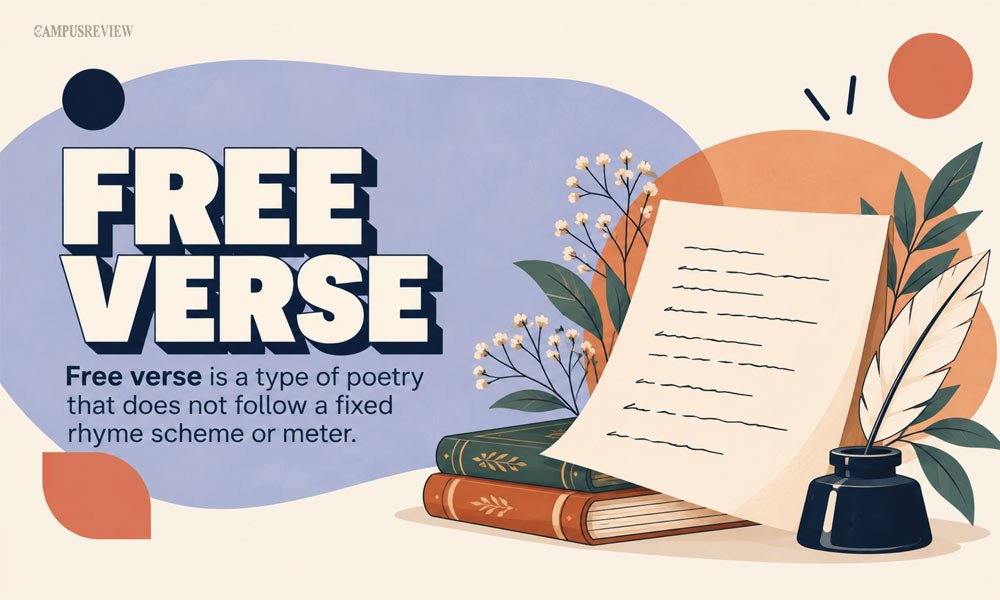
Free verse has no steady rhyme or beat. The poet decides where each line ends. Line breaks, images, and repeated words create the rhythm. Most free verse is unrhymed poetry.
Rules: Use any length, any topic, and any pattern you like. Just skip a fixed rhyme scheme and meter.
Example: an original free verse poem.
Morning bus.
Wet umbrellas crowd the aisle.
Someone hums a song I almost know,
and the whole city leans forward.
Fun fact: Walt Whitman self-published the first edition of Leaves of Grass in 1855. He helped make free verse popular in English.
Blank Verse
Blank verse has a steady beat but no rhyme. In English, it usually uses iambic pentameter.
Rules:
- Write lines of 10 syllables.
- Use a da-DUM beat five times per line.
- Do not rhyme.
Blank verse vs. free verse: Free verse drops the beat and the rhyme. Blank verse keeps the beat and drops the rhyme.
Example: an original two-line sample.
I walk the quiet road that leads to school,
And count the crows that cross the morning sky.
Fun fact: Shakespeare plays often use blank verse, a poetic form written in unrhymed iambic pentameter. John Milton wrote Paradise Lost (1667) in it after he went blind. Helpers wrote down his lines.
Acrostic
In an acrostic, the first letters of the lines spell a word. You may remember writing one in school.
How to write one:
- Pick a word, like a name or a feeling.
- Write its letters down the page.
- Start each line with one letter.
- Skip the rhyme, or add it if you like.
Example: an original acrostic for the word POEM.
Pages open, ink begins to flow,
Open windows let the morning in.
Every line a step I learn to take,
Moments turn to music on the page.
Fun fact: Lewis Carroll ended Through the Looking-Glass with an acrostic. Its first letters spell Alice Pleasance Liddell, the real girl behind Alice.
How to Choose the Right Poetry Form
Pick a form that matches your goal. Beginners should start with haiku, acrostic, or free verse. Short poems with simple rules give quick wins.
| Your goal | Best form | Why it works |
| Write a first poem | Haiku or acrostic | Short and easy to finish |
| Tell a story | Ballad or epic | Rhythm and length carry a plot |
| Share deep feelings | Elegy, ghazal, or free verse | Each lets emotion lead |
| Make people laugh | Limerick | The short middle lines set up the joke |
| Play with language | Villanelle or free verse | Repeating lines or open space invite experiments |
Your 10-minute starter plan
Good guidance means small steps you can do today. Follow these poetry writing techniques in order.
1. Pick one form from the table. Haiku works best for a first try.
2. Read two poems in that form on the Poetry Foundation or Poets.org websites. Read them out loud.
3. Set a timer for 10 minutes.
4. Copy the pattern, not the words. Write about your own day, place, or feeling.
5. Read your poem aloud. Change one weak word.
6. Share it with a teacher or friend and ask one question: “Which line stood out?”
Common beginner mistakes
- Forcing a rhyme that sounds odd. Change the line instead.
- Counting syllables in your head. Clap each one out loud instead.
- Starting with a long form like a villanelle. Try a short form first.
Types of Poems vs. Types of Poetry
Types of poems include specific forms like sonnets and haiku, while types of poetry cover broader categories such as lyric, narrative, and dramatic poetry.
These categories describe how poems express feelings, tell stories, or present characters, as seen in different works, including poems by Rabindranath Tagore.
| Big group | Main job | Forms from this guide |
| Lyric poetry | Share feelings and thoughts | Sonnet, haiku, ghazal, ode, elegy |
| Narrative poetry | Tell a story | Epic, ballad |
| Dramatic poetry | Give voice to characters | Blank verse in plays |
Want more forms to try? Start with these:
- Tanka: A Japanese poem with five lines and 31 syllables, in a 5-7-5-7-7 pattern.
- Sestina: A 39-line poem with no rhyme. Six end words repeat in a rotating order.
- Pantoum: A poem where lines 2 and 4 of each stanza return as lines 1 and 3 of the next.
- Concrete poetry: Words form a picture. George Herbert shaped “Easter Wings” like wings in 1633.
Final Thoughts
The types of poetry may look different, but each one gives you a tool. Use the sonnet to build an idea. Use the haiku to catch a moment. Use free verse to follow your own voice.
Pick one form today. Write four lines. Read them aloud, then fix one weak word. That small habit builds real skill.
Pranjal Kharche
Frequently Asked Questions
1. What is the oldest type of poetry?
Epic poetry is among the oldest known poetic traditions. Ancient works such as The Epic of Gilgamesh and Homer’s Iliad preserve early stories of heroes, gods, and human struggles.
2. Which type of poem is easiest for beginners?
Haiku, acrostic, and free verse are the easiest. They use short lengths or flexible rules.
3. What is the difference between free verse and blank verse?
Blank verse has a steady beat and no rhyme. Free verse has no required beat or rhyme.
4. Does a poem have to rhyme?
No. Haiku, free verse, and blank verse do not need rhyme. A rhyming poem is only one option. Sonnets, limericks, and villanelles do use rhyme patterns.