The Campus Review
October 13, 2026
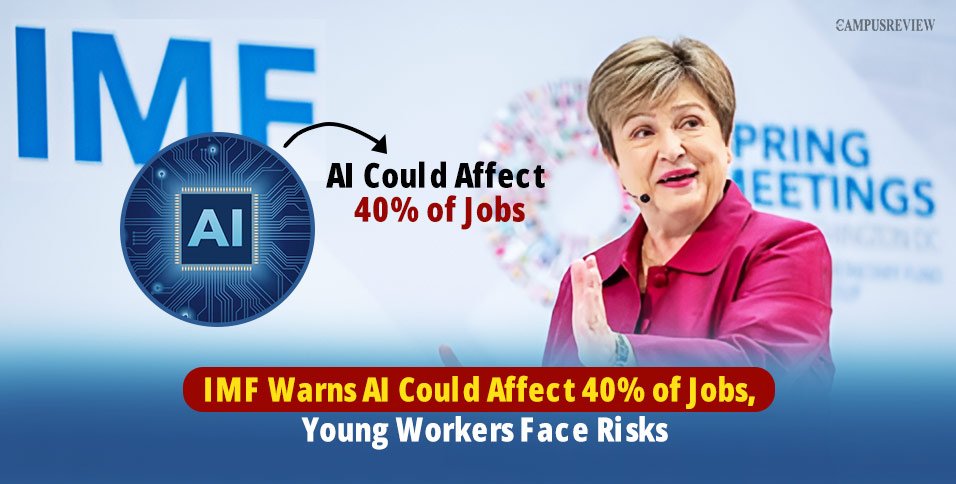
The International Monetary Fund (IMF) has warned that AI could affect 40% of jobs worldwide, with young people and new graduates among those at risk. Speaking at the IMF and World Bank Annual Meetings in Bangkok on October 12, 2026, IMF Managing Director Kristalina Georgieva described AI as a “slow-moving tsunami” that could change the way people work.
The 40% estimate first appeared in an IMF research paper published in January 2024. It does not mean that 40% of jobs will disappear. Instead, AI could take over some tasks or help workers complete them faster.
Young graduates may face challenges if AI replaces routine tasks that often help new employees gain their first work experience.
Key Takeaways at a Glance
| Economy Group | Jobs Exposed to AI |
| Advanced Economies | Around 60% |
| Emerging Markets | Around 40% |
| Low-Income Countries | 23% in Georgieva’s latest remarks (estimated at 26% in the 2024 staff note) |
| Global Workforce | Around 40% |
Source: IMF, “Gen-AI: Artificial Intelligence and the Future of Work,” January 2024. Exposure indicates potential effects on work tasks, not a forecast of job losses.
Why the IMF Assesses AI Exposure Across Jobs
According to the IMF staff research note on AI and the future of work, exposure divides into two main outcomes:
- Task Replacement: Software carries out routine information processing, data organization, and drafting workflows. In some cases, this can reduce employer demand for specific roles.
- Task Enhancement: Workers use AI systems to accelerate analysis and routine production. This can increase individual output and complement existing workplace responsibilities.
In advanced economies, roughly 60% of employment intersects with AI capabilities. The IMF staff paper previously estimated that about half of those exposed positions could benefit from enhanced productivity, while the other half could face reduced labor demand.
Exposure remains lower in low-income economies, at about 23%, though Georgieva noted this lower figure largely reflects that AI tools have not yet fully reached those regions.
What the IMF’s Bangkok Remarks on AI Could Affect 40% of Jobs Mean for Young Workers
Georgieva’s Bangkok remarks highlighted the risks AI poses to young people entering the workforce. As AI takes over routine tasks traditionally assigned to entry-level employees, graduates may find fewer opportunities to gain early work experience.
Singapore President Tharman Shanmugaratnam also noted that demand for graduates’ first jobs is falling, according to Decrypt. However, the impact will vary across industries and countries as employers adopt AI.
Potential Economic and Fiscal Considerations
The panel also addressed broader economic risks associated with technological transition:
- Tax Revenue Risks: Georgieva raised concerns that if AI shifts income from workers to the owners of capital, governments could lose part of the tax base they rely on most heavily.
- Digital Infrastructure Disparities: Poorer economies risk delayed productivity gains if limited internet access and electrical grid constraints prevent them from integrating advanced tools.
What Governments and Universities Can Do
The potential impact of AI on employment creates significant questions for higher education, industry, and public policy. While the Bangkok panel did not issue an official joint policy program, education and labor analysts frequently point to several possible responses:
- Update Course Content: Introduce AI literacy into degree curricula, so students understand how to use digital tools alongside domain expertise and critical thinking.
- Strengthen Work Experience: Expand practical internships, apprenticeships, and applied projects to help students build verifiable experience before graduation.
- Support Retraining Opportunities: Create accessible training pathways for workers whose roles change as employers integrate automated systems.
- Expand Technology Access: Invest in reliable digital infrastructure so lower-income regions can participate in technological developments.
Practical Guidance for Students and Graduates
While the macroeconomic figures describe system-wide shifts, students and early-career jobseekers can take practical steps to navigate this evolving landscape:
- Build AI Literacy: Learn to use modern workplace tools as practical assistants for research, drafting, and data synthesis.
- Prioritise Complementary Capabilities: Cultivate skills that complement AI, including critical thinking, ethical judgment, and interpersonal communication.
- Strengthen Interpersonal Dynamics: Negotiation, team leadership, cross-cultural collaboration, and direct client care remain areas where human interaction adds distinct value.
- Commit to Continuous Learning: Approach technical tools with flexibility, updating workflows as technologies mature.
Recognising that AI could affect 40% of jobs underscores a generational shift in how societies organise work. Proactive institutional policies and focused personal skill-building remain the best route to turning disruption into durable opportunity.
Pranjal Kharche