Why do some bacteria survive an antibiotic while others die? Why did peppered moths turn dark in sooty cities and turn pale again later? Natural selection answers both questions.
Natural selection is the process where organisms with inherited traits that suit their environment survive and reproduce more than others. Over many generations, those traits become more common in the population. It is the main process behind adaptation in evolutionary biology.
This guide answers what is natural selection, explains how the process works, covers its different types, and explores real-world examples.
What Is Natural Selection?
Natural selection occurs when individuals with helpful inherited traits reproduce more successfully, passing those traits to future generations.
Think of the environment as a filter. Every population contains individuals with different traits. The environment tests those traits all the time. Some individuals survive and have many young. Others die early or have few young.
Nobody plans this, and nothing aims for a goal. The filter simply lets some traits pass to the next generation more often than others.
Individuals whose inherited traits fit the environment better survive and reproduce more. Their traits become more common. This repeats every generation.
| Term | Simple meaning |
| Population | A group of the same species living in one area |
| Trait | A feature of an organism, such as fur colour or beak size |
| Gene | A section of DNA that carries instructions for a trait |
| Allele | One version of a gene |
| Adaptation | A trait that helps an organism survive and reproduce in its environment |
| Fitness | How many offspring an individual leaves behind |
Survival of the fittest does not mean the strongest or largest survive. Fitness refers to how well an organism’s traits suit its environment and help it produce offspring. For example, a small, well-camouflaged moth may be fitter than a larger, more visible one.
How Does Natural Selection Work?
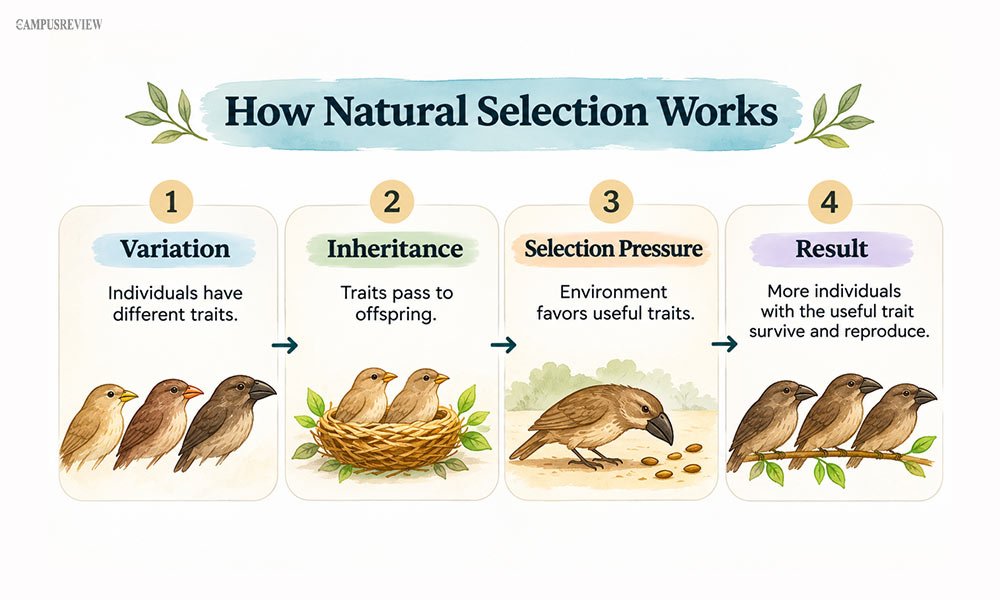
Now that you understand What Is Natural Selection?, let’s look at its four steps of natural selection. These steps repeat in every generation, allowing small changes to build up in a population over time.
Step 1: Variation
Individuals in a population have different traits. Some mice have darker fur. Some finches have deeper beaks. Some bacteria break down an antibiotic and others cannot.
These differences come from genes. Two sources create them:
- Mutation: A mutation is a random change in DNA that occurs when cells copy their genetic material. It can create a new allele. Most mutations have no effect, some are harmful, and a few provide advantages. These beneficial changes are called beneficial mutations.
- Gene shuffling: In sexual reproduction, offspring inherit a new combination of genes from both parents. This creates genetic variation within a population and contributes to genetic diversity.
Step 2: Inheritance
Natural selection only works on traits that parents pass to their young. Biologists call these inherited traits.
| Inherited (selection can act) | Not inherited (selection cannot act) |
| Fur colour set by genes | A tan gained from sunlight |
| Beak depth in finches | Bigger muscles from exercise |
| Antibiotic resistance genes in bacteria | A scar from an injury |
This is why a finch cannot grow a bigger beak just because it needs one. Only the genes it was born with count, and it passes those genes on.
Step 3: Selection Pressure
Selection pressure is any part of the environment that affects who survives and who reproduces. Common pressures include:
- Predators: Animals that hide well escape more often.
- Climate: Heat, cold and drought favour different bodies.
- Food supply: Individuals that can eat the available food survive.
- Disease and chemicals: Resistant individuals live through infections and sprays.
- Mates: Some traits help an animal win a partner, such as a peacock’s tail.
A trait is not good or bad by itself. The environment decides. Black fur helps a mouse on dark rock but hurts it on pale sand. If the environment changes, the pressure changes, and a different trait can win.
Step 4: Differential Reproduction
Differential reproduction means individuals with certain traits produce more offspring than others. Survival alone is not enough; an organism must reproduce to pass on its genes.
- More offspring: Individuals with helpful inherited traits often reproduce more successfully.
- Trait inheritance: Their offspring may inherit these advantageous traits.
- Change in allele frequency: Over generations, the beneficial allele becomes more common in the population.
Even a small reproductive advantage can make a trait more common over time.
Remember: Individuals do not change the genes they were born with. Instead, the genetic makeup of the population changes across generations.
A Worked Example: Mice on Dark Rock
Here is a simplified example that follows the four steps through ten generations.
- Setup: A population of tan mice lives on pale sand near a patch of dark volcanic rock. Hawks hunt them.
- Variation: A mutation gives one mouse in every 100 black fur. Black fur is inherited.
- Selection pressure: Suppose the mice move onto the dark rock. Hawks catch about half of the tan mice in each generation. They catch only about one in ten black mice, because black fur hides them.
- Differential reproduction: Survivors breed. Black mice pass on black fur. More of each new generation is black.
| Generation | Share of black mice |
| Start | 1% |
| After 3 generations | about 6% |
| After 5 generations | about 16% |
| After 7 generations | about 38% |
| After 10 generations | about 78% |
The numbers are illustrative, but they show the pattern. The change looks slow at first, then speeds up as the black allele becomes common. No single mouse changed colour. The population changed because black mice left more young.
What Are Some Real Examples of Natural Selection?
Scientists have watched all four steps happen in nature.
| Example | Selection pressure | Trait that helped | Result |
| Peppered moth | Bird predation on sooty trees | Dark wing colour | Dark moths became common, then rare again |
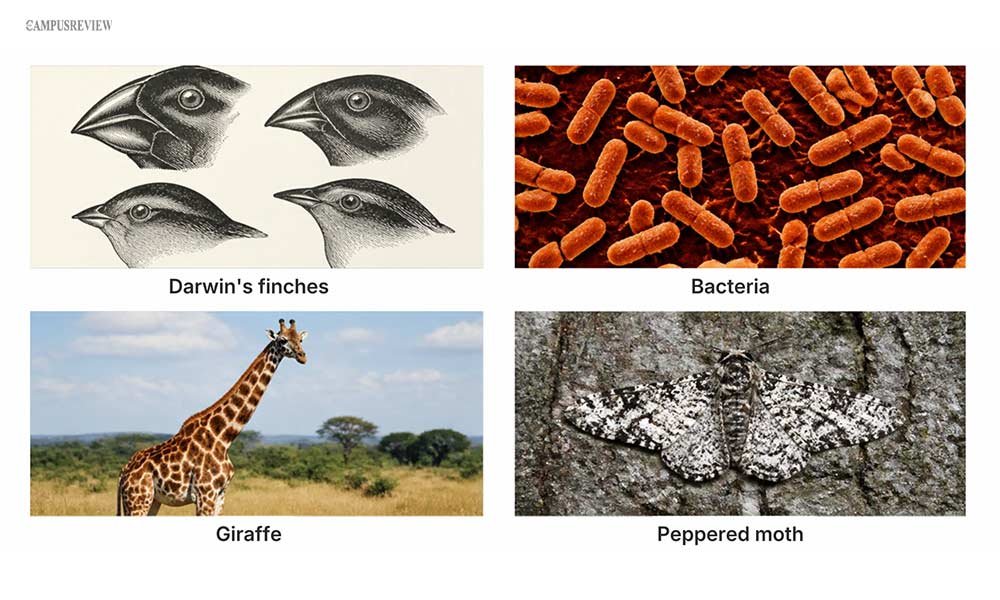
| Darwin’s finches | Drought and tough seeds | Deeper beaks | Average beak size increased |
| Bacteria | Antibiotics | Resistance genes | Resistant strains spread |
| Insects | Pesticides | Pesticide resistance | Resistant pests dominate fields |
Peppered Moth
Peppered moths (Biston betularia) have light and dark wing patterns. Before the Industrial Revolution, light moths blended into lichen-covered trees. Factory soot darkened the bark, making light moths easier for birds to spot.
Dark moths survived better and reached about 98% of the Manchester population by 1895. After Clean Air laws improved conditions, light moths became more common again. Bird predation experiments confirmed this natural selection process.
Darwin’s Finches
For over 40 years, Peter and Rosemary Grant studied finches in the Galápagos Islands. During a 1977 drought, small, soft seeds became scarce, leaving mostly large, hard seeds.
Finches with deeper beaks could crack these seeds and survive. Their offspring inherited deeper beaks, increasing the average beak depth in the next generation.
Antibiotic-Resistant Bacteria and Pesticide-Resistant Insects
Antibiotics kill most bacteria, but resistant bacteria can survive and multiply. They pass resistance genes to future generations. Similarly, some insects survive pesticide exposure, reproduce, and pass resistance to their offspring. Over time, resistant populations become more common.
Giraffe Necks
Giraffes have long necks that help them reach leaves high up in trees. Over generations, giraffes with inherited traits that supported longer necks may have gained advantages in feeding and reproduction.
These traits became more common over time. However, scientists still debate the exact evolutionary pressures behind long necks.
What Are the Types of Natural Selection?
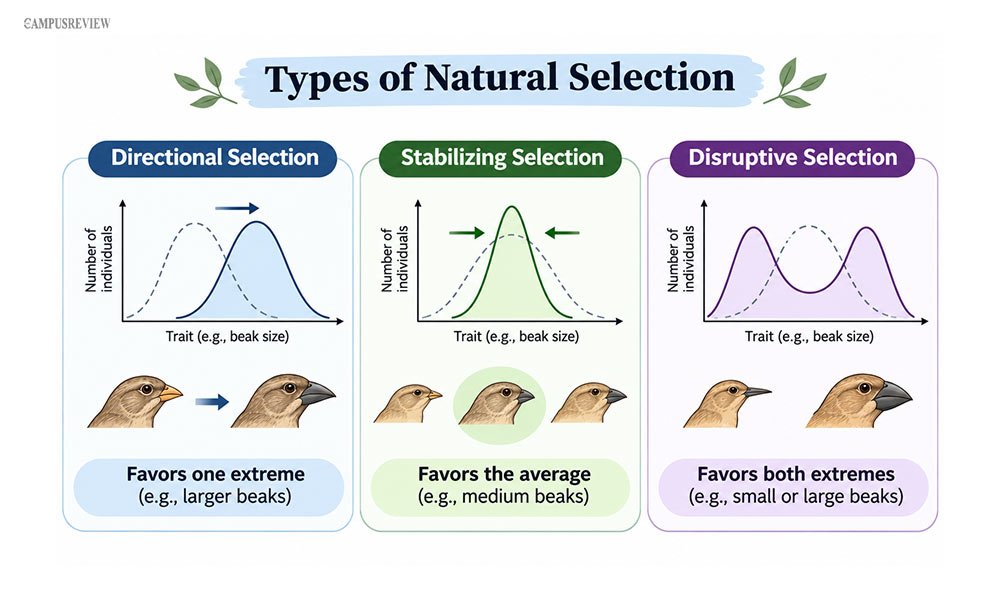
Selection can shape a trait in three ways.
| Type | Which trait wins? | Effect on variation | Example |
| Directional | One extreme | Average shifts | Peppered moth, finch beaks |
| Stabilizing | The middle | Variation shrinks | Robins laying about four eggs |
| Disruptive | Both extremes | Variation grows | Rabbits on dark rock and white snow |
Directional Selection
Directional selection occurs when environmental conditions favour one extreme of a particular trait. Over generations, individuals with that trait reproduce more successfully, shifting the population’s average towards that extreme.
For example, during the Industrial Revolution, dark peppered moths had a survival advantage because they blended into soot-darkened tree trunks.
Stabilizing Selection
Stabilizing selection favours individuals with average or intermediate traits while selecting against both extremes.
For example, birds that lay a moderate number of eggs may raise more surviving chicks than those that lay too many or too few. As a result, the average trait remains relatively stable over generations.
Disruptive Selection
Disruptive selection favours individuals with either extreme of a trait while disadvantaging those with intermediate traits. For example, imagine rabbits living in an environment with dark rocks and white snow.
Dark rabbits blend into the rocks, while white rabbits blend into the snow. Grey rabbits stand out in both places and face more predators. Over generations, the two extreme colour forms may become more common.
Natural Selection vs. Artificial Selection
| Natural selection | Artificial selection | |
| Who selects? | Environmental pressures | Humans |
| Goal | None | Traits people want |
| Where it happens | Wild populations | Farms, kennels and breeding programmes |
Farmers bred wild mustard (Brassica oleracea) into cabbage, broccoli, cauliflower, kale and Brussels sprouts. Genetic drift is different from both. It changes allele frequencies by pure chance, especially in small populations, and it does not build adaptations.
Who Discovered Natural Selection?
Charles Darwin and Alfred Russel Wallace independently developed the theory of natural selection.
- Charles Darwin: Developed his ideas after travelling aboard HMS Beagle and published On the Origin of Species on 24 November 1859.
- Alfred Russel Wallace: Independently reached the same conclusion while collecting specimens in the Malay Archipelago. He wrote an essay explaining his theory in 1858.
- Joint presentation: Both men’s papers were presented at the Linnean Society of London on 1 July 1858.
Darwin’s theory of natural selection helped scientists understand how species evolve and contribute to the biodiversity found on Earth.
Neither scientist knew about genes. Later, scientists combined Darwin and Wallace’s ideas with Gregor Mendel’s work on inheritance to develop the modern theory of evolution.
End Note
Natural selection explains how living things adapt to their environment over generations. But what is natural selection? It is the process in which organisms with helpful inherited traits are more likely to survive and reproduce.
These traits are passed to their offspring and become more common over time. To understand the process, pick one example, follow its four steps, and explain it in your own words.
Pranjal Kharche
Frequently Asked Questions About Natural Selection
1. Does natural selection still happen in humans?
Yes. Natural selection still occurs in humans. For example, lactose tolerance became more common in populations with a long history of dairy farming because adults who could digest milk had a reproductive advantage.
2. Does natural selection create new traits?
No. Mutations create new genetic variations by chance. Natural selection favours inherited variations that provide an advantage in a particular environment.
3. How long does natural selection take?
Natural selection can take a few generations or millions of years, depending on the species and environmental pressures. Bacteria can evolve rapidly, while large animals may take thousands or millions of years to show significant evolutionary changes.