The Campus Review
November 17, 2026
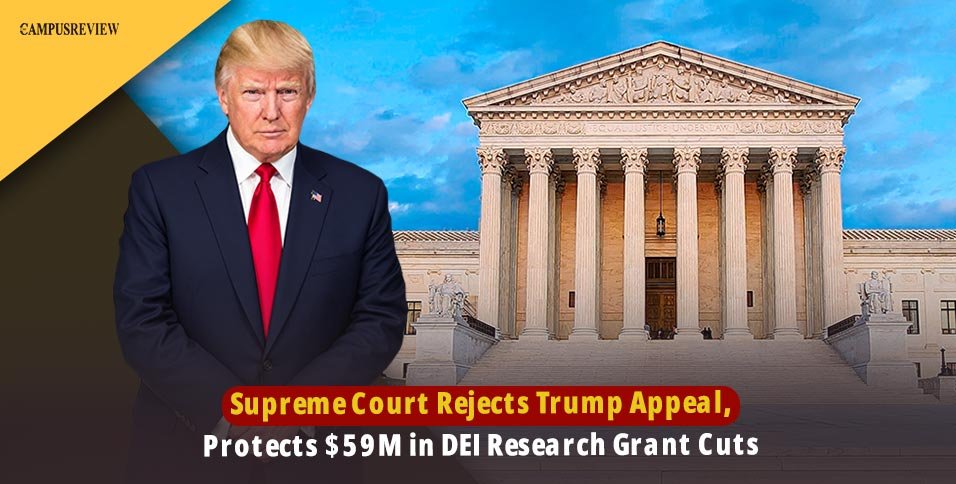
The U.S. Supreme Court on November 16, 2026, declined to hear the Trump administration’s appeal over DEI Research Grant Cuts affecting University of California (UC) researchers. The Supreme Court’s DEI decision leaves lower court protections in place for approximately $59 million in research grants from the National Science Foundation (NSF) and the National Endowment for the Humanities (NEH).
The lower courts found that the cancellations likely violated First Amendment protections against viewpoint discrimination. The decision continues to protect affected University of California research grants while the legal case proceeds.
Why the Supreme Court Rejected the DEI Research Grant Cuts Appeal
The legal dispute, known as Trump v. Thakur, centres on the Trump administration’s authority to cancel federally funded research projects under its broader funding priorities.
The Trump administration filed a US Supreme Court appeal challenging a Ninth Circuit Court of Appeals decision that upheld a preliminary injunction against the cancellations.
However, the justices declined to hear the appeal and provided no explanation for their decision.
The ruling leaves the lower court’s protections intact. However, it does not represent a final Supreme Court judgment on whether the DEI funding cuts were unconstitutional.
How the Trump Administration DEI Policy Affected UC Researchers
The University of California funding dispute began in early 2025 after President Donald Trump issued executive orders targeting federal diversity, equity and inclusion (DEI) initiatives.
Under the Trump administration’s DEI policy, federal agencies began terminating research grants awarded to University of California academics. The affected projects covered areas including climate policy, water management, medicine, humanities, and environmental research.
In June 2025, six UC researchers filed a lawsuit against the administration. They argued that the government had cancelled their grants because of the viewpoints expressed in their research.
The plaintiffs included researchers from UC Berkeley and UC San Francisco who had received funding from three federal agencies:
- Environmental Protection Agency (EPA)
- National Science Foundation (NSF)
- National Endowment for the Humanities (NEH)
The lawsuit challenged how the administration handled academic research funding and the cancellation of previously approved university research grants.
What the Courts Said About the First Amendment
The researchers argued that the government could not terminate previously approved research grants simply because it disagreed with the ideas or viewpoints behind the projects.
Their legal challenge centred on the First Amendment, which protects freedom of speech and expression.
The administration defended its decision by arguing that federal agencies have broad discretion over how taxpayer money is spent. It maintained that the government should be able to direct federal research funding according to its policy priorities.
In May 2026, the Ninth Circuit upheld the lower court’s preliminary injunction in part.
The appeals court explained that the government had not simply chosen which research programmes to support. Instead, it had terminated individual grants within existing programmes based on the perceived viewpoints of researchers.
This distinction became central to the legal dispute.
Which Federal Research Grants Remain Protected?
The original lawsuit involved three federal agencies. However, the EPA claims were subsequently settled separately, leaving NSF and NEH grants at issue in the Supreme Court appeal.
| Federal Agency | Status |
| National Science Foundation (NSF) | Grants covered by the court order remain protected |
| National Endowment for the Humanities (NEH) | Grants covered by the court order remain protected |
| Environmental Protection Agency (EPA) | Claims settled separately |
Approximately $59 million remained in the NSF and NEH grants when they were terminated.
Some awards were scheduled to continue until November 2029.
The Supreme Court’s decision maintains the existing protections for these awards. It does not restore every federal grant affected by the broader DEI funding cuts.
What Researchers and the Government Said
The decision drew different responses from the legal representatives of the researchers and the federal government.
Claudia Polsky, a lawyer representing the University of California researchers, welcomed the Supreme Court’s decision.
In comments to Nature, she said, “The denial is terrific news.”
The Justice Department, meanwhile, indicated that the administration would continue defending its position.
In a statement to Nature, the department said it would “continue to litigate” the lower court order preventing the cancellation of certain federal research grants.
What Happens Next in the DEI Research Grant Cuts Case?
The Supreme Court’s decision keeps the existing grant protections in place, but the legal case is not over. The lower courts must still resolve the researchers’ constitutional claims.
The decision protects about $59 million in funding for now. However, it does not permanently protect all DEI-related research grants or prevent future changes to federal funding priorities.
The DEI Research Grant Cuts case also highlights wider concerns about government control over academic research and federal research funding.
Pranjal Kharche