The Campus Review
November 17, 2026
The United States has long been a leading destination for international students. However, new data from the Institute of International Education (IIE) reveals a shift in global education trends. According to its Open Doors 2026 report, the US International Student Enrollment Decline reached 18% for new international students enrolling at US institutions for the first time during the 2025-26 academic year.
Overall international student numbers declined by 3% to 1,146,163. Rising education costs, visa processing challenges, and growing competition from other study destinations are among the factors affecting international admissions.
The Core Data Behind the US International Student Enrollment Decline
The Open Doors 2026 report highlights differences across academic levels. Graduate programmes experienced a significant decline, while undergraduate enrolment remained almost unchanged.
International Student Enrollment Changes (2025-26):
| Academic Level | Total Enrolled | Percentage Change |
| New International Students | 228,123 | Down 18% |
| Graduate Students | 423,078 | Down 13% |
| Undergraduate Students | 356,165 | Down 0.3% |
| Nondegree Students | 31,135 | Down 18% |
Source: IIE Open Doors 2026 Report.
Why Are International Students Choosing Other Countries?
The IIE’s separate Fall 2026 Snapshot survey, covering more than 800 institutions, identified several challenges affecting international enrolment.
- Visa application process: 88% of surveyed institutions cited visa processing as a barrier.
- Travel restrictions: 70% reported travel-related challenges.
- Global competition: 60% said students were choosing other countries instead.
- Education costs: 45% identified expenses as a factor affecting enrolment.
These findings highlight growing competition from destinations such as the United Kingdom, Canada and Australia.
India and China Remain Top Source Countries for Study Abroad
India remained the largest source of international students in the US for the third consecutive year, with 339,435 students in 2025-26. However, enrolment declined by 6%.
China ranked second with 254,458 students, representing a 4% decrease. Together, the two countries contributed 593,893 students, accounting for approximately 51.8% of the total international student population. These figures highlight the changing study abroad trends among students from the two largest source countries.
Financial impact of declining international student enrollment
The US International Student Enrollment Decline also raises concerns about university finances and the wider economy.
International students contributed nearly $56 billion to the US economy in 2025. They support local businesses through spending on accommodation, food, transport and other services.
Approximately 59% of international students attend public institutions, where many pay nonresident tuition rates. Falling enrolment could therefore put additional pressure on university budgets and campus operations.
Fall 2026 Snapshot Shows Further Enrollment Pressure
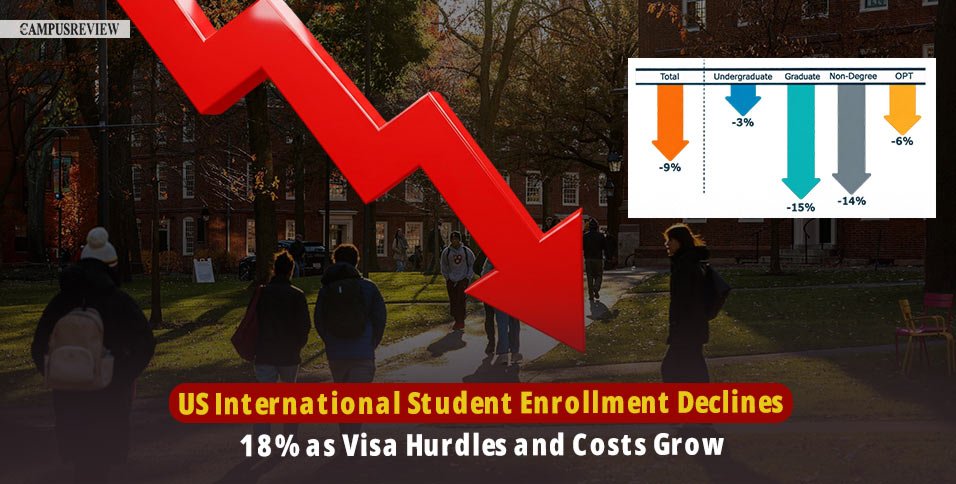
The preliminary Fall 2026 Snapshot indicates that the US International Student Enrollment Decline continued into the 2026-27 academic year.
Overall international student enrolment fell by 9%, while new enrolments declined by 15%. Graduate enrolment decreased by 15%, undergraduate enrolment fell by 3%, and Optional Practical Training (OPT) participation declined by 6%.
This contrasts with the 14% increase in OPT participation recorded in the 2025-26 annual report, when participation reached 335,785 students. OPT allows eligible F-1 students to gain temporary work experience related to their field of study after completing their academic programme.
Pranjal Kharche