The Campus Review
November 20, 2026
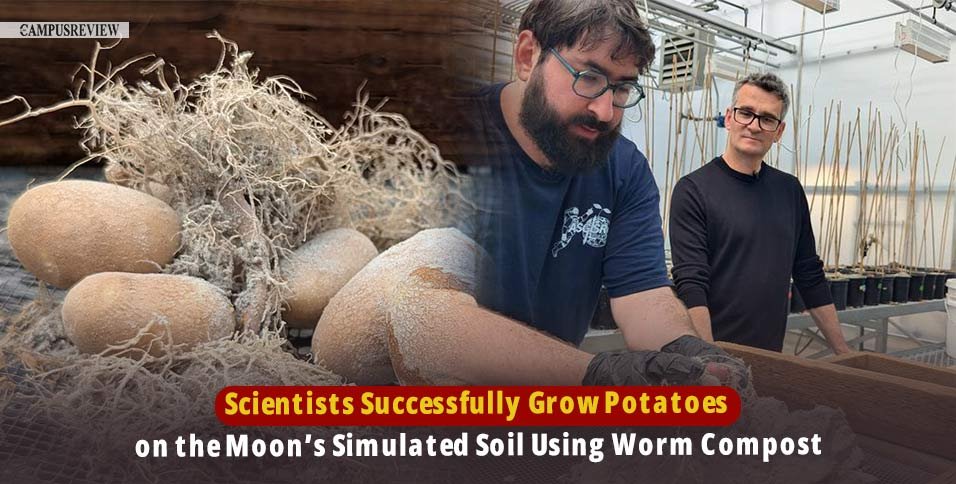
Scientists at Oregon State University have successfully grown nutritious potatoes on the Moon’s simulated dust by mixing it with worm compost. Published in the journal npj Microgravity, this NASA-backed study shows that adding 30% organic compost allows lunar soil to match Earth crop yields.
This breakthrough brings NASA Moon base plans one big step closer to reality, because shipping every meal from Earth costs too much money.
However, turning harsh space dust into a reliable dinner plate still faces major hurdles. Here is a quick breakdown of what researchers achieved, why it works, and what must happen before astronauts harvest their first lunar fries.
Quick Facts: The Lunar Potato Breakthrough
| Study Detail | Key Finding |
| Lead Researcher | Plant biologist Aymeric Goyer at Oregon State University |
| Crop Tested | Modoc potato (a red-skinned, fast-growing variety) |
| Soil Used | Five lab-made lunar regolith simulants vs. fertile Oregon soil |
| Secret Ingredient | Vermicompost (nutrient-rich compost made by worms) |
| Best Result | 30% compost matched Earth-grown yields and nutrition |
| Toxin Levels | No significant jump in natural potato toxins (glycoalkaloids) |
How Scientists Grew Potatoes on the Moon-like Soil
Real Moon dust, known as lunar regolith, is terrible for plants. It has zero nitrogen, no organic matter, and high levels of toxic heavy metals. Without help, crops simply cannot survive in it.
To fix this, Goyer’s team tested different recipes of lunar soil cultivation using lab-made Moon dust and worm compost. Their Moon soil experiments revealed a clear tipping point:
- 0% Compost: Plants suffered stunted growth and produced almost no roots or tubers.
- 5% to 15% Compost: Plants showed partial recovery and grew a few small roots and tubers.
- 30% Compost: Plants matched the growth and harvest of potatoes grown in top-tier Oregon farmland.
Why did worm compost change everything? It acts like a shield.
“Without organic matter, potatoes take up too much heavy metals, which can become toxic for the plants. Organic matter helps make heavy metals less available to the plants, so plants do not over-accumulate them,” said Aymeric Goyer.
Study co-author David Handy added a clear explanation of this defense mechanism:
“We believe the compost helps balance some of the toxicity we see in lunar regolith by reducing plant exposure to harmful compounds”.
Why Potatoes Lead the Race for Lunar Agriculture
Shipping food across 238,000 miles of space is not practical for sustainable lunar living. As NASA prepares for long-term stays under the Artemis Program, scientists need crops that deliver maximum fuel in tiny greenhouse spaces.
Potatoes in lunar soil stand out for four simple reasons:
- High Calorie Output: They produce more calories per square foot than most other staple crops.
- Packed Nutrition: They offer vitamin C, quality protein, fiber, and more potassium than a banana.
- High Fullness Factor: Potatoes keep astronauts feeling full longer during demanding workdays.
- Menu Versatility: Crews can microwave, bake, or mash them easily.
Growing food on the Moon will not rely on spuds alone. Researchers also harvested chickpeas in simulated Moon dirt earlier in 2026, and other teams are testing tomatoes, lettuce, and alfalfa to build a balanced astronaut food supply.
Are Moon-Grown Potatoes Safe for Astronauts to Eat?
The short answer is not yet. While the lab results excite space agriculture experts, this study happened under comfortable Earth conditions. Before potatoes on the Moon become a real meal, scientists must solve four gaps:
- Real Moon Dust: The team used lab-made replicas, not genuine soil brought back from the Moon.
- Space Radiation and Gravity: The lab did not simulate cosmic radiation, the vacuum of space, or weak lunar gravity.
- Trace Metals: Although natural potato toxins stayed safe, some tubers still absorbed extra copper, zinc, and aluminum, and showed active stress genes.
- The Taste Test: Researchers used every tiny 10-gram potato for lab testing, so nobody has actually tasted one yet.
Goyer’s lab is already pushing forward. A follow-up study using larger pots produced normal, store-sized potatoes, and an upcoming paper will test 10 different potato varieties to find the toughest space crop.
How Space Farming Helps People on Earth
Food production in space is not just about astronauts. Solving harsh soil problems on the Moon creates practical tools for struggling farms right here at home.
“The technologies that are invented as a result can be used to produce food in regions of low agricultural output that are reliant on shipments, such as inner cities and desert communities,” Handy explained.
These space farming methods could also help farmers clean up polluted land and rebuild worn-out soil worldwide.
What Happens Next for Lunar Farming?
Growing potatoes on the Moon is no longer pure science fiction. NASA aims to test real plant growth on the lunar south pole through future Artemis missions, turning barren rock into working greenhouses. The soil is harsh and the timeline spans years, yet one humble crop just proved that humans can learn to feed themselves far beyond Earth.
Pranjal Kharche
Also Read – GRPS Fires Deputy Superintendent After Months of Leave and Staff Complaints