Long before modern campuses, digital classrooms, and global rankings, a few remarkable institutions laid the foundation for higher education. These universities survived wars, political change, cultural shifts, and centuries of transformation. Yet they continued to educate scholars, leaders, scientists, and thinkers who shaped the world. Because of their lasting influence, they remain among the oldest universities in the world and continue to inspire academic excellence today.
This article explores ten of the most historic universities still connected to their medieval roots. It covers their founding timelines, historical backgrounds, contributions to the evolution of higher education, notable alumni, and global impact. Additionally, it compares their development with other ancient institutions. Understanding these universities offers valuable insight into how knowledge, research, and intellectual traditions evolved across different civilizations and continue to influence education in the modern era.
Here are the 10 oldest universities in the world
| University & Location | Founding Year | Founder / Originating Figure | Latest Modern Course / Innovation Introduced |
| University of Al-Quaraouiyine (Fez, Morocco) | 859 AD | Fatima al-Fihri | Modern Islamic Finance & Digital Arabic Linguistics |
| Al-Azhar University (Cairo, Egypt) | 970 AD | Fatimid Caliphate (Al-Mu’izz) | Advanced Renewable Energy Engineering & Cybersecurity |
| University of Bologna (Bologna, Italy) | 1088 AD | Irnerius (and the Guild of Scholars) | Executive Master in Artificial Intelligence & Business Valuation |
| University of Oxford (Oxford, United Kingdom) | 1096 AD | Unknown (Rapid growth after 1167) | MSc in AI for Biomedicine & Ethical Governance |
| University of Salamanca (Salamanca, Spain) | 1134 AD | King Alfonso IX of León | Global Digital Law & Transnational Legal Studies |
| University of Paris (Sorbonne) (Paris, France) | 1150 AD | Robert de Sorbon (Cathedral Teachers) | Quantum Computing Foundations & Molecular Engineering |
| University of Cambridge (Cambridge, United Kingdom) | 1209 AD | Displaced Scholars from Oxford | Master of Studies in Sustainability Leadership |
| University of Padua (Padua, Italy) | 1222 AD | Scholars seeking Academic Liberty | Human-Centered Robotics & Space Exploration Sciences |
| University of Naples Federico II (Naples, Italy) | 1224 AD | Emperor Frederick II (Holy Roman Emperor) | Developer Training at the Apple Developer Academy |
| University of Siena (Siena, Italy) | 1240 AD | Commune of Siena (Local Magistrate) | Sustainable Development & Bio-Geomaterials |
University of Al-Quaraouiyine
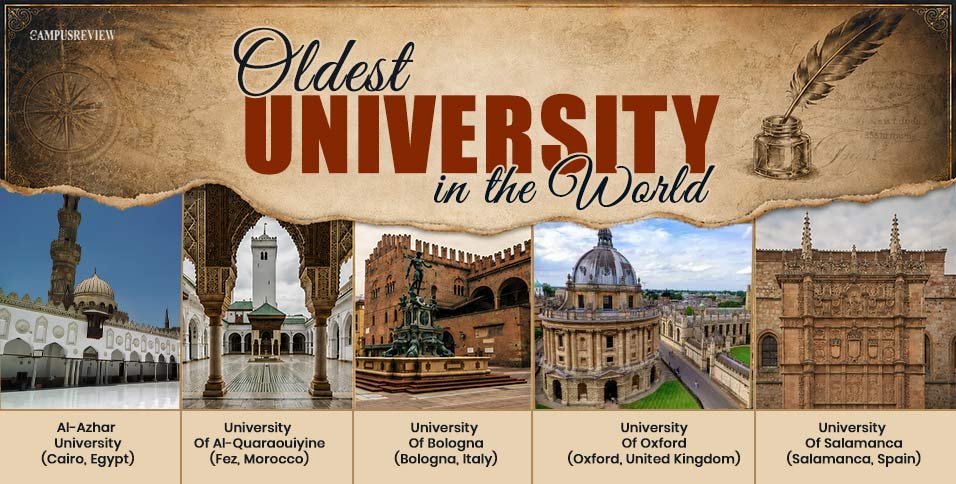
The University of Al-Qarawiyyin began in 859 CE in Fez, Morocco. Fatima al-Fihri founded the institution with a vision for education and community growth. Initially, the university served as a mosque and learning center. However, it soon expanded its academic role. Today, many historians recognize it as the oldest continuously operating higher education institution. Because of its long history, scholars often place it among the oldest universities in the world.
During the medieval period, Al-Qarawiyyin attracted students from North Africa, Europe, and the Middle East. The institution taught theology, mathematics, astronomy, grammar, and law. Consequently, it became a major intellectual center. Moreover, it helped preserve and spread knowledge during important historical periods. This contribution strengthened educational traditions far beyond Morocco.
Several notable scholars studied or taught there. These figures influenced religious, scientific, and cultural thought across regions. Furthermore, Al-Qarawiyyin helped shape early higher education systems. Unlike many European universities, it developed within the Islamic scholarly tradition. Nevertheless, both traditions shared a commitment to advanced learning. Its enduring legacy continues to influence global education and academic excellence today.
Al-Azhar University
Al-Azhar University traces its origins to 970 CE in Cairo, Egypt. The Fatimid Caliphate established the institution as a center for learning and religious scholarship. Soon afterward, students gathered from different regions to study various subjects. As the institution expanded, it developed into one of the world’s most respected educational centers. Therefore, Al-Azhar remains a key part of higher education history.
The university played an important role in preserving knowledge across centuries. Students studied Islamic law, philosophy, medicine, mathematics, and language. Consequently, Al-Azhar became a bridge between cultures and intellectual traditions. Moreover, it adapted to changing educational needs while preserving its historical mission. This balance allowed the institution to remain relevant across generations.
Many influential religious leaders, scholars, and thinkers emerged from Al-Azhar. Their work shaped legal systems, education, and cultural development across numerous countries. Compared with medieval European universities, Al-Azhar followed a different educational structure. However, both systems promoted advanced scholarship and intellectual debate. Today, the university continues to educate thousands of students while maintaining its status as one of history’s most significant centers of learning.
University of Bologna
Founded in 1088 CE, the University of Bologna holds a special place in academic history. Many scholars consider it the oldest university in the Western world. Unlike earlier learning centers, Bologna developed a structured university model. As a result, it influenced higher education across Europe. Because of this role, it frequently appears among the oldest universities in the world.
The university gained fame for legal studies, especially Roman law. Students traveled from different countries to study under respected professors. Consequently, Bologna became an international academic community. Furthermore, it introduced governance systems that allowed students significant participation. These innovations later influenced university administration throughout Europe.
Many distinguished graduates and scholars contributed to politics, law, science, and literature. Their achievements extended Bologna’s influence far beyond Italy. Compared with institutions such as Al-Qarawiyyin and Al-Azhar, Bologna followed the European university tradition. Nevertheless, all three institutions supported intellectual growth and knowledge preservation. Today, Bologna continues to operate as a leading university while maintaining a direct connection to nearly a millennium of educational history.
University of Oxford
The University of Oxford began teaching by 1096 CE, making it the oldest university in the English-speaking world. Although its exact founding date remains uncertain, historical records confirm early academic activity. Over time, Oxford expanded rapidly and attracted scholars from across Europe. Consequently, it became one of the most influential educational institutions in history.
Oxford played a major role in the evolution of higher education. The university developed colleges, research traditions, and academic standards that many institutions later adopted. Moreover, it encouraged intellectual inquiry across subjects such as philosophy, science, law, and literature. These developments strengthened its global reputation and academic influence.
The university produced numerous leaders, scientists, writers, and innovators. Notable alumni include prime ministers, Nobel Prize winners, and renowned authors. Compared with Bologna and Cambridge, Oxford shares similar medieval roots. However, each institution developed unique traditions and strengths. Today, Oxford continues to shape global education through research, teaching, and international collaboration. Its centuries of achievement demonstrate the lasting value of academic excellence and intellectual curiosity.
University of Salamanca
The University of Salamanca officially received recognition in 1218 CE. King Alfonso IX supported its establishment, which strengthened higher education in Spain. Soon afterward, Salamanca became one of Europe’s leading intellectual centers. Because of its historical importance, many scholars include it among the oldest universities in the world.
The institution gained prominence through studies in law, theology, philosophy, and language. Furthermore, it contributed significantly to debates about exploration, governance, and human rights. During Spain’s Golden Age, Salamanca influenced important political and social discussions. As a result, its academic impact reached beyond national borders.
Several distinguished scholars and thinkers studied or taught there. Their ideas shaped legal systems and intellectual movements across Europe and Latin America. Compared with Oxford and Bologna, Salamanca emerged slightly later. However, it quickly established a strong academic reputation. Today, the university preserves its historic character while supporting modern research and education. Its long history reflects the continuing importance of universities in advancing knowledge, critical thinking, and cultural development across generations.
University of Paris (Sorbonne)
The University of Paris emerged during the late twelfth century and became one of medieval Europe’s leading educational institutions. Scholars and teachers gradually formed a recognized academic community. As enrollment increased, the university gained influence throughout Europe. Therefore, it played a central role in shaping the development of higher education.
The institution became especially known for theology, philosophy, and the liberal arts. Students from different kingdoms traveled to Paris to study under respected scholars. Consequently, the university helped spread intellectual ideas across the continent. Moreover, its educational structure influenced many later universities.
The university’s history includes periods of reform, closure, and reorganization. Despite these changes, its intellectual legacy remains powerful. Many important theologians, philosophers, and writers studied there. Compared with Oxford and Bologna, the University of Paris focused strongly on theological scholarship. Nevertheless, all three institutions contributed significantly to academic progress. Today, the Sorbonne name continues to represent educational excellence and scholarly achievement throughout the world.
University of Cambridge
The University of Cambridge was founded in 1209 CE after scholars left Oxford and established a new academic community. From its earliest years, Cambridge emphasized rigorous scholarship and intellectual exploration. Over time, it grew into one of the world’s most respected universities. Therefore, many historians place it among the oldest universities in the world.
Cambridge contributed greatly to the evolution of higher education. The university strengthened research methods and expanded knowledge across scientific and humanistic disciplines. Furthermore, its collegiate system created a unique academic environment. These developments influenced universities across many countries.
The institution produced remarkable alumni, including scientists, mathematicians, political leaders, and writers. Figures such as Isaac Newton transformed human understanding through groundbreaking discoveries. Compared with Oxford, Cambridge shares similar historical foundations. However, each university developed distinct traditions and academic strengths. Today, Cambridge continues to influence global education through research excellence and innovation. Its enduring success highlights the value of curiosity, disciplined learning, and scholarly collaboration.
University of Padua
The University of Padua began in 1222 CE when scholars sought greater academic freedom. This decision shaped the institution’s identity and future development. As the university expanded, it gained recognition for independent thinking and scientific inquiry. Consequently, Padua became one of Europe’s most respected educational centers.
The university played a vital role in advancing medicine, astronomy, law, and philosophy. Moreover, it encouraged open discussion and research. These values supported important discoveries and academic progress. As a result, Padua influenced educational practices throughout Europe.
Several renowned scholars worked or studied there, including Galileo Galilei. Their contributions helped transform scientific understanding and research methods. Compared with Bologna, Padua placed a stronger emphasis on scientific advancement. However, both institutions significantly shaped higher education. Today, the university continues its tradition of innovation and academic excellence. Its long history demonstrates how intellectual freedom can drive discovery, inspire creativity, and expand human knowledge across generations and cultures.
University of Naples Federico II
Founded in 1224 CE by Emperor Frederick II, the University of Naples Federico II stands among Europe’s oldest public universities and also among the one of the oldest universities in the world. Unlike many medieval institutions, it began as a state-supported university. Therefore, it introduced a different model for higher education. Because of this distinction, it often appears in discussions as well
The university aimed to educate administrators, legal experts, and scholars for public service. Consequently, it strengthened the connection between education and governance. Moreover, it expanded academic opportunities across southern Italy. Over time, the institution added new fields of study and adapted to changing social needs.
Many influential graduates contributed to politics, science, literature, and public administration. Their achievements increased the university’s reputation throughout Europe. Compared with Bologna and Padua, Naples developed under stronger government involvement. Nevertheless, all three institutions helped advance higher education. Today, the university remains a major center for research and learning. Its history demonstrates how public investment in education can create lasting intellectual and economic benefits.
University of Siena
The University of Siena officially began in 1240 CE and quickly became an important center of learning in medieval Italy. Local authorities supported its growth and encouraged academic development. As enrollment expanded, Siena attracted students from different regions. Consequently, the university established a respected position within European education.
The institution gained recognition for law, medicine, and the humanities. Furthermore, it contributed to the broader evolution of higher education through centuries of continuous teaching. Academic traditions remained strong even as educational needs changed. Therefore, the university successfully balanced historical heritage with modern learning.
Many graduates and scholars influenced professional fields, public service, and intellectual life. Their work extended Siena’s impact beyond Italy. Compared with older institutions such as Bologna and Oxford, Siena entered the academic landscape later. However, it still belongs to the distinguished group of ancient universities that shaped European scholarship. Today, the university continues to support research, innovation, and cultural preservation while honoring a rich educational legacy that spans nearly eight centuries.
End Note
The story of these oldest universities in the world extends far beyond age alone. Their true significance lies in their ability to preserve knowledge while adapting to changing societies. Each institution contributed to the development of scholarship, research, governance, law, science, and culture. Moreover, their influence helped shape many educational systems that exist today.
A closer examination reveals an important pattern. The most enduring institutions consistently balanced tradition with innovation. They protected intellectual heritage while embracing new ideas and disciplines. That combination remains a defining characteristic of successful universities worldwide. As higher education continues to evolve, these historic institutions provide a valuable benchmark. Their centuries of resilience demonstrate that lasting academic influence comes not from prestige alone, but from a continuous commitment to learning, discovery, and societal progress.
Also Read: Largest University in the World: Scaling Beyond Land
Tejas Tahmankar