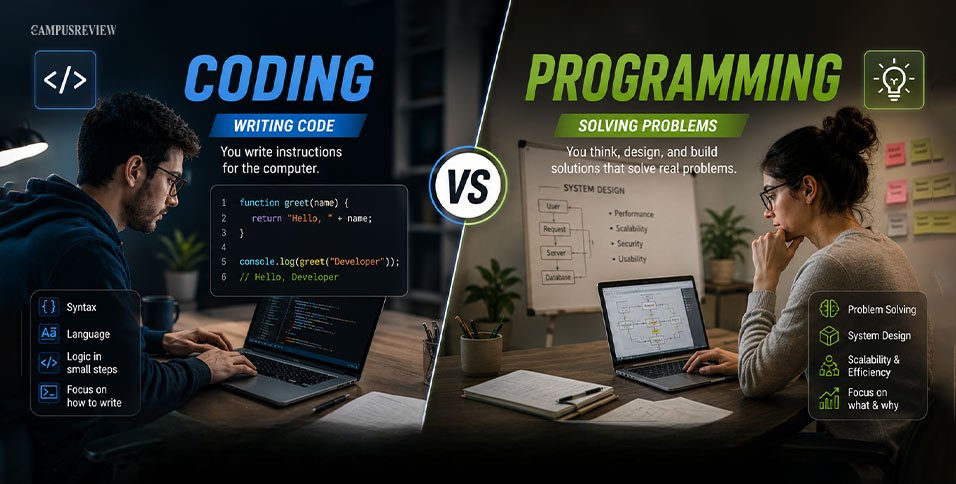
Software careers attract millions of students every year. However, many beginners still confuse coding and programming. People often use both words together, yet the difference remains huge. The confusion resembles comparing a bricklayer with an architect. Both help build a house, but both perform very different responsibilities. That same distinction explains coding vs programming in modern software development.
Today, this difference matters more than ever. Google’s March 2026 DORA insight revealed that 90% of technology professionals now use AI at work, while more than 80% believe AI improves productivity. Therefore, software companies now value logic, architecture, and problem-solving more than repetitive syntax writing. This guide explains coding vs programming in simple language, explores the required skills, discusses career opportunities, and helps beginners choose the right learning path.
Coding vs Programming: What Is the Actual Difference?
Many beginners search for coding vs programming because both terms sound similar. However, both concepts operate at different levels inside software development.
Coding means writing instructions in a programming language. A coder converts human ideas into machine-readable syntax. Python, JavaScript, Java, and C++ all help coders create software instructions.
Programming covers a much larger process. A programmer plans software structure, designs system logic, tests applications, fixes errors, manages resources, and improves performance. Therefore, programming includes coding, but coding alone does not represent complete programming.
A simple way to understand coding vs programming involves responsibility. Coders focus on translating instructions into code. Programmers focus on solving problems through software systems.
This distinction becomes clearer through a real-world analogy.
The House Analogy: Understanding Coding and Programming Without the Jargon
The easiest way to understand coding vs programming involves imagining a house construction project.
The programmer acts like the architect and engineer. First, the programmer designs the blueprint. Next, the programmer calculates structural requirements. Then, the programmer decides room placement, electrical flow, plumbing systems, and material efficiency. Finally, the programmer ensures the complete structure functions correctly.
The coder acts like the bricklayer and carpenter. The coder follows instructions from the blueprint and builds walls, installs windows, and assembles physical structures using specialized tools.
Both roles remain important. However, both roles require different levels of planning and decision-making.
This analogy explains why coding vs programming creates confusion among beginners. Many students see visible code on screens and assume programming only means typing syntax. In reality, professional software development requires planning, testing, debugging, optimization, and maintenance.
For example, imagine a food delivery application. A coder may create login pages or payment buttons. Meanwhile, a programmer designs database architecture, delivery algorithms, security systems, and server communication.
Now that the conceptual difference looks clearer, the technical distinction becomes easier to understand.
Difference Between Coding and Programming: Head-to-Head Comparison
The discussion around coding vs programming becomes easier through direct comparison.
| Feature | Coding | Programming |
| Main Goal | Write syntax | Build complete software systems |
| Focus Area | Instructions and execution | Logic, architecture, and optimization |
| Complexity | Lower | Higher |
| Tools Used | Code editors, IDEs | IDEs, testing tools, DevOps systems |
| Required Knowledge | Syntax and debugging | Algorithms, system design, workflows |
| Outcome | Functional code | Scalable software solutions |
| Thinking Style | Tactical execution | Strategic problem-solving |
The biggest distinction appears inside the Software Development Life Cycle, also called SDLC.
Microsoft Learn defines the Software Development Life Cycle as a “multistage, systematic process for developing software systems.” This definition strongly supports the broader meaning behind coding vs programming.
The SDLC usually includes six stages:
- Requirement analysis
- Planning
- Coding
- Testing
- Deployment
- Maintenance
Coding only represents one phase inside this larger process. Programming connects all six stages together.
This difference matters even more today because AI tools continue changing software development.
According to Google’s DORA research, the most common AI use cases in software development include code generation, information retrieval, code review, and testing. Therefore, companies increasingly expect developers to understand logic, architecture, and debugging rather than memorizing syntax alone.
As a result, coding vs programming no longer represents a debate about typing speed. Instead, the conversation now focuses on critical thinking and system design.
Modern developers increasingly work with AI copilots. However, AI tools still require human judgment. AI can generate syntax quickly, yet AI often struggles with scalability, edge cases, security flaws, and business logic.
Consequently, programmers now spend more time reviewing systems, validating outputs, and optimizing workflows. Meanwhile, coders who only depend on syntax repetition may face difficulty adapting to modern engineering expectations.
The transition from coding toward programming therefore reflects an industry-wide evolution.
That evolution also changes the skill requirements for beginners.
Coding Skills vs Programming Skills: What Do You Actually Need?
The skills required for coding vs programming differ significantly. Although both roles overlap sometimes, each path demands different strengths.
The Coder’s Toolkit
A coder mainly focuses on writing and understanding syntax.
Essential coding skills include:
- Syntax fluency in languages like Python or JavaScript
- Understanding variables, loops, functions, and conditions
- Familiarity with text editors and IDEs
- Basic Git and version control knowledge
- Fast debugging and error correction
- Attention to detail
Coding requires precision because computers follow instructions exactly. Even one misplaced symbol can break an application.
Beginners usually start with Python because the language remains highly readable.
IBM describes Python as a high-level programming language with simple, easy-to-learn, and highly readable syntax. Therefore, Python helps beginners understand coding vs programming without overwhelming technical complexity.
A coder also needs patience. Many beginners expect software development to work instantly. However, debugging often teaches more than successful execution.
The Programmer’s Toolkit
Programming demands broader thinking.
A programmer must understand:
- Algorithms and data structures
- Software architecture
- Object-oriented programming
- Database systems
- API communication
- Testing methodologies
- DevOps workflows
- Performance optimization
- Resource management
Programming also requires strong analytical ability. A programmer must predict how systems behave under pressure, scale applications efficiently, and reduce long-term maintenance costs.
For example, a programmer designing a banking application must consider:
- Security layers
- Transaction speed
- Database efficiency
- Fraud prevention
- Server reliability
- User authentication
Therefore, programming extends far beyond writing code.
The coding vs programming discussion also involves mindset differences.
A coder often asks:
- “Does this code work?”
A programmer usually asks:
- “Will this system remain efficient after one million users?”
That strategic difference explains why advanced programming roles command higher salaries.
The chosen skill set also shapes future career opportunities.
Programming Career Opportunities and Market Trajectories
The career landscape surrounding coding vs programming continues evolving rapidly.
Many beginners start with coding-focused roles because those jobs require narrower technical depth.
Typical coder-first roles include:
- Junior Web Developer
- Front-End Developer
- Automation Specialist
- QA Tester
- WordPress Developer
- Scripting Assistant
These roles mainly involve implementing features, fixing bugs, and maintaining existing systems.
However, programming-focused careers usually involve larger responsibility.
Typical programmer-first roles include:
- Full-Stack Software Engineer
- Systems Architect
- Backend Engineer
- Cloud Infrastructure Engineer
- Lead Data Platform Engineer
- DevOps Engineer
These professionals solve business problems at scale.
The salary difference between coding vs programming also reflects responsibility differences.
A coder mainly executes technical instructions. Meanwhile, a programmer designs systems that directly affect company performance, operational efficiency, and scalability.
For example, an optimized payment system may save millions in infrastructure costs. Similarly, efficient architecture can reduce downtime, improve cybersecurity, and increase user retention.
Therefore, companies often pay higher salaries to professionals who understand software systems strategically.
The AI revolution also changes hiring patterns.
Many repetitive coding tasks now receive automation support through AI tools. Consequently, employers increasingly prioritize:
- Problem-solving ability
- System thinking
- Code review expertise
- Architecture understanding
- Communication skills
This trend explains why coding vs programming matters strongly for career planning.
Students who only memorize syntax may struggle long term. Meanwhile, learners who understand software logic can adapt across technologies.
Still, beginners should not feel pressured to master everything immediately.
Every successful programmer first learned basic coding.
That reality leads naturally toward the best beginner roadmap.
Is Coding or Programming Better for Beginners? The Step-by-Step Roadmap
The answer to coding vs programming for beginners remains straightforward.
Start with coding first. Then gradually transition toward programming.
This sequence works because coding builds practical familiarity. Without syntax knowledge, beginners often feel overwhelmed by advanced concepts like architecture or algorithms.
A student cannot design a skyscraper before understanding bricks and foundations.
Therefore, beginners should follow a structured learning roadmap.
Month 1: Learn Basic Coding Syntax
Choose one beginner-friendly language.
Python works especially well because of its readability and simpler structure.
During this stage, focus on:
- Variables
- Loops
- Functions
- Conditional statements
- Input and output
- Simple debugging
Do not chase multiple languages immediately.
One language builds stronger foundations than five partially learned languages.
The coding vs programming distinction becomes clearer during this phase because beginners start understanding how software instructions behave.
Month 2 to Month 3: Build Small Projects
Projects accelerate learning dramatically.
Build:
- Calculator applications
- To-do lists
- Weather apps
- Basic games
- Expense trackers
Projects reveal logical mistakes quickly. Consequently, debugging improves problem-solving ability.
This stage also teaches an important lesson.
Software rarely works perfectly during the first attempt.
Beginners, therefore, develop patience, adaptability, and structured thinking.
Month 4 and Beyond: Transition Into Programming
After understanding syntax, students should study larger programming concepts.
Focus areas should include:
- Data structures
- Algorithms
- Database systems
- APIs
- System design
- Object-oriented programming
- Software architecture
At this stage, coding vs programming transforms from theory into practical understanding.
Students begin thinking beyond syntax.
They start asking:
- Why does this system scale?
- Why does this application fail under traffic?
- Why does database optimization matter?
That shift marks the transition from coder toward programmer.
Beginners should also understand an important industry reality.
Technology changes constantly. Languages evolve rapidly. AI tools improve continuously.
However, strong programming logic remains valuable across every technological generation.
That reality explains why companies increasingly seek adaptable problem-solvers instead of syntax memorization specialists.
Before concluding, a quick self-check can help identify the current learning stage.
Quick Self-Assessment Checklist
A learner currently focuses on coding if:
- Syntax feels challenging
- Debugging consumes significant time
- Small projects still feel difficult
- Logic building requires practice
A learner currently focuses on programming if:
- System optimization becomes interesting
- Scalability questions appear naturally
- Architecture patterns make sense
- Complex debugging feels manageable
Both stages remain valuable.
However, progression matters most.
Beyond the Syntax: Elevating Your Development Journey
The discussion around coding vs programming ultimately reflects depth of responsibility. Coding introduces software creation through syntax and execution. Programming expands that foundation into architecture, scalability, testing, optimization, and strategic problem-solving.
Google Research notes that modern developers continuously write, build, test, and release software across multiple programming environments and systems. Therefore, long-term success depends less on memorizing syntax and more on understanding systems logically.
Coding gets beginners into the technology industry. Programming helps professionals shape the future of software itself. Focus on solving problems instead of simply translating instructions. That mindset creates stronger careers, sharper technical judgment, and greater adaptability during the AI-driven software era.
Which stage currently feels more challenging: writing code or designing software logic? Share the answer and continue the conversation.
Tejas Tahmankar