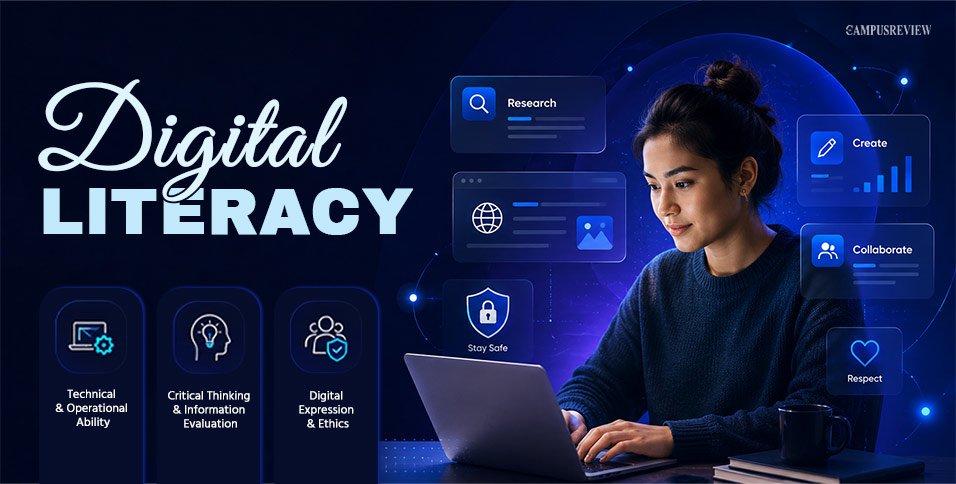
A person can now pay bills, attend classes, apply for jobs, store documents, and verify news through a single screen. However, modern technology demands more than simple screen usage. Today, people must evaluate information, protect privacy, detect misinformation, and communicate responsibly online. That shift explains why digital literacy now shapes education, careers, and daily life across the world.
UNESCO reported in 2025 that more than half of the world’s illiterate adults, around 441 million people, live in just 10 countries. Therefore, literacy and digital literacy now stand closely connected in modern society. This guide explains the definition of digital literacy, the core skills behind it, the role of the Northstar digital literacy assessment, and the practical ways people can build stronger digital capability for work and life.
What Is Digital Literacy? Definition, Meaning, and Core Pillars
Digital literacy means the ability to access, understand, evaluate, create, and communicate information through digital technologies safely and effectively. In simple terms, digital literacy helps people use technology with confidence, awareness, and responsibility.
Many people ask, “What is digital literacy in daily life?” The answer goes far beyond operating a smartphone or browsing social media. True digital literacy includes critical thinking, online safety, ethical communication, and responsible content sharing.
International frameworks strongly support this broader understanding. UNESCO explains that digital literacy combines technical ability with communication, evaluation, and information management. Likewise, the European Commission’s DigComp framework treats digital literacy as a set of interconnected life skills instead of isolated technical actions.
As technology evolves rapidly, digital literacy also evolves. Therefore, modern users must adapt continuously to changing systems, algorithms, and digital risks.
Pillar 1: Technical and Operational Ability
The first pillar focuses on practical usage. People must know how to operate devices, navigate applications, manage files, and use internet tools securely.
These skills include:
- Using browsers effectively
- Managing cloud storage
- Operating productivity software
- Creating secure passwords
- Understanding privacy settings
- Protecting devices from cyber threats
Without these abilities, users struggle to function in digital environments. Moreover, weak technical skills often increase exposure to scams, malware, and misinformation.
The importance of these competencies continues to grow. In 2023, only 56% of EU adults had basic digital skills, even though 92% of workers used digital technologies in their jobs. This gap clearly shows why digital literacy matters in modern economies.
Pillar 2: Critical Thinking and Information Evaluation
The second pillar addresses information analysis. Today, people encounter manipulated media, fake news, algorithmic bias, and AI-generated content daily. Therefore, digital literacy now requires analytical judgment.
A digitally literate person can:
- Verify information sources
- Identify misleading headlines
- Evaluate website credibility
- Detect deepfakes
- Recognize phishing attempts
- Distinguish facts from opinions
This ability protects individuals from online manipulation. Furthermore, it supports healthier public discussion and informed decision-making.
Search engines and social media platforms constantly influence visibility and engagement. Consequently, people must understand how algorithms shape digital experiences. Without this awareness, users may unknowingly consume biased or inaccurate information repeatedly.
Pillar 3: Digital Expression and Ethics
The third pillar focuses on responsible participation. Modern communication happens through emails, comments, videos, collaborative tools, and social platforms. Therefore, digital literacy also includes respectful communication and ethical online behavior.
This pillar covers:
- Digital footprint awareness
- Ethical content creation
- Online collaboration
- Respectful communication
- Copyright awareness
- Responsible AI usage
Every online action creates a permanent trace. As a result, students, employees, and professionals increasingly face consequences for careless digital behavior.
Digital literacy also encourages balanced participation. Instead of passive scrolling, users learn how to create informed, useful, and respectful digital content.
Literacy and Digital Literacy: Understanding the Modern Difference
Traditional literacy focused mainly on reading, writing, and comprehension. While these skills remain essential, digital environments now require additional abilities.
A person may read fluently yet still struggle to identify misinformation online. Similarly, someone may write well but fail to manage digital privacy properly. Therefore, literacy and digital literacy now work together rather than separately.
The transition from static information to interactive media changed how people process knowledge. Printed books once served as the primary information source. Today, users encounter videos, AI-generated summaries, advertisements, sponsored content, and algorithm-driven feeds simultaneously.
This shift changed the meaning of information consumption.
Traditional Literacy vs. Digital Literacy
| Traditional Literacy | Digital Literacy |
| Reading printed text | Evaluating online credibility |
| Writing essays | Creating digital content |
| Understanding grammar | Understanding algorithms |
| Using libraries | Navigating search engines |
| Verifying books | Fact-checking websites |
| Classroom discussion | Online collaboration |
| Memorizing information | Managing information overload |
This comparison highlights an important reality. Digital literacy combines technical understanding with cognitive awareness. Consequently, modern education systems increasingly integrate technology-based learning into classrooms and professional training.
Technology is also transforming early childhood learning, where AI-powered tools are helping preschool students enhance their creativity, communication, and problem-solving skills through interactive activities.
Moreover, employers now expect workers to adapt quickly to evolving digital systems. Therefore, digital literacy directly affects employability and workplace performance.
Northstar Digital Literacy and Real-World Skill Benchmarking
Many learners understand the theory behind digital literacy but struggle to measure their actual skills. That challenge explains the growing relevance of Northstar digital literacy programs.
The Northstar digital literacy assessment provides a structured framework for evaluating practical technology skills. Libraries, workforce agencies, educational institutions, and community organizations use the platform widely.
Unlike general online quizzes, the Northstar system focuses on real-world digital competency.
What Is the Northstar Digital Literacy Assessment?
The Northstar digital literacy assessment measures practical skills across 18 competency areas, including internet basics, information privacy, job search, cloud tools, and digital communication.
The platform allows learners to:
- Test current digital abilities
- Identify skill gaps
- Build confidence gradually
- Earn digital certificates
- Improve workforce readiness
This structure transforms digital literacy from an abstract idea into measurable progress.
Essential Computer Skills
The first group of assessments focuses on foundational computer knowledge.
These modules include:
- Operating systems
- Internet navigation
- Email communication
- Device settings
- Cybersecurity basics
- Information privacy
These skills now influence almost every industry. Employees regularly use cloud software, collaborative platforms, and remote communication tools. Therefore, weak digital literacy can limit career growth significantly.
Essential Software Skills
Modern workplaces depend heavily on productivity software. Consequently, digital literacy now includes software fluency.
Northstar evaluates practical ability in:
- Word processing
- Spreadsheets
- Presentation tools
- Cloud collaboration
- File sharing systems
These competencies support productivity, organization, and communication. Moreover, employers increasingly value workers who can adapt quickly to digital workflows.
Technology in Daily Life
Digital literacy also shapes personal life. Online banking, healthcare portals, government services, and education systems now depend on technology access.
Northstar therefore includes practical modules such as:
- Career search skills
- Social media usage
- Digital communication
- Online learning
- Digital footprint management
This broader approach reflects modern reality. Digital literacy no longer belongs only to technical professionals. Instead, it affects students, parents, workers, and senior citizens equally.
How to Use the Assessment Effectively
Learners can begin by selecting one module at a time. After completing the assessment, they can review weaknesses and strengthen specific areas gradually.
This step-by-step structure works well because digital literacy improves through consistent practice rather than memorization alone.
Many users start with:
- Internet basics
- Email communication
- Information privacy
- Cloud collaboration
- Career search skills
This sequence builds confidence steadily while reducing digital anxiety.
Why Digital Literacy Matters in the Modern Economy
Digital transformation continues to reshape global labor markets. Therefore, digital literacy now acts as an economic advantage instead of an optional skill.
The World Economic Forum reported in 2025 that technology literacy appeared in 34% of all U.S. job postings. This statistic clearly shows how digital competency now influences employability.
Employers increasingly seek workers who can:
- Adapt to digital tools
- Collaborate remotely
- Analyze information critically
- Protect sensitive data
- Communicate professionally online
As remote and hybrid work models expand, digital literacy also affects productivity and career mobility.
The Connection Between Digital Literacy and Income
Workers with stronger digital skills often access better employment opportunities. Additionally, digitally skilled employees adapt faster to automation and AI-driven systems.
Businesses now prioritize efficiency, cybersecurity, and digital collaboration. Consequently, workers with limited digital literacy may struggle in technology-driven environments.
This shift appears across industries, including:
- Finance
- Healthcare
- Education
- Retail
- Logistics
- Media
- Government services
Even traditional sectors increasingly depend on digital infrastructure.
Digital Rights, Privacy, and Personal Protection
Digital literacy also protects personal freedom and privacy. Every online interaction generates data. Therefore, users must understand how organizations collect, store, and process information.
Modern digital literacy includes:
- Understanding encryption
- Managing privacy settings
- Detecting scams
- Avoiding phishing attacks
- Recognizing manipulative content
Without these protections, users face identity theft, misinformation exposure, and digital exploitation.
Consequently, digital literacy now supports democratic participation and informed citizenship.
The Growing Importance of AI Literacy
Artificial intelligence rapidly changes how people learn, work, and communicate. Therefore, AI literacy now forms an important part of digital literacy.
Microsoft’s 2025 education report found that 54% of global educators and 76% of global leaders considered AI literacy essential. However, 45% of educators and 52% of U.S. students had received no AI training.
This gap highlights a major educational challenge.
Students increasingly use AI systems for research, writing, and communication. However, responsible usage requires critical thinking and ethical understanding.
People must learn how to:
- Verify AI-generated information
- Detect hallucinated content
- Avoid misinformation
- Protect personal data
- Use AI responsibly
Therefore, future-ready digital literacy must combine human judgment with technological awareness.
End Note and Next Steps
Digital literacy now defines how people learn, work, communicate, and protect themselves in modern society. Simple device usage no longer guarantees meaningful digital competence. Instead, people must evaluate information critically, communicate responsibly, and adapt continuously to changing technologies.
The relationship between literacy and digital literacy will grow even stronger as AI, automation, and digital infrastructure expand globally. Therefore, long-term success increasingly depends on informed and ethical technology usage.
The next step remains practical and measurable. The Northstar digital literacy assessment offers a structured way to evaluate skills, identify weaknesses, and build stronger digital confidence gradually. Consistent improvement, informed awareness, and responsible participation now form the foundation of successful digital citizenship.
Also Read: Tech-Savvy Governance: How Digital Literacy is Becoming Essential for Future Civil Servants
Tejas Tahmankar