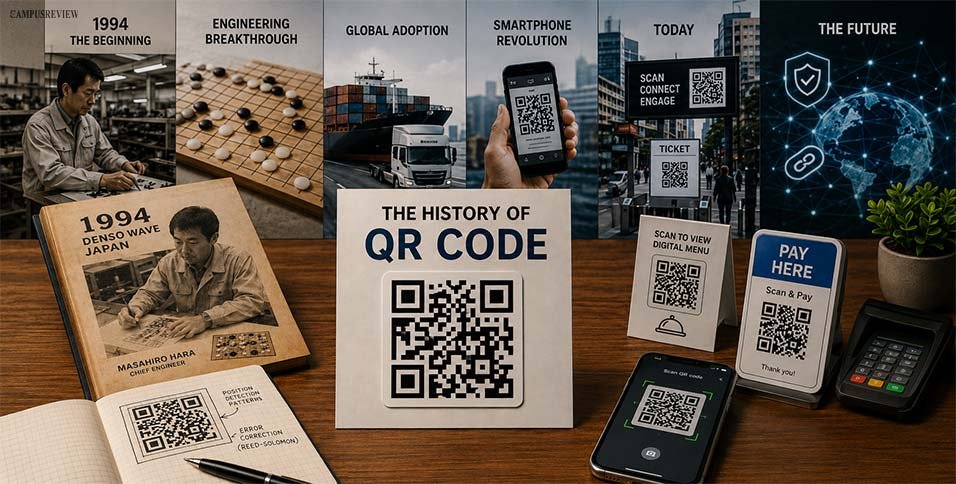
A small black-and-white square now appears almost everywhere. Restaurant menus, metro stations, concert tickets, and payment counters depend on it daily. Yet very few people realize that this modern digital shortcut began inside Japan’s automotive factories during the 1990s. The history of QR code reveals a remarkable story shaped by industrial pressure, engineering creativity, and global digital transformation.
Today, QR codes connect physical objects with digital experiences within seconds. However, this technology did not emerge from advertising or smartphones. Instead, it solved a manufacturing crisis at Toyota’s supplier network. Therefore, understanding the history of QR code requires a journey back to the factory floors of Japan, where speed, accuracy, and efficiency became critical business priorities.
History of QR Code and the Industrial Crisis That Started It
The early history of QR code began during Japan’s manufacturing boom. At that time, factories relied heavily on traditional barcodes for inventory tracking. However, those linear barcodes stored only around 20 alphanumeric characters. As production systems became more complex, workers needed to scan several barcodes on a single automotive component.
Consequently, factory operations slowed down significantly. Employees spent valuable time scanning multiple labels instead of focusing on assembly work. The Origin and history of QR codes directly connects to this operational bottleneck at Denso Wave, a subsidiary of Toyota.
Moreover, automotive companies required faster data processing because production lines handled thousands of parts every day. Engineers needed a system that could store more information while scanning instantly from different angles. Therefore, Denso Wave launched a focused engineering effort to solve this growing industrial problem.
The limitations of older barcode systems also created financial pressure. Slow inventory tracking increased assembly delays and reduced operational efficiency. In large manufacturing plants, even a few seconds lost during each scan created serious productivity losses across entire production cycles. Therefore, companies needed technology that could support lean manufacturing models without slowing factory speed.
That challenge soon led chief engineer Masahiro Hara toward an unexpected source of inspiration during a simple lunch break.
Masahiro Hara and the Birth of the Matrix Revolution
Many people still ask, Who invented QR codes? The answer points directly to Masahiro Hara and his small engineering team at Denso Wave in 1994. During development, Hara observed the black-and-white patterns on a Go board. That visual structure inspired the grid-based design that later became the QR code.
However, creating the system required more than visual inspiration. The team needed scanners to detect codes instantly without interference from nearby text or graphics. Therefore, the engineers developed three square corner markers called position detection patterns. These markers allowed scanners to identify the code from any direction with remarkable speed.
The history of QR code also includes another major technical breakthrough. The system used Reed-Solomon error correction technology. As a result, scanners could still read QR codes even when nearly 30% of the printed surface became damaged, torn, or dirty.
Additionally, QR codes stored far more data than traditional barcodes. While standard barcodes held limited text, QR systems stored more than 7,000 numeric characters. Consequently, businesses could embed URLs, tracking information, product records, and payment instructions inside one compact square.
Another important advantage involved scanning speed. Traditional barcode readers required careful positioning because they scanned information horizontally. However, QR scanners processed data both vertically and horizontally. Therefore, scanning became significantly faster and more reliable in crowded industrial environments.
Still, technical success alone could not guarantee global adoption. The next strategic decision changed the future of digital communication forever.
The Open Access Strategy and Early Global Adoption
The history of QR code became globally important because Denso Wave made a rare business decision. Although the company retained patent ownership, it allowed public use of the QR code specification without charging licensing fees.
As a result, companies across logistics, medicine, retail, and transportation rapidly adopted the technology. This decision accelerated the Evolution of QR code technology far beyond the automotive industry. Manufacturers could now track products across supply chains with greater transparency and accuracy.
Furthermore, pharmaceutical companies began using QR codes for medicine tracking and safety verification. Food distributors also improved traceability systems through advanced packaging identification. Therefore, QR codes gradually became essential for global commerce and logistics.
Airlines and railway systems soon integrated QR technology into digital ticketing systems. This transition reduced paper dependency while improving customer convenience. Consequently, businesses discovered that QR codes reduced operational costs while improving speed and accuracy.
However, ordinary consumers in Western countries still showed limited interest during the 2000s. Most people viewed QR codes as complicated marketing tools instead of practical digital solutions.
That hesitation mainly existed because smartphone technology had not yet removed the scanning barrier.
Smartphone Integration and the Global QR Resurgence
The history of QR code changed dramatically once smartphones simplified scanning. Earlier consumer adoption remained weak because users needed separate third-party scanning applications. Consequently, many people ignored QR codes completely.
HubSpot referenced earlier U.S. consumer research showing that only 21% of smartphone users had ever scanned a QR code, while only 2% used them daily during the early adoption years. These numbers clearly reflected consumer friction.
However, the situation changed rapidly after Apple and Google integrated QR scanning directly into smartphone cameras. Google officially confirmed that Android 9 and later devices could scan QR codes through the native camera system. Similarly, Apple stated that iPhones and iPads supported QR scanning through the Camera app and Control Center without additional software.
As scanning became effortless, the history of QR code entered a completely new phase. During the 2020 global health crisis, businesses urgently needed contactless solutions for payments, menus, and customer interactions.
Restaurants replaced printed menus with QR-linked digital interfaces almost overnight. Hospitals also used QR systems for patient check-ins and health verification processes. Meanwhile, retailers shifted toward touch-free payment systems to reduce physical interaction.
McKinsey later reported that 82% of Americans used digital payments, including QR-based in-store transactions. Therefore, QR codes evolved from optional marketing tools into mainstream infrastructure almost overnight.
The rapid expansion of contactless systems soon pushed QR codes into education, retail, finance, and enterprise logistics.
QR Codes in Modern Industries, Education, and Payments
Today, the history of QR code continues across multiple industries. Modern restaurants use QR menus because they reduce printing costs while updating content instantly. Shipping companies also depend on QR systems for real-time product tracking and warehouse management.
The Uses of QR codes in modern industries now extend far beyond manufacturing. Retailers connect customers directly to digital catalogs, loyalty programs, and product information through dynamic QR systems.
Shopify explains that dynamic QR codes allow businesses to update destination links without reprinting physical materials. The company also highlights scan analytics for customer engagement tracking. Therefore, businesses can measure customer behavior while reducing operational expenses.
Marketing teams now use QR systems in billboards, product packaging, and live events. These campaigns help companies connect offline advertising with measurable digital engagement. Consequently, businesses receive detailed consumer insights through scan data, location tracking, and interaction metrics.
The QR codes in the education, business, and digital payments ecosystem has also expanded rapidly. Schools and universities now connect textbooks with interactive videos, pronunciation guides, and digital learning portals. Museums additionally use QR systems to deliver immersive visitor experiences without printed guides.
Teachers increasingly use QR codes to improve accessibility for students with different learning styles. Audio lessons, translated resources, and visual demonstrations become instantly available through a simple smartphone scan. Therefore, educational institutions now use QR systems as low-cost digital learning bridges.
Meanwhile, financial technology companies transformed QR codes into affordable payment infrastructure. Visa states that QR-code payments and digital wallets help improve account-to-account transactions while expanding access for underbanked populations.
Consequently, countries like India accelerated digital payment adoption through systems such as BharatQR and UPI-based payment ecosystems. Small merchants could finally accept digital payments without expensive hardware investments.
Therefore, QR codes now function as low-cost digital bridges between consumers, businesses, and financial networks worldwide.
End Note
The history of QR code demonstrates how a simple engineering solution transformed into global digital infrastructure. What began in 1994 as an automotive tracking tool now supports payments, education, logistics, healthcare, and interactive commerce worldwide.
Its long-term success emerged from three powerful advantages: simplicity, accessibility, and adaptability. Denso Wave solved an industrial problem, yet the technology later reshaped modern communication itself. Furthermore, smartphone integration removed consumer friction and accelerated worldwide adoption.
Looking ahead, QR systems will likely expand into encrypted verification, anti-counterfeiting protection, and Web3 authentication networks. Still, the core principle remains unchanged. A compact grid inspired by a traditional board game continues to connect the physical and digital worlds with remarkable efficiency and precision.
Also Read: History of Alaska: 7 Key Events That Forged the 49th State