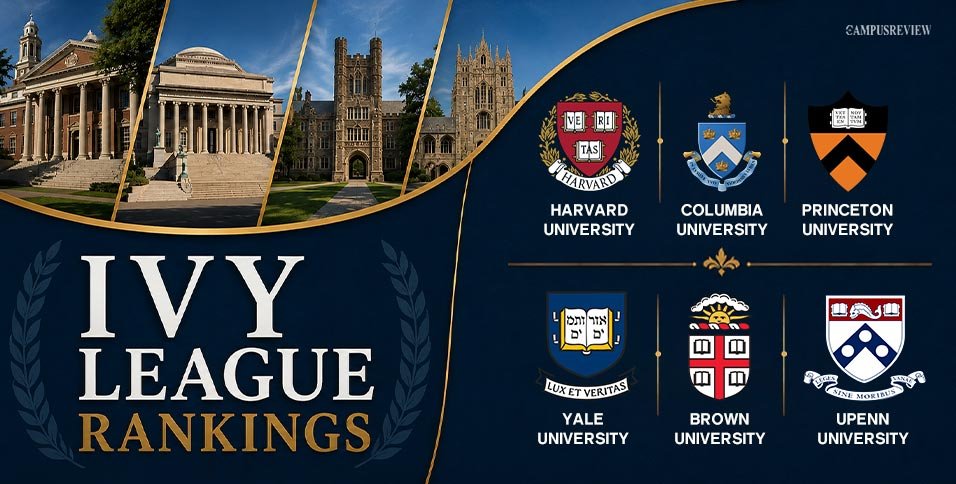
Every year, millions of students dream about studying at an Ivy League university. However, prestige alone does not tell the complete story. Academic strength, acceptance rates, student opportunities, research access, and career outcomes often shape long-term success more than rankings alone. That is why understanding Ivy league rankings requires a closer look at what each institution offers beyond its reputation.
This guide explores all eight Ivy League universities through key factors that matter most to students. It covers academic reputation, admission selectivity, popular courses, and unique opportunities available on each campus. As a result, students can make more informed decisions based on their academic goals, career ambitions, and personal interests rather than relying solely on university prestige.
Here are the top 8 Ivy League Schools in 2026
| University | 2026 Est. Acceptance Rate | Median SAT Range | Primary Academic Reputation Driver |
| Harvard | 3.4% | 1500 – 1580 | Global Hegemony & Historical Preeminence |
| Columbia | 3.9% | 1510 – 1560 | Core Curriculum & Global Financial Hub Access |
| Princeton | 4.0% | 1500 – 1570 | Pure Undergraduate Research & Academic Rigor |
| Yale | 4.35% | 1480 – 1560 | Legal, Political, & Literary Prestige |
| Brown | 5.0% | 1480 – 1550 | Open Curriculum & Student Intellectual Autonomy |
| UPenn | 5.8% | 1490 – 1560 | Pre-Professional Excellence & Corporate Pipelines |
| Dartmouth | 6.0% | 1460 – 1550 | Elite Undergraduate Focus & Deep Alumni Network |
| Cornell | 7.9% | 1450 – 1540 | STEM, Architecture, & Multi-Collegiate Breadth |
Harvard
Harvard University remains one of the most recognized names in global higher education. Founded in 1636, it carries a strong academic reputation across disciplines. The university reports an acceptance rate of around 3% to 4%, making admission highly competitive. In many Ivy League rankings, Harvard consistently appears among the top institutions due to its research output and influential alumni network. Students often pursue economics, law, business, political science, and computer science. Moreover, Harvard offers extensive research funding, global exchange programs, and leadership opportunities. As a result, graduates frequently secure positions in government, finance, technology, and academia.
Columbia
Columbia University stands at the center of New York City and offers students direct access to global industries. The university maintains a highly selective acceptance rate of about 4%. Furthermore, Columbia enjoys a strong reputation for journalism, international affairs, business, medicine, and engineering. Students benefit from internships with major corporations, media organizations, and financial institutions. The university also houses world-renowned research centers that encourage innovation and collaboration. Additionally, its location creates valuable networking opportunities throughout the academic year. Therefore, Columbia attracts ambitious students who seek both academic excellence and practical professional exposure.
Princeton
Princeton University consistently earns recognition for its exceptional undergraduate education and research quality. With an acceptance rate near 4% to 5%, Princeton remains among America’s most selective institutions. The university excels in mathematics, public policy, economics, engineering, and the humanities. Unlike many peers, Princeton provides substantial resources for undergraduate research. Consequently, students often work closely with faculty members on advanced projects. In recent Ivy league rankings, Princeton frequently secures top positions because of its academic outcomes and student satisfaction. Moreover, generous financial aid programs help talented students access world-class education regardless of financial background.
Yale
Yale University combines academic excellence with a strong focus on leadership and intellectual exploration. The university typically admits about 4% to 5% of applicants each year. Yale enjoys particular strength in law, history, political science, arts, and literature. Additionally, its residential college system creates a close-knit learning environment. Students gain access to research grants, international programs, and mentorship opportunities throughout their studies. The university’s distinguished faculty and influential alumni further strengthen its reputation. Therefore, Yale remains a preferred destination for students seeking a balanced academic and extracurricular experience.
Brown
Brown University stands out for its flexible Open Curriculum, which allows students to design personalized academic pathways. The university maintains an acceptance rate close to 5%. Furthermore, Brown enjoys a strong reputation in computer science, public health, economics, and interdisciplinary studies. In several Ivy league rankings, Brown earns praise for academic freedom and student engagement. Students often participate in research projects, entrepreneurial ventures, and community-focused initiatives. Moreover, the collaborative campus culture encourages innovation without excessive competition. As a result, graduates develop both specialized expertise and broad intellectual skills that employers highly value.
UPenn
The University of Pennsylvania blends rigorous academics with strong professional development opportunities. Its acceptance rate generally falls between 5% and 6%. The university is particularly famous for the Wharton School, which ranks among the world’s leading business schools. Besides business, UPenn excels in nursing, engineering, economics, and medicine. Students benefit from extensive internship opportunities and industry partnerships. Additionally, the university promotes interdisciplinary learning through cross-school programs. In many Ivy league rankings, UPenn receives recognition for career outcomes, innovation, and research excellence. Consequently, graduates often secure leadership positions across multiple industries.
Dartmouth
Dartmouth College offers a distinctive educational experience through its close faculty-student interaction and strong undergraduate focus. The college records an acceptance rate of roughly 6%. Dartmouth enjoys an excellent reputation in economics, government, computer science, and environmental studies. Furthermore, students participate in research, global study programs, and leadership development initiatives. Its smaller size fosters a strong sense of community and personalized learning. The institution also maintains an influential alumni network across business, healthcare, and public service. Therefore, Dartmouth continues to attract students seeking academic rigor within a supportive campus environment.
Cornell
Cornell University combines Ivy League prestige with one of the broadest academic offerings in higher education. The university’s acceptance rate generally ranges from 7% to 9%, depending on the program. Cornell excels in engineering, computer science, architecture, hospitality management, agriculture, and business. In recent Ivy league rankings, Cornell often stands out for research volume and program diversity. Students gain access to extensive laboratories, industry partnerships, and entrepreneurial resources. Additionally, the university’s large scale supports a wide variety of academic and extracurricular opportunities. As a result, Cornell graduates enter numerous industries with strong technical and leadership capabilities.
End Note
The true value of an Ivy League education extends far beyond a university’s position in Ivy league rankings. While selectivity and prestige attract global attention, the most important differences often emerge through academic culture, research opportunities, faculty access, and career pathways. Each institution has developed distinct strengths that serve different student aspirations.
A careful evaluation of these universities reveals that no single institution fits every student. Harvard excels in global influence, Princeton shines in undergraduate education, Columbia leverages its urban advantages, and Cornell offers exceptional academic breadth. Therefore, the strongest choice often depends on personal goals rather than public perception. Students who align their interests with institutional strengths typically gain the greatest long-term academic, professional, and personal benefits from the Ivy League experience.
Also Read: The 7 Best Public Schools in US: A Data-Backed Ranking Guide
Tejas Tahmankar