The Campus Review
July 29, 2026
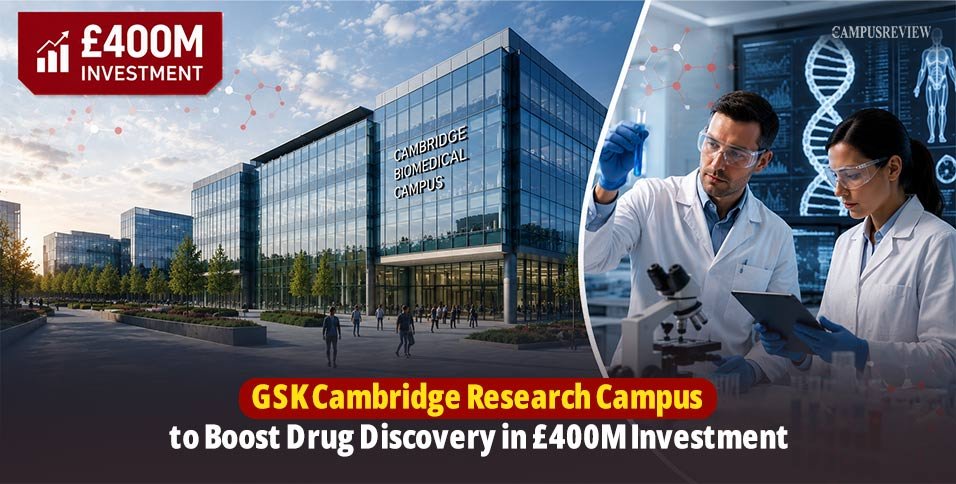
Pharmaceutical giant GSK will invest £400 million over three years to build a state-of-the-art GSK Cambridge research campus. Located on the Cambridge Biomedical Campus, the 300,000-square-foot facility will unite more than 1,000 scientists alongside universities, teaching hospitals, and biotechnology startups.
The Cambridge Biomedical Campus is one of Europe’s largest biomedical research clusters, bringing together the University of Cambridge, Addenbrooke’s Hospital, research institutes, biotechnology companies, and global pharmaceutical firms.
This investment is expected to strengthen collaboration between industry and universities, potentially expanding opportunities for STEM research, postgraduate collaboration, and graduate careers in life sciences.
Core Details of the GSK Cambridge Research Campus Facility
| Feature | Project Specification |
| Capital Investment | £400 million over three years |
| Facility Size | 300,000 square feet |
| Scientific Workforce | 1,000+ scientific positions relocating |
| Primary Location | Cambridge Biomedical Campus, UK |
| Site Developer | Prologis |
| Completion Target | Phased transition ending by 2029 |
| Core Research Focus | Oncology, Respiratory, Hepatology, Vaccines, HIV |
What This Means for Universities and STEM Students
For higher education institutions across the UK, the creation of the new GSK R&D hub builds a direct bridge between academic study and commercial drug development. The facility places scientific teams inside a dense innovation cluster, giving university researchers closer access to industry infrastructure.
The new R&D hub could expand higher education opportunities over time in several key areas:
- University of Cambridge Collaborations: The facility deepens existing academic ties, building on established programs like the Cambridge-GSK Translational Immunology Collaboration and joint data science projects.
- Postgraduate and PhD Research: The new campus could support future industry-sponsored doctoral research, postdoctoral collaborations, and joint research projects in genomics and structural biology.
- Student Placements and Internships: The campus could create more opportunities for internships, placements, and collaborative research for students in biotechnology, chemistry, and biomedical engineering, similar to research opportunities at the best medical schools in America.
- AI in Healthcare Research: The campus places strong emphasis on computational biology, machine learning, and data-driven discovery, potentially creating specialized career paths for mathematics and computer science graduates.
- Graduate Employment Pipelines: Bringing 1,000 scientists onto a single site strengthens long-term recruitment pathways for STEM graduates entering UK life sciences research.
Why GSK Chose Cambridge for Its New Research Hub
The move reflects a clear trend in pharmaceutical development toward integrated innovation clusters. Moving closer to academic hubs allows drug developers to translate laboratory discoveries into clinical trials much faster.
Three main factors drove the location decision:
- Academic and Clinical Proximity: The location places researchers steps away from Addenbrooke’s Hospital and world-leading academic faculties.
- Concentration of Top Talent: The broader Cambridge life sciences ecosystem includes over 22,000 life sciences workers and 470 biopharma, biotech, and artificial intelligence entities.
- Shared Technology Infrastructure: Co-locating with university labs allows researchers to share advanced platforms in genomic sequencing, biological imaging, and data analytics.
Industry and Academic Leadership Perspectives
Leaders across science and industry emphasized how physical proximity accelerates scientific breakthroughs.
“This investment will accelerate our R&D and help us deliver new, competitive products. It integrates GSK further into one of the world’s leading centers of knowledge and demonstrates the attractiveness of the UK’s life sciences ecosystem.” – Luke Miels, Chief Executive Officer, GSK
Scientific directors pointed to the collaborative opportunities created by working directly alongside university researchers and hospital staff.
“Cambridge has built one of the world’s best life sciences ecosystems, with leading universities, hospitals, and biotech companies. The campus provides exceptional opportunities for collaboration. With our existing connections, we see this move as a catalyst for faster, bolder medicines discovery.” – Tony Wood, Chief Scientific Officer, GSK
Primary Disease Research Areas at the New Facility
The primary scientific programs at the Cambridge site target five critical healthcare fields, each closely tied to university academic departments.
| Research Discipline | Primary Focus Area | Relevant Academic Field |
| Oncology | Targeted cancer therapies and immuno-oncology | Molecular biology and cancer genomics |
| Respiratory | Asthma, chronic lung disease, and tissue repair | Pharmacology and respiratory physiology |
| Hepatology | Chronic liver disease and hepatitis B treatments | Cellular pathology and biochemistry |
| Vaccines | Next-generation mRNA and platform technologies | Immunology and bioprocess engineering |
| HIV Care | Ultra long-acting antiviral regimens | Virology and medicinal chemistry |
How Research Operations Will Change
The £400 million investment redefines GSK’s scientific footprint across the United Kingdom, shifting operations from isolated research parks to a collaborative academic cluster.
| Operational Metric | Previous Setup | Updated Strategy |
| Primary UK R&D Hub | Stevenage, Hertfordshire | GSK Cambridge research campus |
| Ecosystem Model | Standalone research park | Embedded inside university and hospital cluster |
| Role of Ware Site | Standard laboratory testing | Upgraded center for drug development scale-up |
| Academic Links | Off-site institutional agreements | Daily physical collaboration with university scientists |
Economic Impact of the New GSK Cambridge Research Campus
The £400 million project contributes significantly to national scientific output while supporting broader regional development.
- Long-Term Capital Commitment: The £400 million investment by GSK will be deployed over three years, funding construction, laboratory equipment, and technology infrastructure.
- Regional Employment: Relocating over 1,000 high-skilled positions sustains regional demand for specialized scientific services, housing, and supply chain partners.
- Upgrades to Manufacturing: Alongside the Cambridge site, GSK will upgrade its laboratories at Ware in Hertfordshire to scale up commercial drug manufacturing.
- Global Strategic Restructuring: The investment comes as GSK continues a wider cost-saving program that includes job reductions across parts of its global operations.
- Site Redevelopment: Property developer Prologis will manage the construction of the energy-efficient 300,000-square-foot facility.
As Cambridge strengthens its position as a global life sciences hub, closer collaboration between universities, hospitals, and industry could accelerate scientific discovery while creating new opportunities for researchers and the next generation of STEM graduates.