The Campus Review
July 28, 2026
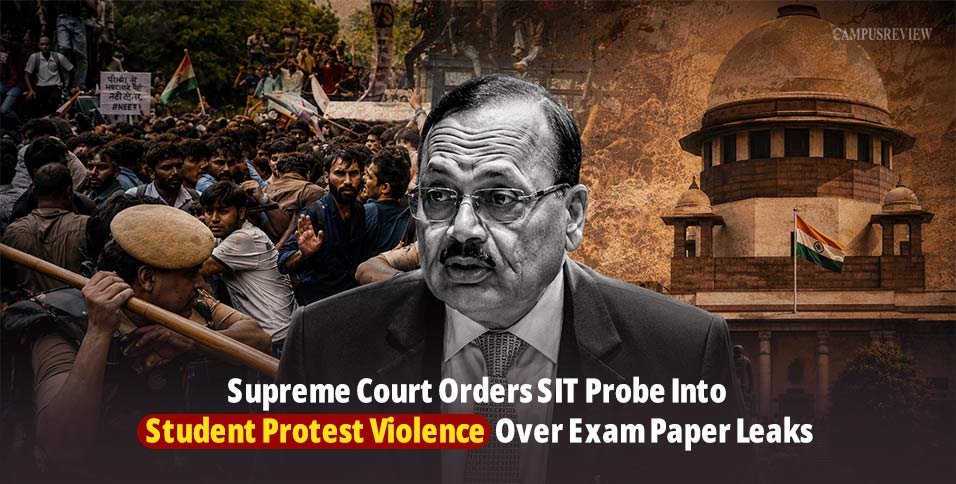
The Supreme Court of India has ordered a Special Investigation Team to investigate recent incidents of student protest violence across multiple states.
The nationwide demonstrations began after students demanded accountability over alleged examination paper leaks and irregularities in central competitive exams. A three-judge bench led by Chief Justice of India Surya Kant directed state authorities to immediately release all detained students who have no criminal antecedents.
The Supreme Court order establishes a clear framework to protect student rights while ensuring an impartial investigation into protest violence.
The bench, which also includes Justice Joymalya Bagchi and Justice V Mohana, addressed petitions challenging heavy-handed police action on students during the July 20 demonstration in New Delhi and subsequent rallies in other states.
Supreme Court’s Key Directions at a Glance
| Decision Area | Core Ruling |
| SIT Inquiry | Establishing an independent Special Investigation Team headed by a former Supreme Court Judge |
| Student Relief | Directing immediate release of all detained students without prior criminal records |
| Data Protection | Barring public release or misuse of protesters’ personal digital data |
| Evidence Preservation | Ordering preservation of CCTV, drone footage, PCR logs, and body-worn recordings |
| State Responses | Seeking formal responses from Union Government, Delhi NCT, and seven state administrations |
Supreme Court Intervention in Student Protest Violence
The top court’s decision follows widespread nationwide student protests linked to the recent NEET protest movement and broader paper leak protests. Thousands of examinees and youth groups gathered on July 20 to march toward Parliament, demanding systemic reforms in central testing agencies and greater accountability from government administrators.
Tensions escalated after demonstrators attempted to breach police security barricades near central government buildings. Security personnel deployed tear gas canisters, water cannons, and baton charges to disperse crowds, resulting in injuries to both young demonstrators and police officials.
During proceedings, the bench emphasized that peaceful agitation remains a constitutionally protected democratic right.
Key observations made by the bench include:
- Constitutional Protection: Citizens have a fundamental right to peaceful assembly and lawful demonstration.
- Proportionate Response: Law enforcement agencies must refrain from using excessive force against unarmed youth.
- Neutral Inquiry: Independent mechanisms are essential to separate peaceful demonstrators from outside elements who escalate violence.
- Privacy Rights: Authorities cannot publish or leak the personal digital information of young demonstrators in the public domain.
How the Protests Shaped Education Reforms
The demonstrations eventually led to major political developments, including the resignation of former Education Minister Dharmendra Pradhan, the appointment of Pralhad Joshi as the new Education Minister, and the government’s announcement of new examination security reforms.
These administrative changes highlight how youth-led movements over paper leaks have directly shaped national education leadership and policy decisions.
Arguments Presented Before the Supreme Court
Legal counsel representing student groups presented evidence highlighting alleged physical assaults, improper detentions, and plainclothes deployment during the education protests India experienced over the past week.
Senior Advocate Gopal Sankaranarayanan urged the court to intervene quickly to protect young citizens from unfair police action:
“The court must send a firm message to protect peaceful protesters. An independent, court-monitored investigation is necessary to ensure police accountability across all affected states.”
Senior Advocate Shadan Farasat pointed out that several young examinees, including teenagers aged 19 and 20, remained in custody without formal charges:
“Many young students were picked up simply for participating in demonstrations. Releasing them without delay is essential for their academic future.”
In response, government legal representatives noted that security personnel also suffered injuries during crowd management efforts, supporting the need for a comprehensive inquiry into both sides.
“A peaceful protest is protected by the Constitution, no doubt. Now two things can happen. People who want to stop the protests can indulge in violence after entering it. There has to be a high-powered investigation team to look into these allegations.”
- Chief Justice of India Surya Kant, Supreme Court of India
Timeline of the Student Protest Movement
Understanding the sequence of events helps explain how the nationwide student protests India witnessed eventually reached the highest court in the country:
- May to June 2026: Controversy erupts over alleged irregularities and paper leaks in national entrance examinations.
- July 20, 2026: Thousands of students participate in the ‘Sansad Chalo’ march toward Parliament in New Delhi.
- July 21 to 24, 2026: Protests spread to major educational hubs in Bihar, Uttar Pradesh, Maharashtra, and West Bengal, resulting in mass detentions.
- July 25, 2026: Public interest petitions are filed in the top court seeking urgent intervention against police excesses.
- July 28, 2026: Supreme Court issues an interim order directing a Supreme Court SIT probe and ordering the release of detained examinees.
Why the Supreme Court’s Order Matters
This judicial intervention holds significant long-term implications for youth activism, constitutional rights, and national governance in India:
- Protects Students’ Right to Peaceful Protest: Reaffirms that young citizens can demand administrative accountability without fear of arbitrary detention.
- Ensures an Independent Investigation: Removes the inquiry from local police departments, placing it under a neutral court-appointed team.
- Establishes Crowd Management Standards: Sets a legal precedent for how law enforcement agencies handle future youth demonstrations across states.
- Drives Systemic Exam Accountability: Maintains pressure on central testing bodies to implement transparent examination security reforms.
Addressing Student Protest Violence and What Lies Ahead
Addressing incidents of student protest violence requires balancing law enforcement protocols with constitutional rights. The Supreme Court is expected to monitor the progress of the SIT investigation in upcoming hearings.
The findings could shape future policies on crowd management during student protests and influence ongoing reforms aimed at improving the integrity of India’s examination system.
By directing immediate relief for detained examinees while holding law enforcement accountable, the court reinforces democratic values during a critical moment for higher education.