The Campus Review
November 4, 2026
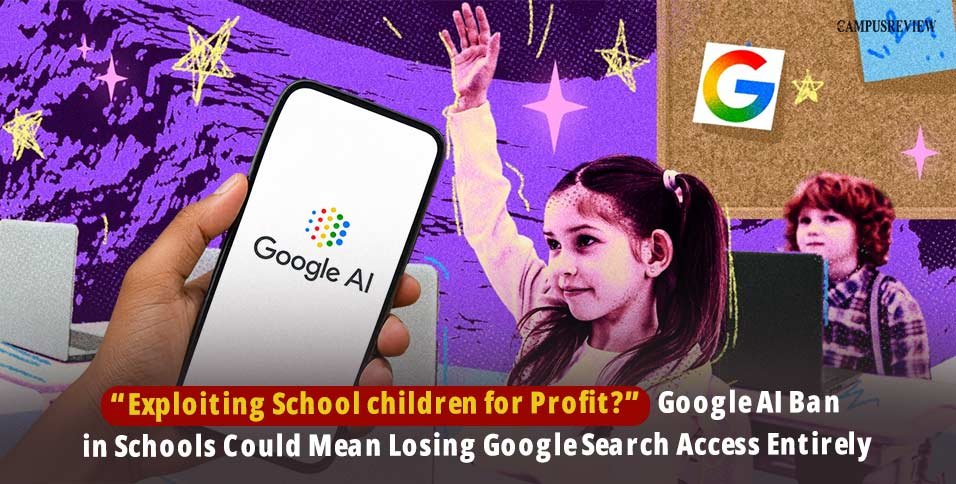
A Google AI ban in schools could affect students’ access to Google Search on school-managed accounts, following Alphabet’s response to schools seeking to restrict generative AI tools.
Under Google’s updated K-12 education framework, administrators can manage access to individual services. However, schools that want to block AI entirely may also lose Google Search access because Google considers Search and AI features closely connected.
The decision has prompted questions from educators and digital rights advocates about how schools can maintain access to essential search tools while restricting generative AI.
Districts must now consider whether to allow Google’s AI features or switch to an alternative search engine.
Quick Summary of Google’s New Policy for Schools
The table below summarizes how the Google AI ban in schools affects student accounts and access to Google services.
| Policy Area | Updated Rule |
| Default Access | Search and AI tools are off by default for K-12 student accounts |
| Search and AI Setup | Administrators can enable individual services, but Search cannot be separated completely from AI |
| Learning Controls | Search uses Guided Learning features to help students work through problems |
| Strict AI Bans | Schools that prohibit AI entirely will also lose Google Search |
| Account Scope | Applies strictly to managed K-12 student accounts |
Why Is Google Linking Search With AI?
Google says artificial intelligence is becoming an integral part of its search experience, including features that summarize information and help students explore complex questions.
In an interview with The New York Times, Chris Phillips, Vice President of Education at Google, explained that the company no longer treats the two services as separate products:
“Search and A.I. are deeply integrated,” Phillips told The New York Times. Students at schools that ban AI “will not have access to search, and they’ll see a message from their school that indicates it’s not available.”
Because automated overviews and generative assistance are built directly into search queries, Google will not offer an administrative toggle that strips AI components out while keeping the traditional search bar active.
School districts that want Google Search must accept the underlying AI infrastructure.
What Google’s AI Policy Means for Schools
The announcement introduces several technical adjustments for educational networks:
Google’s new policy introduces several changes for K-12 schools:
- Off by Default: Gemini, Gemini Notebook, Gemini in Google Classroom, and Google Search will be disabled by default for student accounts.
- Administrator Control: School administrators must enable individual services through the Google Admin console.
- Guided Learning in Search: The step-by-step guided learning feature will guide students through homework problems with prompts and explanations instead of simply providing answers.
- Managed Account Restrictions: The policy affects school-managed accounts. Access through personal accounts depends on district and device settings.
Schools now have three options:
- Adopt AI Features: Enable Guided Learning and teach students to use AI responsibly.
- Enforce a Strict Ban: Block AI tools and switch to alternative search engines.
- Allow Limited Access: Enable AI for older students while restricting it for younger grades.
Why Are Schools Concerned About Google’s Decision?
The policy shift has raised serious questions among educators, school administrators, and parent groups:
- Reduced District Choice: School boards lose the flexibility to approve basic internet search while holding back generative AI tools. Tying the two products together removes a middle ground for schools that want cautious adoption.
- Classroom Cheating and Integrity: Educators worry that AI summaries may reduce critical thinking and make copying homework easier. They want evidence that Guided Learning supports genuine problem-solving.
- Extra Work for School IT Teams: Schools using Google Chromebooks may need to install alternative search engines or web portals if they block Google’s AI features.
Growing Criticism of Google’s AI Policy
The company’s response to the Google AI ban in schools has triggered pushback from digital rights advocates, consumer protection groups, and education leaders.
They argue that integrating AI into essential web services limits public schools’ freedom to choose their digital tools.
- Coercion Concerns: Critics argue that Google is forcing schools to train children on automated models by tying those models to essential research tools.
- Commercialization in Education: Advocacy groups emphasize that public school curricula should not serve corporate product adoption strategies.
- Antitrust Parallels: Legal analysts note that federal regulators, such as former FTC Chair Lina Khan, frequently challenged tech corporations that bundled separate services to lock in public customers.
Prominent figures like Senator Bernie Sanders and New York State Assemblyman Zohran Mamdani have regularly criticized Big Tech monopolies for overstepping into civic and educational institutions.
“Educational value, not shareholder value, must determine which products are used by students, and regulators must intervene to prevent big tech from exploiting schoolchildren for profit,” said consumer advocate Jeffrey Chester in a public critique regarding tech platforms in classrooms.
What Schools Need to Know About the Google AI Ban in Schools Rollout
Google is introducing the administrative framework through a staged plan:
- Guided Learning in Classroom: Available globally from November 3, 2026.
- Search Pilot: Google plans to test Guided Learning in Search at selected US schools later in November 2026.
- Administrative Guidance: Google announced it will share detailed administrative instructions and console specifications with schools in the coming months.
- Wider Rollout: The updated default-off settings and integrated controls are expected to begin rolling out in early 2027, according to Education Week.
District leaders now have time to examine how their classrooms conduct online research and determine whether maintaining a strict Google AI ban in schools justifies replacing Google Search with an alternative research provider.
Pranjal Kharche