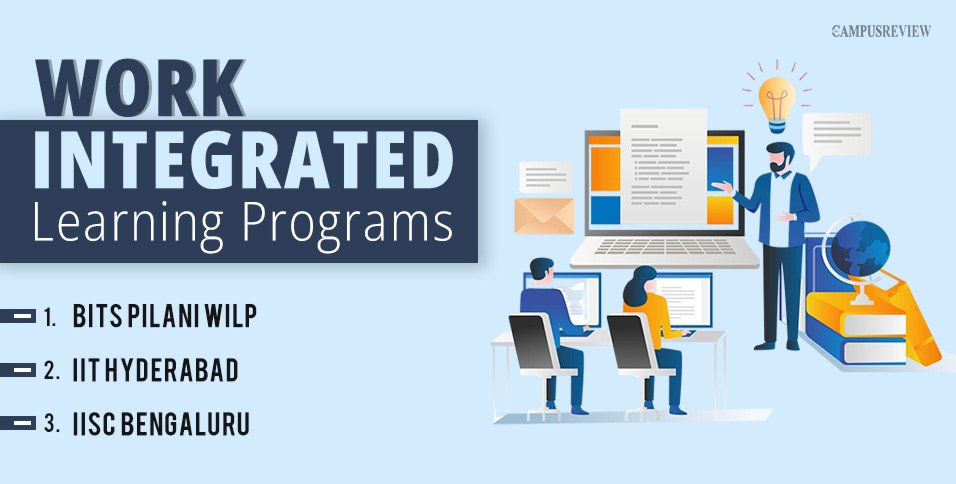
Work-integrated learning programs let you study while working through weekend, evening, or online classes. Some also include workplace training, helping you build skills and earn a qualification without leaving your job.
India offers flexible programs through institutions such as BITS Pilani, IIT Madras, IISc Bengaluru, and IIM Bangalore. Degree apprenticeships also combine work with study.
Choosing the right program depends on eligibility, work experience, employer approval, fees, and class schedules. This guide compares eight programs to help you understand their requirements and find an option that fits your career goals.
What Are Work Integrated Learning Programs?
Work-integrated learning programs (WILP) are degree, diploma, or credit courses that you study while you work full-time. Your job, your employer, and your workplace projects become part of the course.
- Purpose: WILP helps you grow without a career break. Companies use these industry-oriented learning programs to upskill staff.
- How it differs from a full-time degree: A WILP moves classes to weekends or evenings and uses your workplace for projects.
WILP is not the same as distance learning; WILP needs active employment and employer involvement. Distance courses do not. AICTE guidelines also expect labs and in-person exams for engineering degrees. So, treat a fully online engineering degree as a red flag.
How We Selected These Work-Integrated Learning Programs
Each program was evaluated against six criteria, using official program pages as the primary sources.
- Work integration: Does the program use workplace learning, employer support, or industry projects?
- Academic credibility: Does the institute hold UGC, AICTE, or Institute of National Importance status?
- Eligibility and accessibility: What do you need in marks, work experience, and employer papers?
- Learning flexibility: Do classes run online, on weekends, or in the evening?
- Program relevance: Does the course teach skills that employers need now?
- Information transparency: Does the institute publish clear details on fees, duration, and qualification?
8 Work Integrated Learning Programs in India
This table gives a quick view of all eight work-integrated degree programs. Details follow in each section.
| Institution and program | Credential | Work experience | Approx. cost |
| BITS Pilani WILP (engineering, management) | B.Tech, M.Tech, M.Sc, MBA, PG diploma | 1 to 2 years, varies by program | Varies. Online MBA about ₹3.12 lakh |
| IIT Hyderabad M.Tech in Data Science (computing) | M.Tech or Executive M.Tech | 3 years, currently employed | About ₹9 lakh for 48 credits |
| IISc Bengaluru Online M.Tech (engineering) | M.Tech | 2 years, plus employer MoA | Stream based, about ₹8.8 to ₹10 lakh |
| SSPU B.Tech Automobile WILP (engineering) | B.Tech through lateral entry | Must be employed in the sector | About ₹98,500 a year |
| TeamLease Degree Apprenticeship (vocational, retail, IT) | Diploma, degree, or MBA | None for freshers | Fee deducted from stipend |
| IIT Madras Web-Enabled M.Tech (engineering) | M.Tech or PG Diploma | 2 years for M.Tech only | Check brochure by track |
| IIIT Hyderabad PGSSP (computer science) | Course credits, no degree | Hyderabad employee with NOC | About ₹1.6 lakh for two courses a semester |
| IIM Bangalore PGPEM (management) | MBA | 6 years for the 2026 to 2028 batch | Check IIMB website |
1. BITS Pilani Work Integrated Learning Programmes
BITS Pilani says it has run WILP for more than four decades. The programs follow the same academic standards as its campus degrees. BITS states that these programs are UGC approved.
- Courses and specialisations: B.Tech in Engineering Technology, Power Engineering, and AI and ML; M.Tech in Software Systems, Data Science and AI, Microelectronics, Embedded Systems, and Structural Engineering; MBA in Digital Business, Business Analytics, and FinTech. M.Sc. and PG diploma options are also available.
- Eligibility and work experience: M.Tech applicants need a relevant BE, B.Tech, MCA, or M.Sc. with at least 60% marks. B.Tech applicants need an eligible engineering diploma or B.Sc. with Mathematics. Relevant employment and employer and mentor consent forms are required.
- Learning format: Weekend live online classes, virtual labs, proctored exams, and a final workplace project with faculty and company mentorship.
- Who should consider it? Working professionals in IT, engineering, or manufacturing seeking a degree alongside employment.
2. IIT Hyderabad M.Tech in Data Science for Industry Professionals
The Computer Science department runs this self-paced M.Tech. It began in August 2018 and is only for people who work in industry. You pay the fees yourself.
- Curriculum and credit structure: The degree has 48 credits. Coursework carries 24 credits. A capstone project carries the other 24. If you skip the capstone, you can graduate with an Executive M.Tech in Data Science.
- Eligibility and industry experience: You need an engineering degree, or an MCA, MSc, or MS in computer science or IT, with about 70% marks or a 7.0 CGPA. You need three years of relevant industry work and a current job. Internships do not count. Selection uses a written test and an interview.
- Duration and learning format: Plan for three to four years at your own pace. Live classes run on Saturdays and weekday mornings. Exams take place on the Kandi campus. Fees are ₹25,000 per coursework credit and ₹12,500 per capstone credit.
- Suitable candidates: Mid-level developers and data engineers who want to move into machine learning roles while keeping their salary.
3. IISc Bengaluru Online M.Tech for Sponsored Candidates
IISc launched this online M.Tech in 2021. IISc says it matches the rigour of its full-time M.Tech. Classes run live and fully online. The 2025 brochure lists over 350 students from 25 companies.
- Available specialisations: Artificial Intelligence, Data Science and Business Analytics, and Electronics and Communication Engineering.
- Employer sponsorship: Your company must have a signed MoA with IISc and nominate you. Check IISc’s list of eligible sponsoring companies before applying. Fees are payable each semester.
- Eligibility and duration: Applicants need a relevant B.E. or B.Tech, the required minimum marks, and at least two years of industry experience. Admission may include an online written or programming test. The program runs for four semesters and includes a capstone project.
- Suitable candidates: Engineers in electronics, semiconductors, software, and related industries whose employers support sponsored higher education.
4. Symbiosis Skills and Professional University B.Tech in Automobile Engineering WILP
SSPU offers a six-semester B.Tech in Automobile Engineering through WILP at its Pune campus, with a 70% practical and 30% theory structure.
- Eligibility and employment: Applicants need a three-year engineering diploma with at least 45% marks (40% for reserved categories) or a B.Sc. with Mathematics. Employment in the automobile, ancillary, or manufacturing sector and employer authorisation are required.
- Practical learning: Every semester includes on-the-job training. Topics include vehicle dynamics, robotics, mechatronics, electric vehicle systems, and battery management.
- Duration and learning format: Lateral entry into the second year allows completion in three years, with evening and weekend classes. Confirm current fees with SSPU.
- Suitable candidates: Diploma holders working as testing technicians, shop-floor operators, CAD draftspersons, or assembly supervisors.
5. TeamLease Degree Apprenticeship Programs
TeamLease offers degree apprenticeship programs that combine paid employment with academic study. It partners with universities to provide work-linked qualifications.
- Available programs: Options include a three-year B.Sc. in Mechatronics, a three-year BBA in Retail, and an MBA offered with Mizoram University.
- Employer and university roles: The partner university sets the curriculum and awards the degree, while the employer provides workplace training, mentorship, and a stipend.
- Eligibility and training: Requirements vary by course, with options for Class 12, ITI, diploma holders, and graduates. Much of the learning takes place at work. Confirm current fees and stipend deductions before enrolling.
- Suitable candidates: School leavers, ITI graduates, and other learners who want to gain work experience while pursuing a qualification.
6. IIT Madras Web-Enabled M.Tech for Working Professionals
IIT Madras launched its web-enabled program in 2017. In May 2026, the institute reported around 1,200 enrolled learners and more than 500 graduates.
- Available study pathways: Options cover aerospace, AI, information security, electrical and mechanical engineering, and e-mobility. Working professionals can pursue the M.Tech, while the PG Diploma route is open to graduates, including freshers.
- Eligibility and admission: M.Tech applicants need a relevant degree and two years of work experience. The PG Diploma has no work-experience requirement. Admission may include an entrance test and interview.
- Learning format and duration: Live online classes run on evenings and weekends, with in-person exams. M.Tech workplace projects require company support through an MoU or Letter of Support.
- Suitable candidates: Engineers, technical consultants, and R&D professionals seeking postgraduate study alongside work. Graduates without work experience can consider the PG Diploma route.
7. IIIT Hyderabad Post Graduate Student Status Programme (PGSSP)
IIIT Hyderabad’s Post Graduate Student Status Programme (PGSSP) lets working professionals attend regular postgraduate classes without enrolling in a degree program.
- Course options: Students can select advanced courses in machine learning, natural language processing, computer vision, algorithms, VLSI, and embedded robotics, typically taking one or two courses per semester.
- Eligibility and learning format: Applicants must live in Hyderabad and provide an employer NOC if attending classes during working hours. Classes take place on campus during the day, with Monsoon and Spring intakes.
- Qualification and fees: PGSSP does not award a degree or diploma. Credits may count toward an IIIT Hyderabad M.Tech, MS by Research, or PhD if the student is subsequently admitted and meets applicable conditions. Check the official portal for current fees and credit-transfer rules.
- Suitable candidates: Hyderabad-based developers and researchers who want to study advanced subjects before committing to a full postgraduate program. Apply directly through IIIT Hyderabad’s official portal.
8. IIM Bangalore Post Graduate Programme in Enterprise Management (PGPEM)
IIM Bangalore’s Post Graduate Programme in Enterprise Management (PGPEM) is a two-year weekend MBA designed for experienced professionals and executives.
- Curriculum: The first year covers core subjects such as accounting, economics, finance, marketing, and operations. The second year offers electives.
- Eligibility and work experience: Applicants need a bachelor’s degree with at least 50% marks or an eligible professional qualification. The 2026-2028 batch requires six years of full-time work experience and a valid CAT, GMAT, GRE, or IIMB Test score.
- Weekend learning format: Classes take place on campus on weekends. Applicants should confirm the current timetable and account for travel to Bengaluru.
- Suitable candidates: Experienced professionals, engineers, and department heads seeking to develop management skills and move into leadership roles. Check IIM Bangalore’s official admissions page for current deadlines and requirements.
How to Choose a Work Integrated Learning Program
Start with your work experience and your employer’s support. Those two facts remove most options.
Check these six points before you apply:
- Eligibility: Match your degree marks and work years to the rules.
- Qualification: Confirm whether you get a degree, diploma, certificate, or only credits.
- Work integration: Ask who guides your project, and whether your company must sign any paper.
- Learning format: Compare live evening classes, weekend classes, and campus visits against your office schedule.
- Fees and duration: Ask for the full cost, including registration and exam fees. Fees change every year.
- Recognition: IITs, IIMs, and IISc award degrees under central laws. For deemed or private universities, check UGC approval. For engineering, check AICTE rules too.
How to Get Good Guidance Before You Apply
The best guidance comes from three places: your employer, the program’s own admission office, and people who already study there. Use them in that order. Follow these steps.
1. Write your goal in one line. Example: “I want a data science role in three years without leaving my company.”
2. Talk to HR first. Ask about consent letters, sponsorship, study leave, and fee support. Many programs need signed papers before you can apply.
3. Email the official admissions office. Use the address on the official site. Ask the questions in the table below. Save every reply.
4. Talk to current students. Search LinkedIn for people in the program. Ask about weekly study hours, exam travel, and project approval.
5. Verify recognition. Check UGC and AICTE listings for deemed and private universities.
6. Ignore pushy agents. Apply only on official portals.
| Question to ask | Why it matters |
| Does my current role count as relevant experience? | Programs reject unrelated work |
| What exactly does my employer need to sign? | Missing papers delay admission |
| What is the total fee, including exam and registration fees? | Headline fees often leave costs out |
| Where and how often do I take exams? | Exam travel affects leave planning |
| What happens if I change jobs mid-program? | Many programs make employment a condition |
| How many hours a week should I plan? | It tests whether you can balance work and study |
Red flags: Walk away if a seller promises a guaranteed job. Walk away if you cannot find the program on an official site. Walk away if someone pressures you to pay today.
Final Thoughts
Work-integrated learning programs let you upgrade your career without pausing your income. The right program depends on your experience, your employer, and your city. Shortlist two options, talk to HR, and email the admissions office.
Rules, fees, and dates change every year. Verify current eligibility, fees, admission dates, and qualification details on official program pages before you apply.
Pranjal Kharche
Frequently Asked Questions
1. Can I change jobs while pursuing a WILP?
Yes, you can change jobs while pursuing an IILP, but it depends on the program. Employer-sponsored programs may require continued sponsorship, workplace access, or employer approval for projects. Check the rules before changing jobs.
2. Do work integrated learning programs offer placement assistance?
Placement support varies by institution for WILPs. Degree apprenticeship programs may connect learners with employers, while many WILPs are designed for people who are already employed and do not guarantee placement.
3. Can I pursue a WILP from another city?
Some programs offer online classes so you can pursue a WILP from another city, but others require campus attendance, in-person examinations, or workplace training. Check the location and attendance requirements before applying.