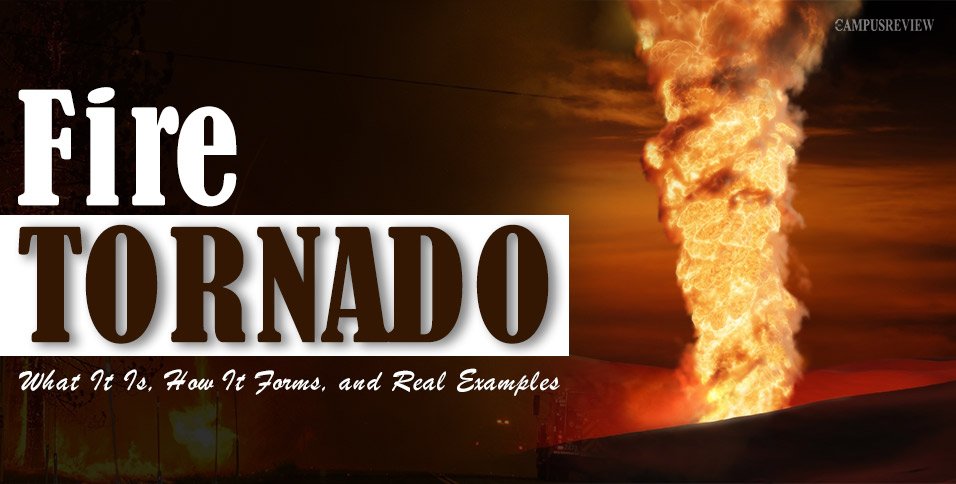
Flames twist into the sky and spin like a giant drill. Minutes later, the whole thing vanishes without a trace. A fire tornado is a spinning column of fire, smoke and hot air that forms over an intense blaze. Scientists call it a fire whirl. Yes, it is real. And yes, it can kill. The true story is stranger than the videos.
Most fire whirls stay small and fade fast. A few grow into monsters. The Carr Fire tornado in California hit 143 mph winds in 2018. The Great Kanto Earthquake fire whirl in Japan killed an estimated 38,000 people in 1923.
This guide explains what a fire tornado is, how it forms, real examples, its dangers and safely tips.
What Is a Fire Tornado?
A fire tornado is a rotating column of rising hot air, flames, smoke and debris created by an intense fire. The National Wildfire Coordinating Group (NWCG) calls it a fire whirl. NWCG says fire whirls can measure less than 1 foot across or more than 500 feet across. The largest ones match the strength of a small tornado.
What are the other names for a fire tornado?
Many names float around. They do not all mean the same thing.
| Name | What it means | Where you hear it |
| Fire whirl | The official science and firefighting term | Research papers, NWCG |
| Fire devil | A small, weak whirl, like a desert dust devil | Weather service guides |
| Firenado | A media blend of fire and tornado | News and social media |
| Fire vortex | A plain name for the same spinning flames | General writing |
| Pyrotornado or FGTV | A giant fire-generated vortex linked to a fire storm cloud | Atmospheric science |
How do scientists size a fire tornado?
In 1978, National Weather Service meteorologist David Goens grouped these vortices by size. His system appears in NOAA Technical Memorandum WR-129.
| Type | Width | Wind speed | Effect on the fire |
| Fire devil | 3 to 33 ft | Under 22 mph | Little effect on spread |
| Fire whirl | 33 to 100 ft | 22 to 67 mph | Pushes fire in odd directions and puts firefighters at risk |
| Fire tornado | 100 to 1,000 ft | Up to 90 mph | Shapes the whole fire |
Real events can break these limits. The Carr Fire vortex was stronger than the top figure in this table.
How Does a Fire Tornado Form?
A fire tornado forms when an intense fire pulls in air that already has some spin. The rising heat then stretches that spin into a tight, fast column. Here is the process step by step.
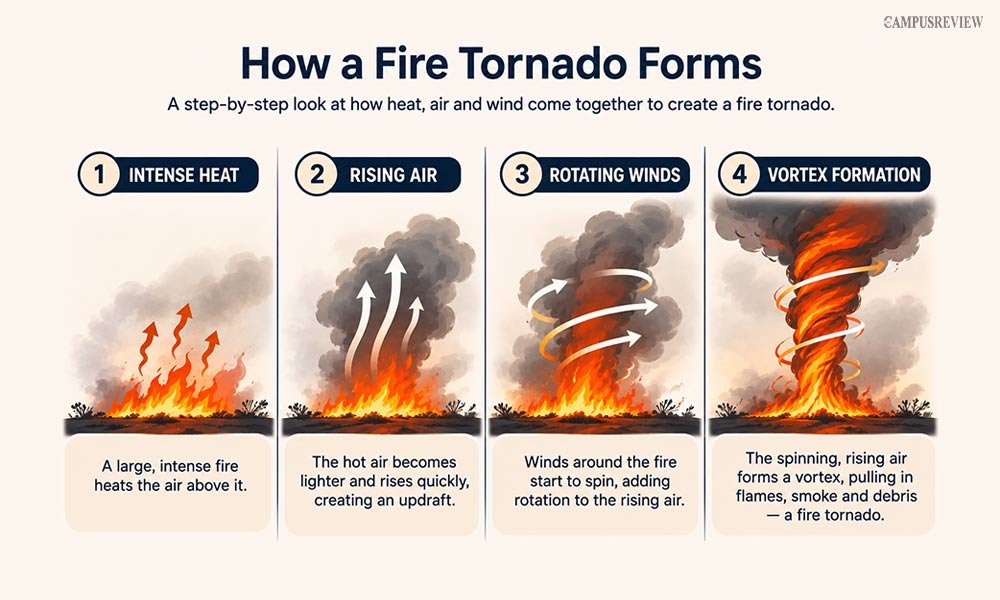
- Intense heat (fire): A large fire or firestorm heats the air above it to very high temperatures. The intense heat lowers the air density, creating a strong buoyant updraft.
- Rising air (updraft): The superheated air rises rapidly, carrying smoke and embers upward. In massive blazes, this can develop into a towering pyrocumulonimbus (fire-created thundercloud) that extends kilometers aloft.
- Rotating winds: Near the fire, the upward flow draws in surrounding air. If there is wind shear (changes in wind direction or speed with height) or obstacles (hills, buildings, fire lines) imparting spin, the rising air column begins to rotate. Essentially, the inflow of air replacing the updraft starts to swirl due to horizontal wind shear and terrain effects.
- Vortex formation: As the rotating updraft intensifies, the column tightens into a visible vortex. Flames, smoke and burning debris are drawn into the spinning core. The vortex can stretch high (sometimes hundreds of meters) and sometimes detach partially from the ground (shedding a moving vortex). At this stage a fire whirl a sustained rotating funnel of flame is fully formed.
Fire Tornado Characteristics: Size, Wind Speed and Temperature
How big and how hot is a fire tornado? It depends on the type. Most are small. A few are extreme.
| Feature | Typical fire whirl | Extreme fire tornado |
| Height | 10 to 50 m (33 to 164 ft) | Over 1 km. Radar tracked some at 4.5 to 4.9 km |
| Width | A few metres | About 270 to 500 m at the base |
| Wind speed | 22 to 67 mph in Goens’s fire whirl class | Over 200 km/h (120 mph) in strong cases |
| Temperature | Not often measured | Up to 1,400 °C (2,500 °F). Some estimates pass 1,480 °C (2,700 °F) |
| Lifespan | A few minutes | 20 minutes to 2 hours |
| Official rating | None on the Enhanced Fujita (EF) scale | Rare damage surveys gave EF1 to EF3 equivalents |
Difference Between Fire Tornado and Regular Tornado
A fire tornado looks like a storm tornado, but the engine behind it is different. A regular tornado hangs down from a thunderstorm cloud. A standard fire whirl builds from the ground up.
| Feature | Fire tornado | Regular tornado |
| Source | Heat from an intense fire | Severe thunderstorm or supercell |
| Direction of growth | Ground up. Rare giants link to a fire cloud above | Cloud down to the ground |
| Fuel | Flames, gases, smoke and burning debris | Air and moisture |
| Usual size | A few metres wide. Giants reach 270 to 500 m | Up to about 2 km wide |
| Rating | No EF rating for standard whirls | EF0 to EF5 |
Meteorologists treat ordinary fire whirls like dust devils. They leave them out of official tornado counts. Rare fire-generated vortices blur that line. NWS teams have rated damage from three of them: EF1 at the Loyalton Fire, EF2 at the Creek Fire and EF3-equivalent at the Carr Fire.
Famous Fire Tornado Examples
Small fire whirls appear often on wildfire flanks. A handful of events stand out for their size, deaths or scientific value.
| Event | Year | Place | Why it matters |
| Great Kanto Earthquake fire whirl | 1923 | Tokyo, Japan | Deadliest fire whirl on record (about 38,000 deaths) |
| Canberra fire tornado | 2003 | Canberra, Australia | First scientifically confirmed pyrotornado |
| Carr Fire tornado | 2018 | Redding, California | 143 mph winds, EF3-equivalent |
| Loyalton Fire | 2020 | California, near Reno, Nevada | First NWS Tornado Warning for a fire vortex |
| Creek Fire | 2020 | Sierra Nevada, California | EF2 forest damage |
Great Kanto Earthquake fire whirl (1923)
A magnitude 7.9 earthquake hit the Tokyo and Yokohama region at 11:58 a.m. on September 1. Lunchtime kitchen fires and broken gas lines set the city on fire. About 40,000 people ran to an open space, the former Army Clothing Depot. They believed open ground meant safety.
A moderate south wind blew at 4 to 5 m/s. Giant fire whirls then swept the depot.
Scale-model tests by Soma and Saito (1991) and Kuwana and colleagues (2007) showed that surrounding fires can create a large whirl right over open ground.
Be careful with online numbers. Some articles claim a 300-metre whirl moving at 200 km/h. Peer-reviewed studies do not confirm those figures.
Canberra fire tornado (2003)
This was the day the world got proof. On January 18, 2003, a vortex tore across rugged land into the suburbs of Canberra. It moved at about 30 km/h along a 20 km track. It snapped tall eucalyptus trees and threw burning trees into houses.
Gaps with no damage along the path showed the vortex lifted off the ground, like a storm tornado. McRae and colleagues (2013) rated it at least F2.
Carr Fire tornado (2018)
The Carr Fire tornado began on July 26, 2018, near Redding. Record heat and very dry fuel fed the fire. Radar work by Lareau and colleagues (2018) showed a vortex about 4.5 to 5.2 km deep.
A Cal Fire report put the base at roughly 1,000 feet wide. The vortex lasted about 80 minutes. It collapsed at least two steel transmission towers and lifted vehicles and a steel shipping container. Reports linked it to the death of a Redding fire inspector.
Loyalton Fire (2020)
On August 15, 2020, the Loyalton Fire grew a huge pyroCb. Its plume rose from 6.5 km to about 13 km. Doppler radar spotted rotating winds reaching 25.5 m/s (about 50 knots). NWS Reno meteorologists saw the same radar pattern as the Carr Fire and issued the first Tornado Warning ever for a fire-generated vortex.
The warning also changed a rule. Normal tornado warnings say to shelter in place. This one told people to follow wildfire evacuation orders instead. The ground survey found EF1 tree damage.
What Is a Blue Fire Tornado?
A blue whirl is a small, quiet, blue flame discovered by researchers Huahua Xiao, Michael Gollner and Elaine Oran in 2016. It forms under controlled laboratory conditions and stands about 4-8 cm tall.
Unlike yellow flames, it burns with almost no soot because fuel and air mix more efficiently. Researchers created it while studying cleaner ways to burn oil spills on water. Although blue whirl experiments are real scientific research, no natural wildfire blue whirl has been documented.
Why Are Fire Tornadoes So Dangerous?
They throw embers. The updraft lifts burning bark, branches and logs. These start new fires far ahead of the main fire.
They jump fire lines. A whirl can move into unburned land, over black ground or even over a lake. It can keep its wind after the visible flame disappears.
They can burn without flames. Some whirls carry scorching gases across unburned ground. They cause heat and wind damage with no flame tower in sight.
They hit crews. The Carr Fire vortex was linked to a firefighter’s death.
10 Interesting Facts About Fire Tornadoes
Fire tornadoes are more than just spinning flames. Their formation, movement and intensity make them one of the most unusual wildfire phenomena. Here are 10 interesting facts about fire tornadoes.
1. Scientifically called fire whirls: Fire tornadoes are commonly known as fire whirls in scientific research. They are rotating columns of air and flames formed around intense fires.
2. Occur in different types of fires: Fire whirls can develop during wildfires, large structural fires, oil fires and even volcanic eruptions.
3. Can carry burning debris: Their strong rotating winds can lift embers, ash and burning materials, potentially spreading fire to nearby areas.
4. Can move beyond the main fire: Strong winds can push fire whirls away from the main fire, sometimes starting new spot fires.
5. Can reach enormous heights: Some historical fire whirls have reportedly reached several kilometres in height, while smaller ones can exceed 100 metres.
6. Produce powerful winds: Their rotating winds can become extremely strong, with exceptional cases recording speeds above 50 metres per second.
7. Terrain affects their formation: Slopes, valleys and ridges can influence local wind patterns and create conditions that help fire whirls develop.
8. Do not have an EF rating: Unlike regular tornadoes, fire whirls are not officially rated on the Enhanced Fujita (EF) scale.
9. Blue whirls can form in laboratories: Scientists have created small, stable blue flames called blue whirls under controlled laboratory conditions.
10. Form differently from regular tornadoes: Regular tornadoes usually develop from severe thunderstorms, while fire whirls get their rotation from fire-driven heat and surrounding winds.
How to Stay Safe and Where to Find Good Guidance
You do not need to fear every fire video. But you should know what to do when a wildfire is near. Use these steps.
1. Turn on local alerts. Sign up for your area’s emergency alerts. Check weather service warnings during fire season.
2. Learn the new warning language. After Loyalton, the NWS can issue a Tornado Warning for a fire vortex. It tells you to follow wildfire evacuation orders, not to shelter in place.
3. Leave when officials say leave. Do not wait to see the flames. Fire whirls can appear fast and hurl embers ahead of the fire.
4. Do not treat open ground as safe. The Tokyo disaster happened on open ground surrounded by fire.
5. Stay away from the fire edge. Do not stand near ridges and canyons. Do not film from close range. Embers from pyroCb fires can travel up to 3 miles (4.8 km).
6. Check viral videos. Look for the date, place and a trusted news or agency source before you share.
Which sources should you trust?
| Source | Best for | Where to find it |
| National Weather Service | Warnings, forecasts and EF scale details | weather.gov/oun/efscale |
| NWCG Glossary of Wildland Fire | Official definitions | nwcg.gov (search “fire whirl”) |
| USDA Forest Service Fire Lab | Fire whirl research | research.fs.usda.gov/firelab/projects/firewhirl |
| NOAA Technical Memorandum WR-129 | The classic fire whirl paper | weather.gov/media/wrh/online_publications/TMs/TM-129.pdf |
| Your local fire or disaster office | Evacuation orders and local alerts | Your city or state website |
This guide explains the science. It does not replace orders from local authorities. Rising global temperatures and changing climate patterns can increase wildfire risks in some regions. These changes are part of the broader effects of climate change.
Final Thoughts
A fire tornado is real, rare at full strength and still full of mysteries. Heat, rising air and spin combine to make a rotating column of flames. Most fire whirls are small. A few, like the Carr Fire tornado, rival strong storm tornadoes.
Remember three things. Trust official sources. Leave early when told. Check viral videos before you share them. Science is still learning, so keep following NWS and NWCG updates.
FAQS
1. How long does a fire tornado last?
Most fire tornadoes last a few minutes. Extreme ones can last from 20 minutes to 2 hours.
2. Which way does a fire tornado spin?
A fire tornado can spin clockwise or counterclockwise. Its direction depends on surrounding winds, wind shear and terrain.
3. Does a blue whirl need water to form?
No. Although the first blue whirl was created over water in 2016, later experiments produced it on smooth metal surfaces.
4. Can a fire whirl form in a small fire?
Yes. Small fire whirls can form around prescribed burns, logging fires and bonfires. Most disappear within minutes.