The Campus Review
November 13, 2026
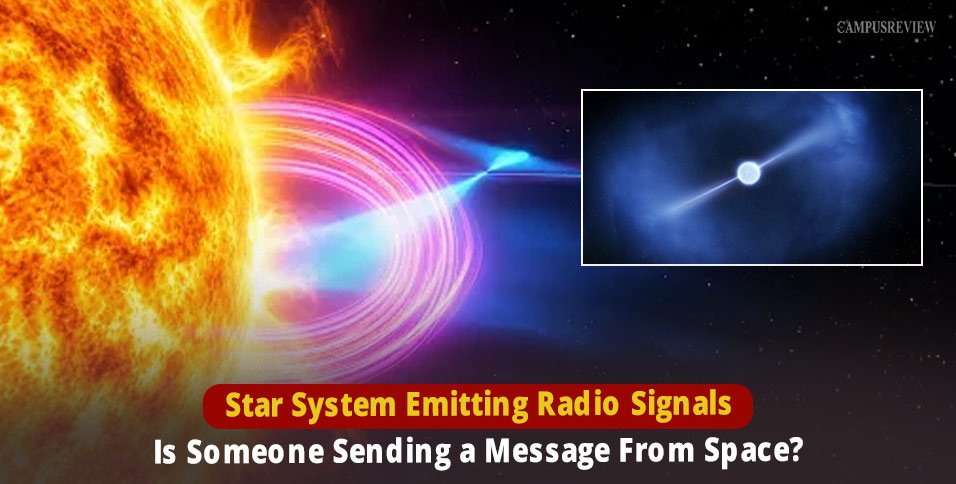
Astronomers have discovered a rare star system emitting radio signals every eight minutes from more than 5,000 light-years away. A study published in Nature Astronomy on November 12, 2026, reveals that researchers at the International Centre for Radio Astronomy Research (ICRAR) traced these repeating signals to a pair of stars called GPM J071507-114153.
The discovery may sound like a message from outer space, but scientists have identified a natural explanation. The signals come from interactions between a white dwarf, the dense leftover core of a dead star, and a companion star similar to our Sun.
Quick Facts About the Discovery
Scroll through the core facts and numbers behind this cosmic detection in the table below.
| Feature | Discovery Details |
| System Name | GPM J071507−114153 |
| Distance from Earth | Over 5,000 light-years away |
| Signal Interval | Roughly every 8 minutes |
| Total Pulses Recorded | 214 pulses (December 2024 to September 2025) |
| Star Pairing | One low-mass white dwarf and one Sun-like G-type star |
| Lead Research Group | International Centre for Radio Astronomy Research (ICRAR), Australia |
| Scientific Journal | Nature Astronomy (Published November 12, 2026) |
What Is Behind This Star System Emitting Radio Signals?
For decades, astronomers thought only rapidly spinning neutron stars, known as pulsars, could send out regular flashes of radio waves. Pulsars usually blink every few seconds or milliseconds. However, GPM J071507-114153 behaves very differently.
According to ICRAR researchers, this object belongs to a mysterious group of space objects called long-period radio transients (LPTs). These objects switch their radio emissions on and off over minutes or hours rather than seconds. Scientists have only found about a dozen of these systems since 2021.
Why This Star Pairing Is a Scientific First
Previously, every known white dwarf system producing repeating radio signals was paired with a small, cool red dwarf star. GPM J071507-114153 breaks that rule completely.
It is the first confirmed detection of a white dwarf orbiting a Sun-like companion star (a G-type star) that generates steady radio bursts from space.
Here is how the two stars interact to create the signal:
- The Dead Star: The white dwarf is the dense, leftover core of a star that ran out of fuel long ago. It spins once roughly every eight minutes.
- The Living Companion: The second star looks and behaves very much like our own Sun, complete with solar flares and magnetic storms.
- The Magnetic Trigger: As the white dwarf spins and orbits its bright neighbor, their magnetic fields interact. This cosmic dance accelerates charged particles and beams natural radio emissions toward Earth like a lighthouse.
“It’s amazing that by using radio wavelengths we can detect the storms on a star over 5,000 light-years away.” – Dr. Natasha Hurley-Walker, Astronomer at Curtin University and Study Co-Author
Are Aliens Sending a Message From Space?
Whenever a telescope picks up mysterious radio signals from space on a strict schedule, people naturally wonder about extraterrestrial communication. An eight-minute timer sounds remarkably precise, almost like a beacon or a clock.
However, lead author Dr. Sam McSweeney and the ICRAR team ruled out alien signals from space using clear physical evidence. By tracking the tiny shifts in the arrival times of the 214 pulses, the team measured the exact orbital motion of the white dwarf moving around its partner.
Natural Physics vs. Artificial Beacons
| Clue | What Scientists Observed | What It Proves |
| Pulse Timing Shift | Signal arrival times shift slightly as the stars orbit each other. | The signal originates directly from a moving natural star, not a stationary transmitter. |
| Radio Wavelengths | Broad radio frequencies matching magnetic particle acceleration. | Standard physics of stellar magnetic fields explains the energy output. |
| Companion Flares | Optical and radio data show massive stellar flares and prominences. | The Sun-like star is experiencing active space weather that feeds the signal. |
This radio astronomy discovery actually gives scientists a brand-new tool. Because the white dwarf’s radio beam passes through the outer atmosphere of its Sun-like partner, researchers can study space weather and solar storms on distant stars.
How Astronomers Tracked Down the Signal
Pinpointing the star system emitting radio signals across 5,000 light-years required teamwork across three continents. According to Curtin University and ICRAR reports, the research team used a multi-step observation strategy:
- Initial Detection in Australia: Researchers first spotted GPM J071507−114153 in late 2024 using the Murchison Widefield Array (MWA) radio telescope in Western Australia. Over 100 hours of observation logged 214 distinct pulses.
- Pinpointing Location in South Africa: Astronomers turned to the sensitive MeerKAT radio telescope in South Africa to lock onto the exact coordinates of the signal in the night sky.
- Identifying the Stars in Hawaii: With exact coordinates in hand, researchers used the optical telescopes at the W. M. Keck Observatory in Hawaii to see the light from the G-type companion star and confirm its identity.
With next-generation facilities like the Square Kilometre Array Observatory (SKAO) coming online soon, astronomers expect to uncover dozens more signals from distant stars hiding in our galaxy.
Discoveries such as a new dwarf planet candidate beyond Pluto and advances in astronomy continue to expand our understanding of space.
Pranjal Kharche